
Who Prices Cognitive Labor? Why Your Salary is Moving to the GPU Market
Who Prices Cognitive Labor in the Age of Agents? A Position on Compute-Anchored Wages
This position paper introduces the Compute-Anchored Wage (CAW) framework, which argues that AI agents should be modeled as a capital-to-labor conversion technology rather than a labor input. By identifying compute capital as the elastic margin, it establishes a formal upper bound on human cognitive wages () for tasks where humans and agents are substitutes.
TL;DR
In the age of AI agents, the "supply and demand" of human workers is becoming irrelevant for many jobs. A new paper from UIUC argues that AI is not labor—it is a technology that converts compute capital into labor. Consequently, the ceiling for human wages on substitutable tasks is now "anchored" to the cost of renting a GPU. If a model can do your task for 50/hour for long.
Background: The Misplacement of Elasticity
The standard economic intuition is that because AI agents can be replicated at almost zero marginal cost, cognitive wages should drop to zero. The CAW (Compute-Anchored Wage) framework argues this is a mechanical error.
AI agents aren't "free" labor; they are the output of Compute Capital (). While you can copy code for free, running that code requires GPUs, electricity, and data centers—all of which have finite, inelastic supplies. The "price-setter" for your work has migrated from the labor market to the semiconductor and energy markets.
Methodology: The CAW Bound
The author, Siqi Zhu, redefines the production function to treat AI agents () as a conversion: Where is the "compute intensity" (how many GPU-hours it takes to do one human-hour of work).
On tasks where humans and AI are perfect substitutes (), the Compute-Anchored Wage Bound is:
- : Relative productivity (Is the human better or worse than the AI?).
- : Compute intensity (How efficient is the algorithm?).
- : The rental rate of compute (H100 GPU spot prices).
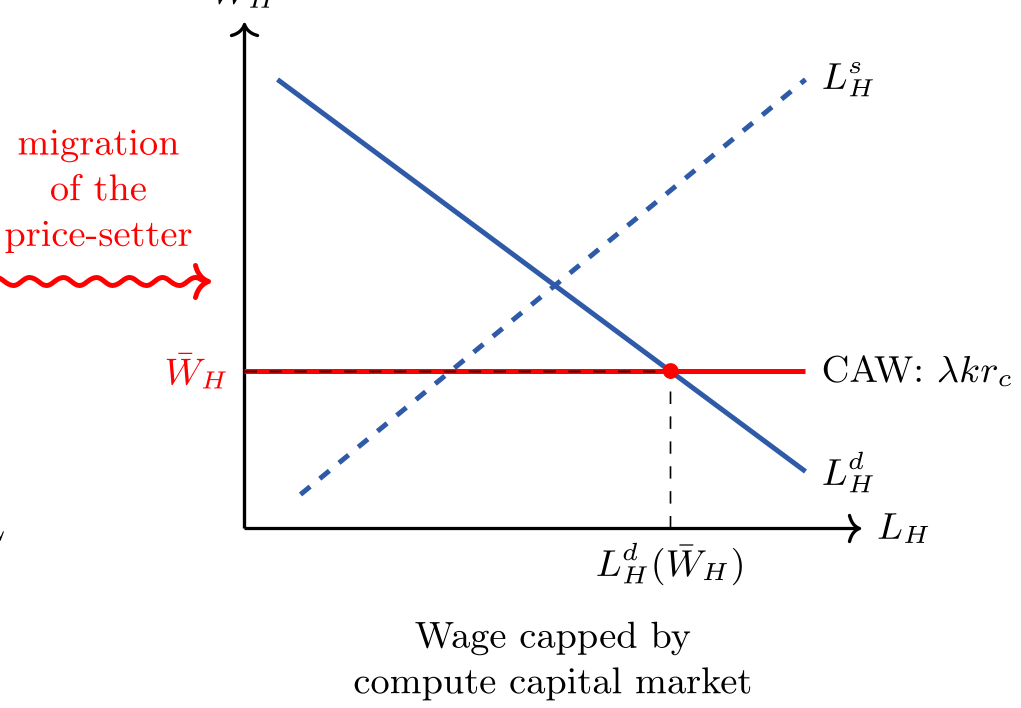 In the figure above, the wage is no longer set by the intersection of labor supply () and demand. Instead, it hits a "hard ceiling" determined by the price of compute ().
The Directional Inversion of Skill
Historically, technology helped "high-skill" workers (coders, lawyers) and replaced "low-skill" routine workers. CAW predicts an Inversion:
- Substitutable Tasks (): Document review, first-pass drafting, basic coding. Here, (elasticity of substitution) is high. Wages will be crushed toward the CAW bound.
- Complementary Tasks (): Judgment under uncertainty, high-stakes accountability, political navigation. Here, AI makes humans more valuable.
The result? Two people with the same PhD might see their salaries diverge 10x based solely on how much of their daily "to-do list" can be computed on an H100.
Real-World Calibration
Using 2024-2025 data, the paper provides a chilling look at the current wage ceilings:

If you are doing "distilled" tasks (like basic summarization), the market-clearing wage is already 0.20 per hour. For "frontier" reasoning tasks, the ceiling is currently 10.00 per hour. Any human asking for more must prove they are working in the "Complementary" () zone.
Critical Insight: Compute is the New Policy Lever
If wages are anchored to compute, then labor unions and minimum wage laws might lose their teeth for cognitive work. Instead, the "new" labor policy will be:
- Antitrust on GPU Markets: If Nvidia/Cloud providers have high markups on , they are effectively lowering human wages.
- Energy Policy: Cheaper electricity for data centers paradoxically accelerates human wage compression on substitutable tasks by lowering the CAW ceiling.
- Compute Taxation: Taxing GPUs might be the only way to "propped up" human cognitive wages.
Conclusion
The CAW framework provides a rigorous, testable prediction: the price of cognitive labor is now a projection of the compute market. As algorithms become more efficient ( falls) and hardware scales, the pressure on human wages will only intensify. The only escape is to move into tasks where humans are not just "better" (), but fundamentally different ().