
Why Open Source? A Game-Theoretic Anatomy of the AI Race
Why Open Source? A Game-Theoretic Analysis of the AI Race
This paper introduces a game-theoretic framework to analyze the strategic decisions of AI development teams regarding open-sourcing versus closed-sourcing models. By modeling the AI race as a winner-takes-all R&D contest, the authors provide the first formal mathematical treatment of how model openness impacts scientific progress and competitive standing across both discrete and continuous action spaces.
TL;DR
Why did Meta release Llama 3 while OpenAI kept GPT-4 behind a curtain? This paper moves beyond the ethical debate of "is open source good?" to ask the strategic question: "When is open-sourcing a winning move?" By modeling the AI race as an R&D game, the authors prove that open-sourcing is the rational weapon of the underdog, allowing trailing players to leverage the global community to leapfrog leaders.
Background Positioning
In the landscape of AI literature, this work is a theoretical bridge. It connects the "Safety vs. Speed" literature (like Armstrong et al.) with the economic reality of Open Source software. It is a descriptive model that explains the current geopolitical and corporate maneuvers we see today in the frontier AI race.
The Core Conflict: Gains vs. Spillovers
Existing models often fail because they treat AI development as a lonely sprint. In reality, it's a social race. The authors identify a fundamental tension:
- The Community Boost (): Open-sourcing attracts bug fixes, fine-tuning, and talent.
- The Competitor Leakage (): Your rivals can now see your "recipe" and build on top of it.
The authors argue that a player's utility isn't just their own performance, but their distance from the leader. This "Winner-Takes-All" dynamic creates a high-stakes environment where every decision to share code is a calculated risk.
Methodology: Mapping the Equilibrium
The team developed two versions of the game:
- Discrete: You either open-source (1) or you don't (0).
- Continuous: You "partially" open-source (e.g., releasing weights but not the training data).
High-Level Model Architecture
The beauty of the model lies in its simplicity. A player’s position is determined by:
eq i} \Delta_{ji} a_j + d_i$$ Where $d_i$ is the initial baseline and $a_i$ is the action. The utility is then: $$u_i(\mathbf{a}) = \mu_i(\mathbf{a}) - \max_{j eq i} \mu_j(\mathbf{a})$$  The paper proves that searching for a **Pure Nash Equilibrium (PNE)**—a stable state where no one wants to change their strategy—is **NP-hard**. To solve this, they cleverly reformulate the problem into a **Mixed-Integer Program (MIP)**, allowing them to use off-the-shelf solvers to find the strategic "sweet spot" for any given number of players. ## Key Insights: The Underdog’s Gambit One of the most profound takeaways is found in **Corollary 2**. It explains why a player who is "sufficiently behind" is mathematically incentivized to deviate from a closed-source status quo. If you are the leader, open-sourcing helps your rivals more than it helps you (relative to the gap). If you are in last place, you have nothing to lose and everything to gain from community contributions. By open-sourcing, you might help the leader a little, but you might gain enough "community traction" to surge into second or first place. 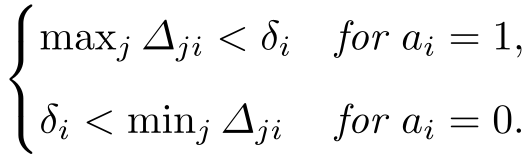 ## Critical Analysis & Conclusion ### Takeaway Open-sourcing isn't just altruism; it's a **catch-up mechanism**. For regulators, this suggests that if you want to diversify the AI market, you should increase the rewards for open-source contributions ($\delta_i$), making it the rational choice for more players. ### Limitations The model assumes players have perfect knowledge of each other's gains. In the real world, "secret sauces" exist. We don't truly know how much Meta benefited from the community compared to how much it helped its rivals. ### Future Outlook The authors suggest a move toward **Bayesian Game Theory**, where players must decide to open-source under uncertainty. As AI models become more expensive to train, the "Winner-Takes-All" nature of this model will only become more relevant for policymakers trying to prevent a total monopoly. *** *Primary Source: Mladenovic et al., "Why Open Source? A Game-Theoretic Analysis of the AI Race" (2026).*