
[2026] WR-Arena: Moving Beyond Visual Fidelity to True Simulative Reasoning in World Models
World Reasoning Arena
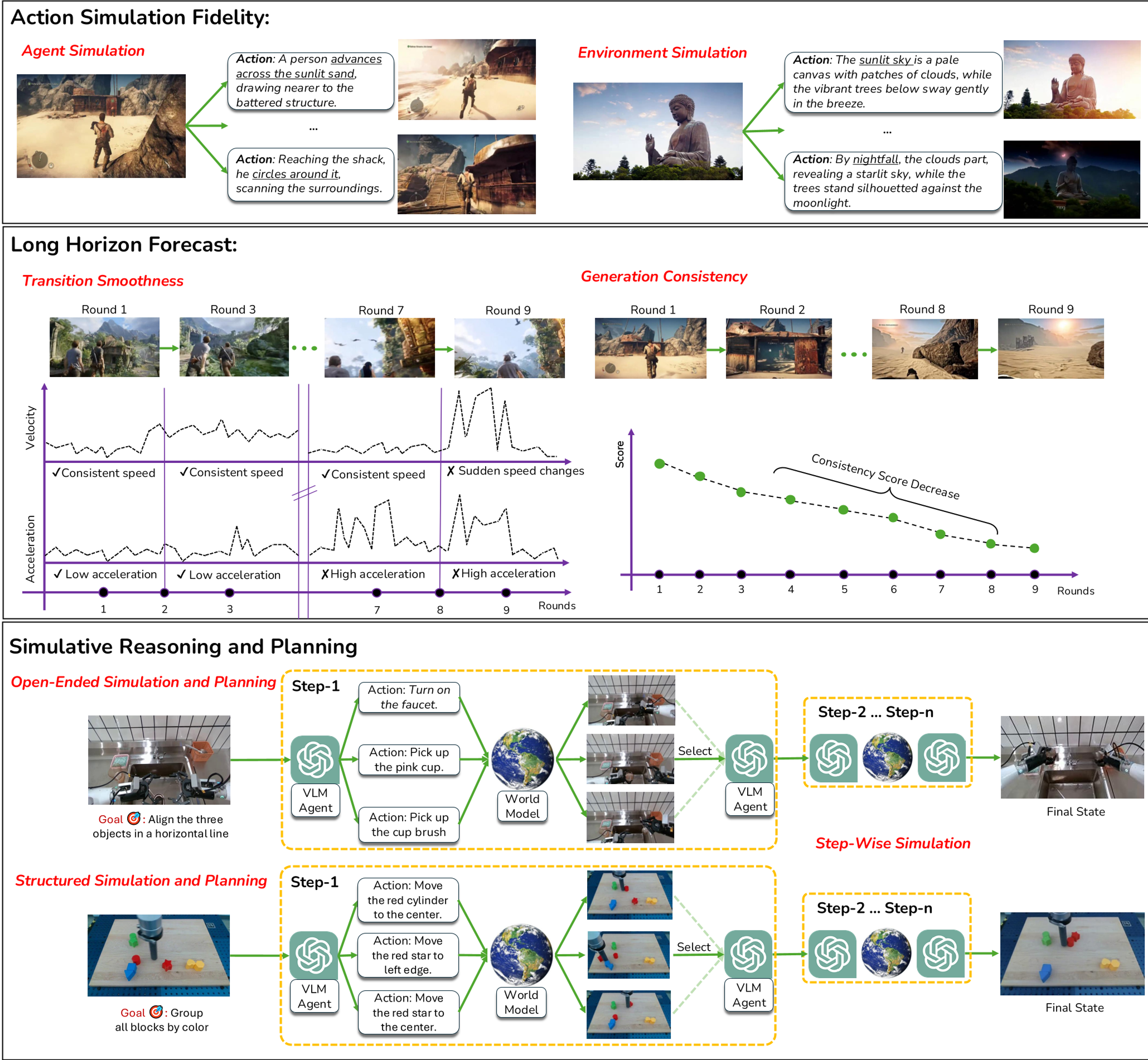
The paper introduces World Reasoning Arena (WR-Arena), a novel benchmark specifically designed to evaluate World Models (WMs) across three high-level cognitive dimensions: Action Simulation Fidelity, Long-horizon Forecast, and Simulative Reasoning & Planning. It establishes a new standard for judging whether a model acts as a true "internal simulator" rather than just a visual predictor, featuring a comprehensive task taxonomy and a large-scale evaluation of SOTA models like Cosmos, V-JEPA2, and PAN.
TL;DR
Current World Models (WMs) are often glorified video generators that look good but "hallucinate" physics. The World Reasoning Arena (WR-Arena) shifts the focus from pixel-perfection to functional intelligence. By testing action fidelity, long-term stability, and the ability to support "thought experiments," this benchmark reveals that even the best models (like PAN and Cosmos) still struggle with environment-level causality and long-horizon consistency.
The Motivation: From "Looking Real" to "Being Useful"
For years, the AI community has debated whether video generators (like Sora or Gen-3) are true World Models. The authors of WR-Arena argue that a true World Model is an algorithmic surrogate—an internal sandbox where an agent can test "what if" scenarios.
Prior benchmarks focused on What happens next (prediction). WR-Arena asks How and Why:
- Can the model follow a complex command like "make it rain harder"?
- Does the scene fall apart after 5 steps of interaction?
- Can an agent actually use the model's simulation to make a better decision?
The Taxonomy of Next-World Simulation
The paper breaks down "World Modeling" into three critical pillars:
- Action Simulation Fidelity: Can the model handle counterfactuals? If I have a video of a car and say "turn left" vs "turn right," does the model generate two distinct, physically plausible futures?
- Long-horizon Forecast: This tackles the "compounding error" problem. The authors use an ingenious Multi-round Smoothness (MRS) score based on optical flow to detect if the simulation "jitters" or "teleports" between action steps.
- Simulative Reasoning & Planning: This is the ultimate test. It uses a VLM (like GPT-4o) as a "brain" and the WM as "imagination." The brain proposes 3 plans, the WM simulates all 3, and the brain picks the best one.
Methodology: Tracking the "Jerk" and the "Drift"
To measure if a world model is actually stable, the authors don't just look at one frame. They look at the transition boundaries.
- MRS (Multi-round Smoothness): Uses velocity proxies from optical flow and finite-difference acceleration to penalize abrupt changes (). A smooth simulation gets a high score; a "twitchy" one fails.
- AP (Additive Penalty): Measures how much the style and content drift from the original starting point () as the rounds () progress.
Experimental Results: The "Action Grounding" Gap
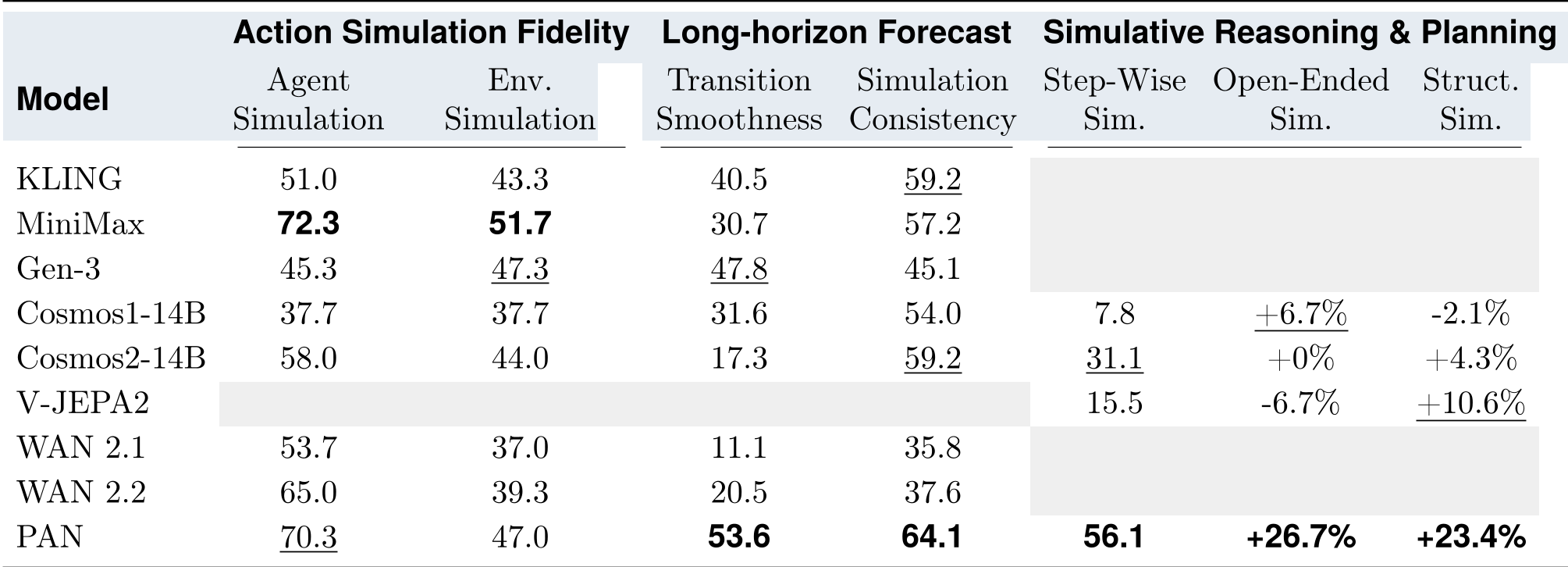
The results are a wake-up call for the industry. While commercial models like MiniMax and KLING produce beautiful videos, they often fail at Environment Simulation (scene-level interventions).
| Model | Agent Sim | Env. Sim | Planning Gain |
|---|---|---|---|
| PAN | 70.3% | 47.0% | +26.7% |
| Cosmos2 | 58.0% | 44.0% | +0% |
| WAN 2.1 | 53.7% | 37.0% | N/A |
Key Insight: The Planning Power of PAN
The PAN model (Generative Latent Prediction) significantly outperformed others in planning tasks. Why? Because it was fine-tuned on action-state aligned sequences. It doesn't just predict pixels; it understands the causal link between an instruction and a visual change.
Critical Analysis & Conclusion
The core takeaway from WR-Arena is that semantic grounding beats perceptual quality. A model that provides a "blurry" but causally correct simulation is more useful for a robot than a "4K" simulation that violates the laws of physics.
Limitations & Future Work
Despite the progress, even the best models fail to maintain high consistency beyond 7-9 interaction rounds. The "visual drift" (where a living room slowly turns into a forest after 10 actions) remains a massive hurdle. Future research must focus on Global Consistency Constraints—ensuring the world state is anchored in a permanent latent memory rather than just autoregressive frame generation.
WR-Arena serves as a rigorous diagnostic tool that will likely become the "ImageNet" for the next generation of Physical AI and Generalist Agents.