
WAV: Elevating VLA Systems with Implicit Latent Planning
World-Value-Action Model: Implicit Planning for Vision-Language-Action Systems
The World–Value–Action (WAV) model is a unified Vision-Language-Action (VLA) framework that integrates a language-conditioned world model with a trajectory value function to enable implicit latent planning. It achieves state-of-the-art results on the LIBERO benchmark (98.1% average success rate) and significantly outperforms baselines in real-world robotic tasks.
TL;DR
The World–Value–Action (WAV) model is a breakthrough in embodied AI that moves beyond "reactive" behavior. By combining a world model (predicting the future) and a value function (evaluating the future), it allows robots to "think before they act." Through an iterative latent-space inference process, it identifies high-value, physically feasible paths, achieving a 98.1% success rate on the LIBERO benchmark and doubling performance in real-world multi-step tasks.
The Problem: The Curse of Action-Space Planning
Modern Vision-Language-Action (VLA) models often treat robot control as a mere translation task: Image + Instruction -> Action. While effective for simple tasks, this approach fails in long-horizon scenarios because it doesn't account for the future consequences of current actions.
If we try to solve this by "planning" in the raw action space, we hit a mathematical wall. The authors formalize this as the Vanishing Feasible Mass: as the planning horizon grows, the set of valid, non-colliding, and semantically correct trajectories becomes an infinitesimally small fraction of all possible movements. In short, random sampling in action space almost always yields "garbage" trajectories.
Methodology: World, Value, and Action Synergy
WAV addresses this by moving the planning search into a Latent Space. Instead of searching through every possible millimeter of movement, it searches through a learned representation of "plausible futures."
1. The Architecture
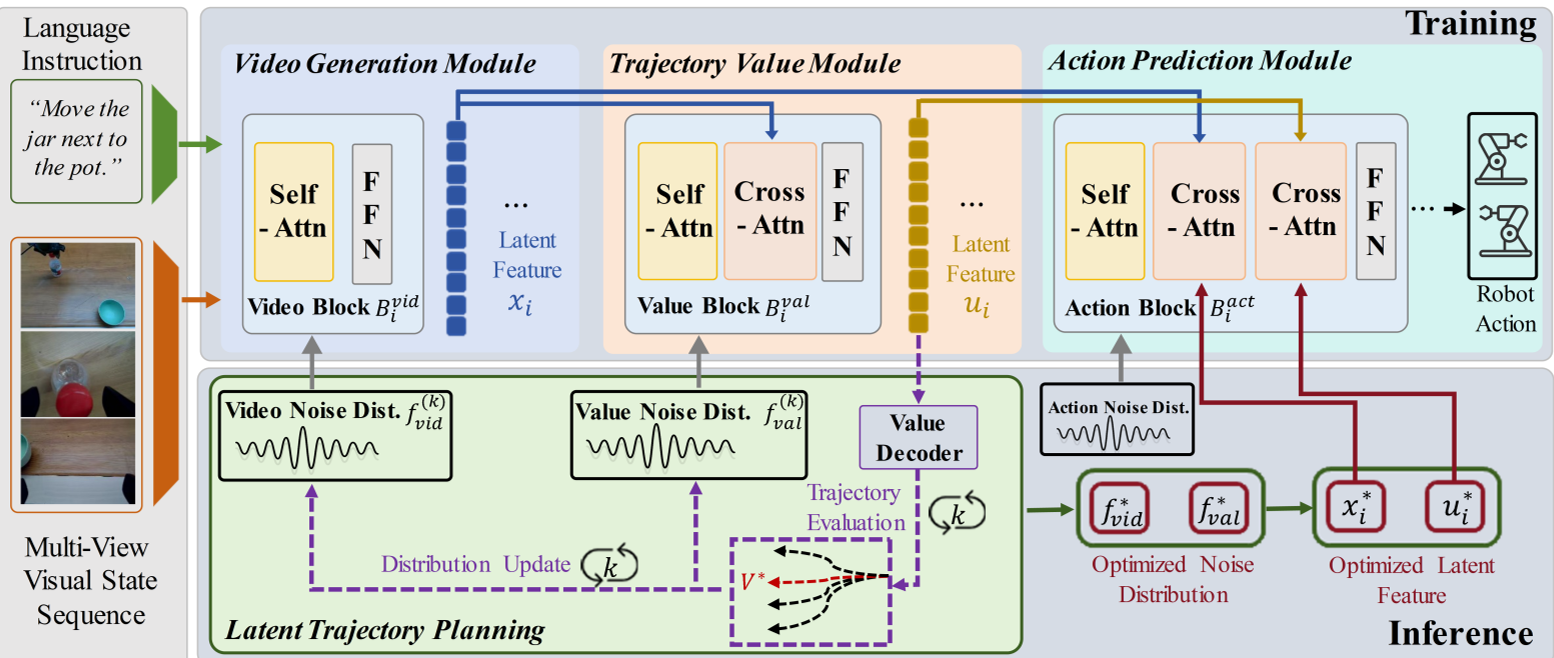
WAV consists of three modules built on Diffusion Transformers (DiT):
- Video Generation Module: Acts as the "imagination," predicting future visual frames based on the current scene and text instruction.
- Trajectory Value Module: Predicts the "return" or success probability of those imagined futures.
- Action Decoding Module: Translates the high-value imagined trajectory into executable robot motor commands.
2. Iterative Latent Planning
The secret sauce is Algorithm 1: Latent Trajectory Planning. During inference, the model doesn't just pick one future. It:
- Samples multiple "latent noises" (potential futures).
- Denoises them to generate visual features.
- Evaluates these features via the Value Module.
- Updates its belief: It shifts its sampling distribution toward the "Elite" (high-value) samples.
- Repeats this for iterations (optimizing the plan) before outputting the final action.
Experimental Results: SOTA and Beyond
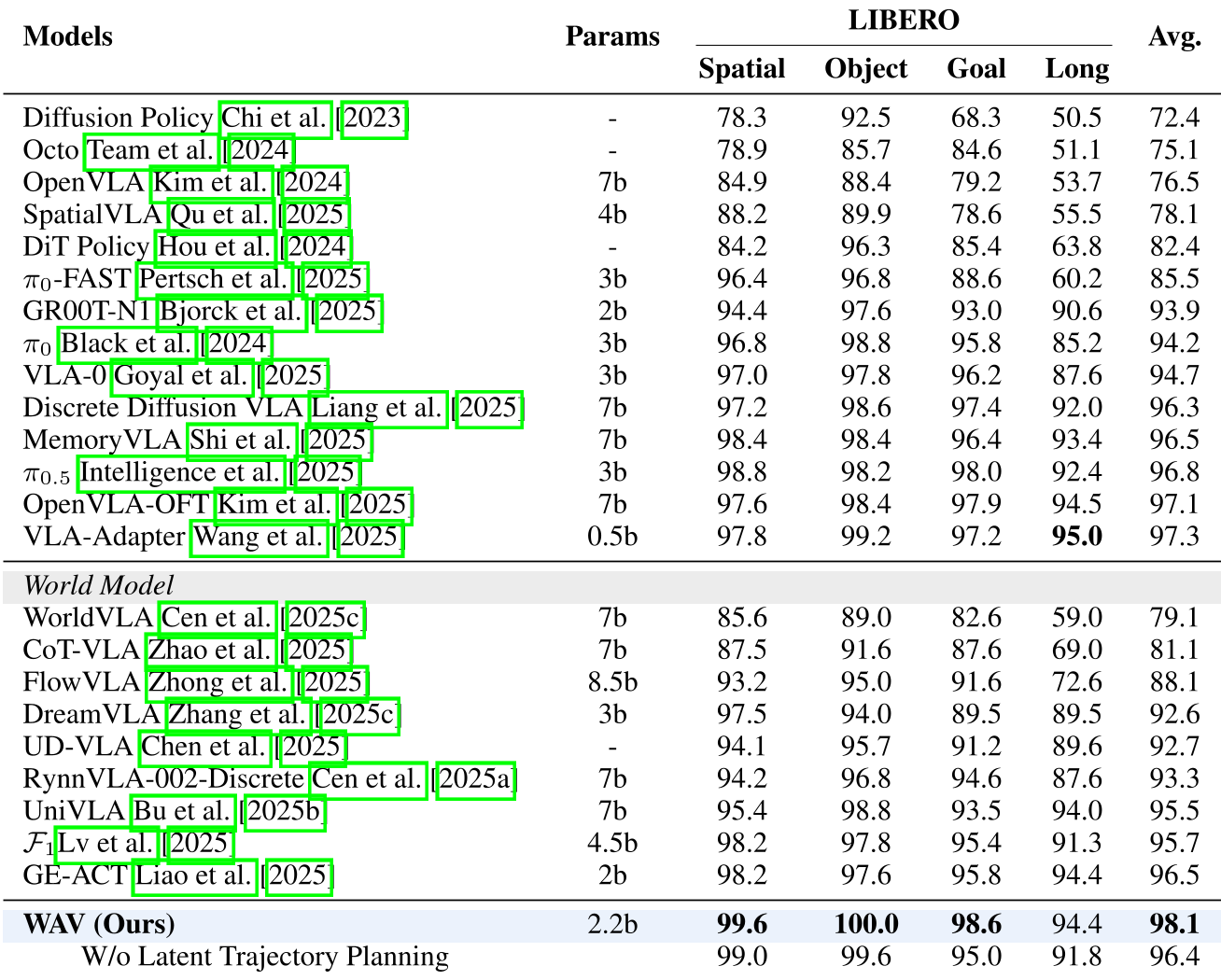
WAV was tested extensively on the LIBERO benchmark, which tests everything from spatial reasoning to long-horizon composition.
Simulation Performance
WAV achieved an average success rate of 98.1%, outperforming major models like OpenVLA and . Crucially, the "Long" suite (multi-step tasks) showed the most significant gains, proving that the latent planning mechanism effectively mitigates compounding errors.
Real-World Robustness
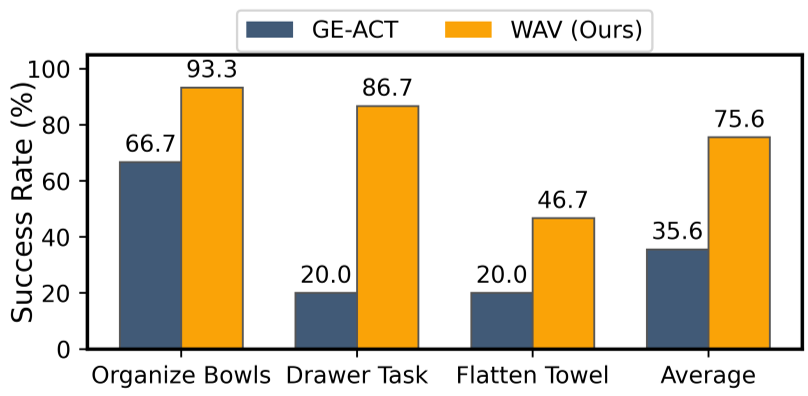
In real-world tests involving drawer operations and towel flattening, WAV showed a 75.6% success rate, whereas the baseline GE-ACT struggled at 35.6%. Qualitative analysis showed that while baselines often lost track of the goal mid-way, WAV maintained "temporal coherence," adjusting its grip and approach based on its internal "imagined" plan.
Critical Insight: Why Does It Work?
The paper provides a rigorous theoretical proof (Lemma 4.1 & Proposition 4.2) showing that latent-space planning provides an exponential advantage over action-space planning. By learning the "manifold" of feasible movements during training, the generator functions as a probabilistic filter. During inference, the value function then acts as a "guide," navigating this already-filtered space to find the optimal path.
Conclusion and Future Work
WAV represents a significant shift toward Unified Embodied Foundation Models. It proves that we don't need a separate "reasoner" and "executor"—both can coexist within a generative framework.
Future Directions:
- Efficiency: Currently, the iterative inference (K iterations) adds computational overhead. Optimizing this for real-time 100Hz control is the next frontier.
- Generalization: Expanding the world model to handle even more diverse, open-vocabulary environments.