
WORLDJEN: Beyond Pixels — A New Era of Multi-Dimensional Video Benchmarking
WorldJen: An End-to-End Multi-Dimensional Benchmark for Generative Video Models
W O R L D J E N is an end-to-end multi-dimensional benchmark for generative video models that replaces traditional reference-based metrics with a VLM-as-a-judge framework. By utilizing adversarially curated prompts and dimension-specific Likert questionnaires, it successfully establishes a three-tier Bradley-Terry (BT) ranking across 6 SOTA models, including Veo 3.1 and Kling v2.6.
TL;DR
Evaluating AI video has historically been a choice between pixel-matching math (SSIM/PSNR) or abstract distribution statistics (FVD). W O R L D J E N breaks this dichotomy by introducing a VLM-as-a-judge framework that sees video at native resolution, asks 160 specific questions per clip, and perfectly mirrors human preferences. It reveals a startling truth: while AI videos look beautiful, they are still failing the most basic laws of physics.
The "Resolution Gap" and the Failure of Binary VQA
Why are current benchmarks like VBench failing to distinguish between a "passable" video and a "Slightly better" one? The authors identify three critical bottlenecks:
- Low Resolution: Most auditors resize frames to 224x224, "averaging away" the very temporal flickers and physics glitches that humans notice.
- Binary Bias: If you ask a VLM "Is the physics correct?", it defaults to "Yes" (yes-bias).
- Prompt Simplicity: Real user queries are complex, but benchmarks use narrow, single-dimension prompts.
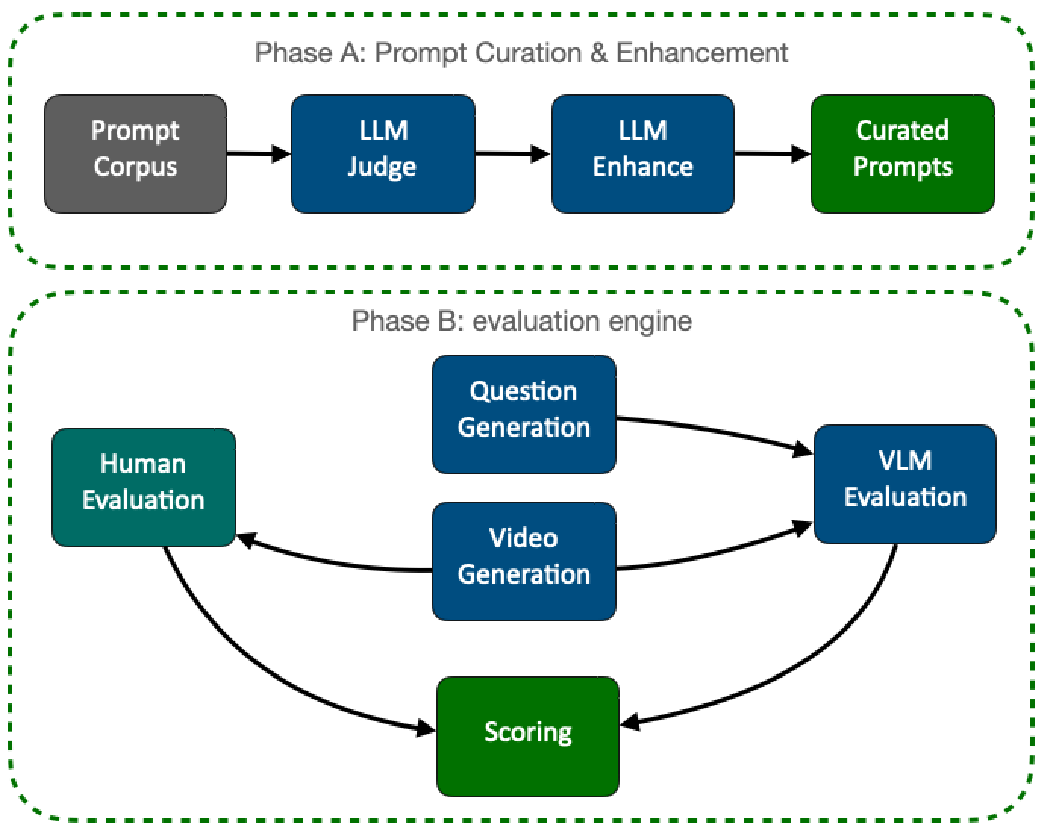
Methodology: The VLM-as-a-Judge Engine
The core of W O R L D J E N lies in its Phase B Evaluation Engine. Instead of generic scoring, the system generates prompt-specific Likert questionnaires.
Dimension-Aware Sampling
Not all artifacts occupy the same temporal space. W O R L D J E N uses three distinct modes:
- Holistic Mode (32 frames): For aesthetics and color harmony.
- Sampled Mode (16 frames): To catch "identity drift" in characters.
- Micro Mode (Dense Prefix): Evaluates the first 2 seconds frame-by-frame to catch jerky motion and physics violations.
The Human Ground Truth
The researchers didn't just trust the AI. They conducted a blind human preference study (2,696 annotations). This established a Three-Tier Ranking where Veo 3.1 Fast and Kling v2.6 Pro sit comfortably at the top, while smaller models like Wan 2.1 1.3B trail significantly.
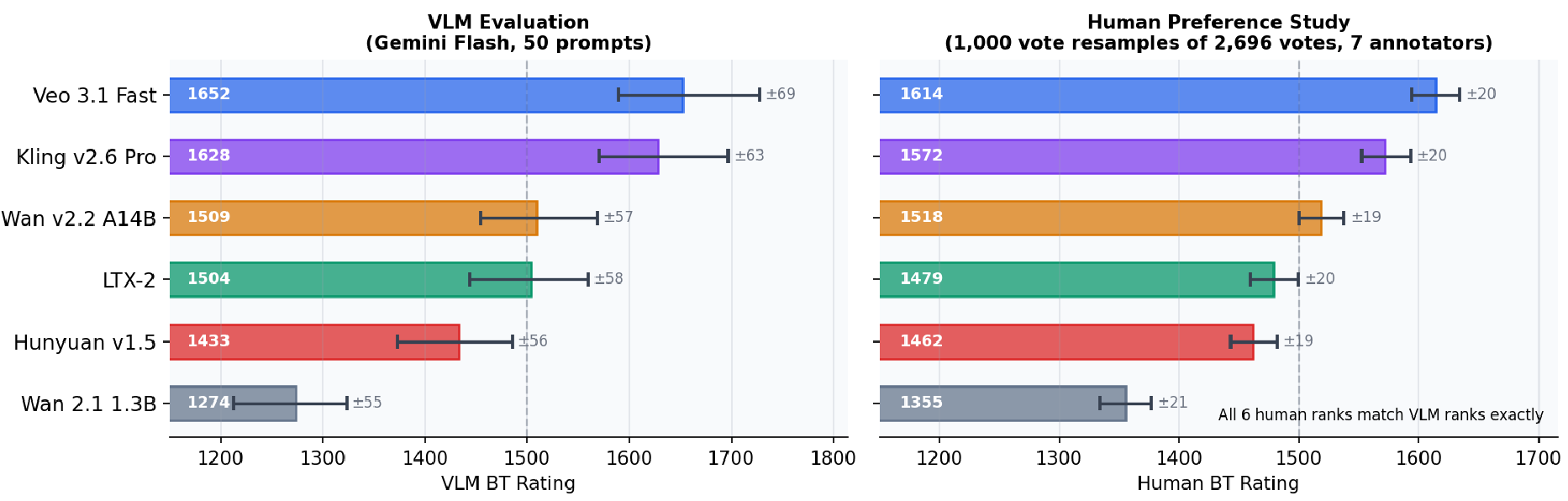
Key Insight: The Physics Gap
The most profound result from the dimension-wise analysis is the "Physics Floor." While models achieve near-perfect scores (4.8/5.0) in Color Harmony and Aesthetics, they plummet to ~3.0 in Physical Mechanics and Inertial Consistency. AI models can render a "dragon lord," but they struggle to show the weight of his sword hitting the floor.
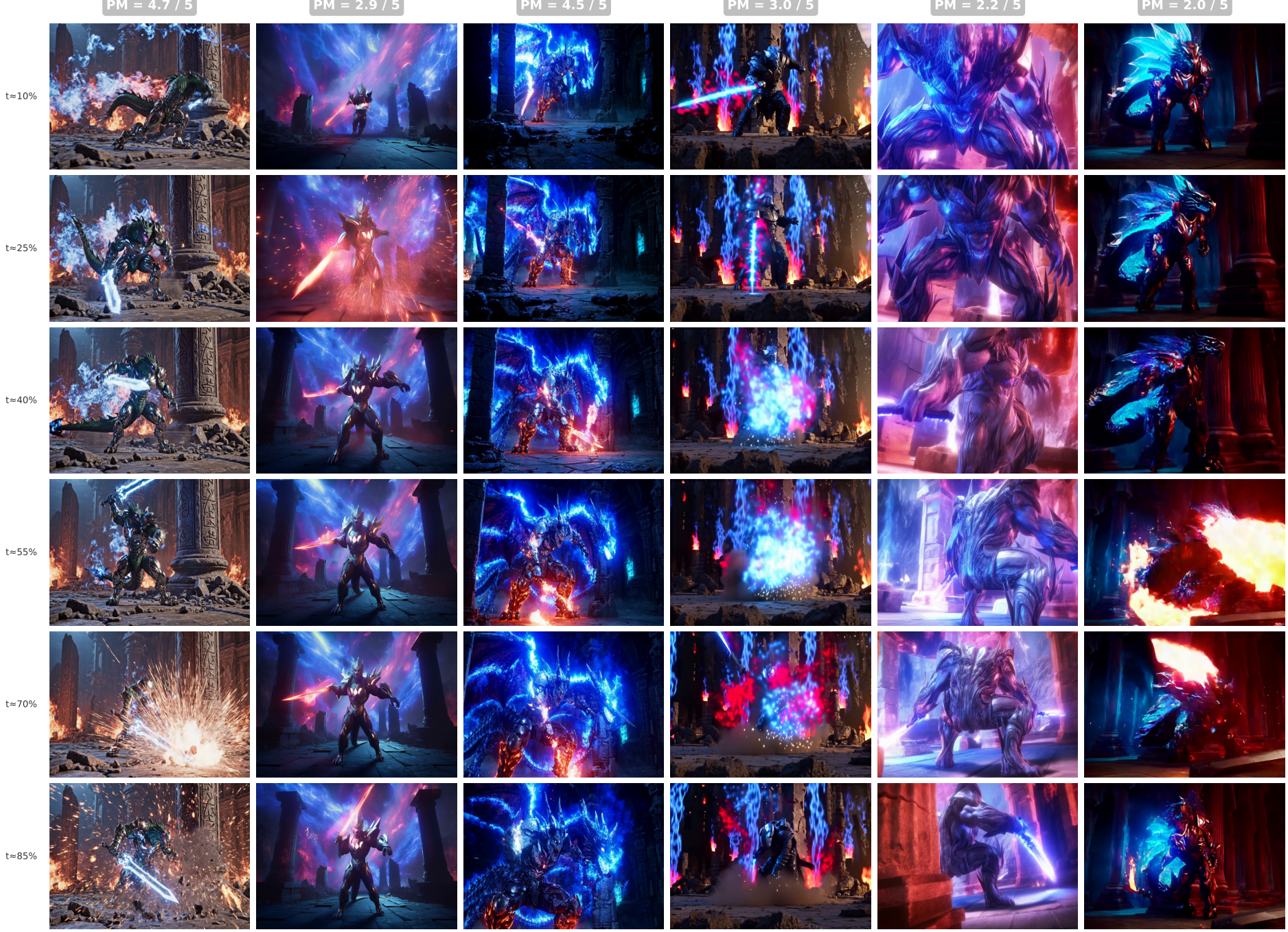
Comparison with VBench: Signal vs. Noise
When pitted against the industry-standard VBench, W O R L D J E N showed 12x more discriminative power in motion smoothness. VBench scores tend to cluster at the ceiling (0.97-0.99), making the resulting rankings effectively random. W O R L D J E N’s native-resolution audit captures the subtle jitter that reference-free metrics miss.
Critical Analysis & Conclusion
Takeaway
W O R L D J E N's success proves that granularity matters. By moving from binary "Success/Failure" to 1-5 Likert scales and using complex, multi-dimensional prompts, we can finally rank video models with the same rigor we use for LLMs in Chatbot Arena.
Limitations
- Stochasticity: The benchmark currently uses a single seed per prompt. Generative video is a "lottery"; future iterations will require 3-5 seeds to reduce variance.
- Auditor Cost: Relying on frontier models like Gemini 3 Flash or Claude 3.5 Sonnet is expensive, though the authors demonstrated that open-source models like Gemma 4 are beginning to catch up.
W O R L D J E N provides the community with a much-needed "compass" for the video generation race, shifting the focus from mere "visual polish" to "physical reality."