
X-Voice: Breaking Language Barriers with Transcript-Free Zero-Shot Voice Cloning
X-Voice: Enabling Everyone to Speak 30 Languages via Zero-Shot Cross-Lingual Voice Cloning
X-Voice is a 0.4B parameter multilingual non-autoregressive (NAR) voice cloning model supporting 30 languages. Built on the F5-TTS flow-matching framework, it achieves SOTA zero-shot cross-lingual synthesis and transcript-free cloning by utilizing a novel two-stage training paradigm and IPA as a unified representation.
TL;DR
X-Voice is a 400M-parameter multilingual TTS model that allows anyone to "speak" 30 languages with just a short audio clip. By evolving the F5-TTS architecture, it introduces a two-stage training strategy that eliminates the need for reference transcripts and uses Dual-Level Language Injection to kill the "accent leakage" problem. It delivers billion-parameter quality at a fraction of the computational cost.
Positioning: This work is a "SOTA-efficiency" play—scaling non-autoregressive (NAR) models to industrial-grade multilingual performance without the inference lag of traditional Autoregressive (AR) LLMs.
Problem & Motivation: The "Transcript" Bottleneck
Most zero-shot voice cloning systems (like VALL-E or early F5-TTS) require two things: a target speech prompt and its transcript. In the real world, especially for low-resource languages or spontaneous speech, getting a clean transcript is a nightmare.
The authors identify three main pain points:
- Transcript Dependency: Hard to scale for unwritten dialects.
- Inference Speed: AR models (e.g., Qwen3-TTS, Fish Audio) are slow and prone to error accumulation.
- Accent Leakage: When cloning a voice from English to Chinese, the model often retains an English "accent" in the Chinese output because it can't fully decouple identity from prosody.
Methodology: The Two-Stage Evolution
X-Voice solves these through a clever "Self-Supervision" loop and architectural hardening.
1. Unified Phonetic Space
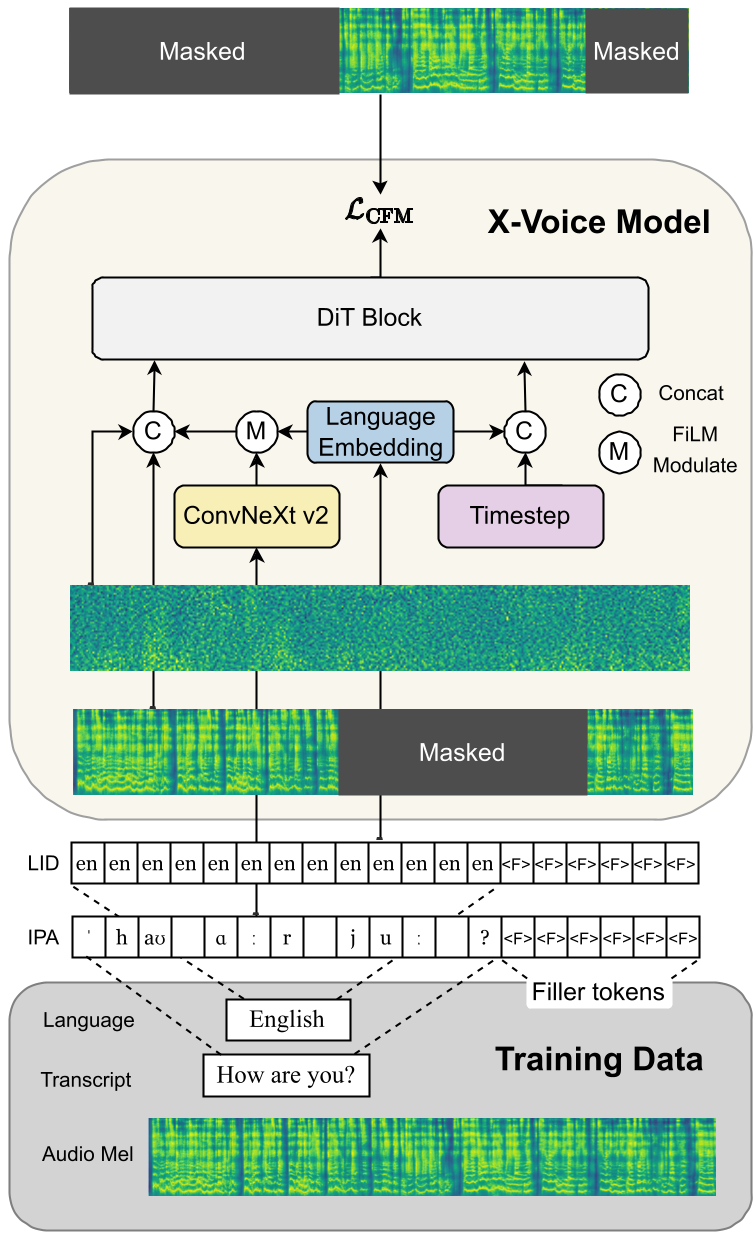
Instead of raw text, the model uses the International Phonetic Alphabet (IPA). This acts as a "Universal Language" that bridges 30 different tongues into a shared acoustic manifold.
2. X-Voices1: The Foundation & Dual Injection
The team trained a 0.4B DiT (Diffusion Transformer) on a massive 420K-hour multilingual corpus. To solve accent leakage, they didn't just tell the model which language to speak via a simple tag. They used Dual-Level Language Injection:
- Time Level: Injecting Language ID (LID) into the time embeddings to steer the global "flow" of speech.
- Textual Level: Using FiLM (Feature-wise Linear Modulation) to adapt phonetic features based on the language, acting like a "gate" for articulation.
3. X-Voices2: Going Transcript-Free
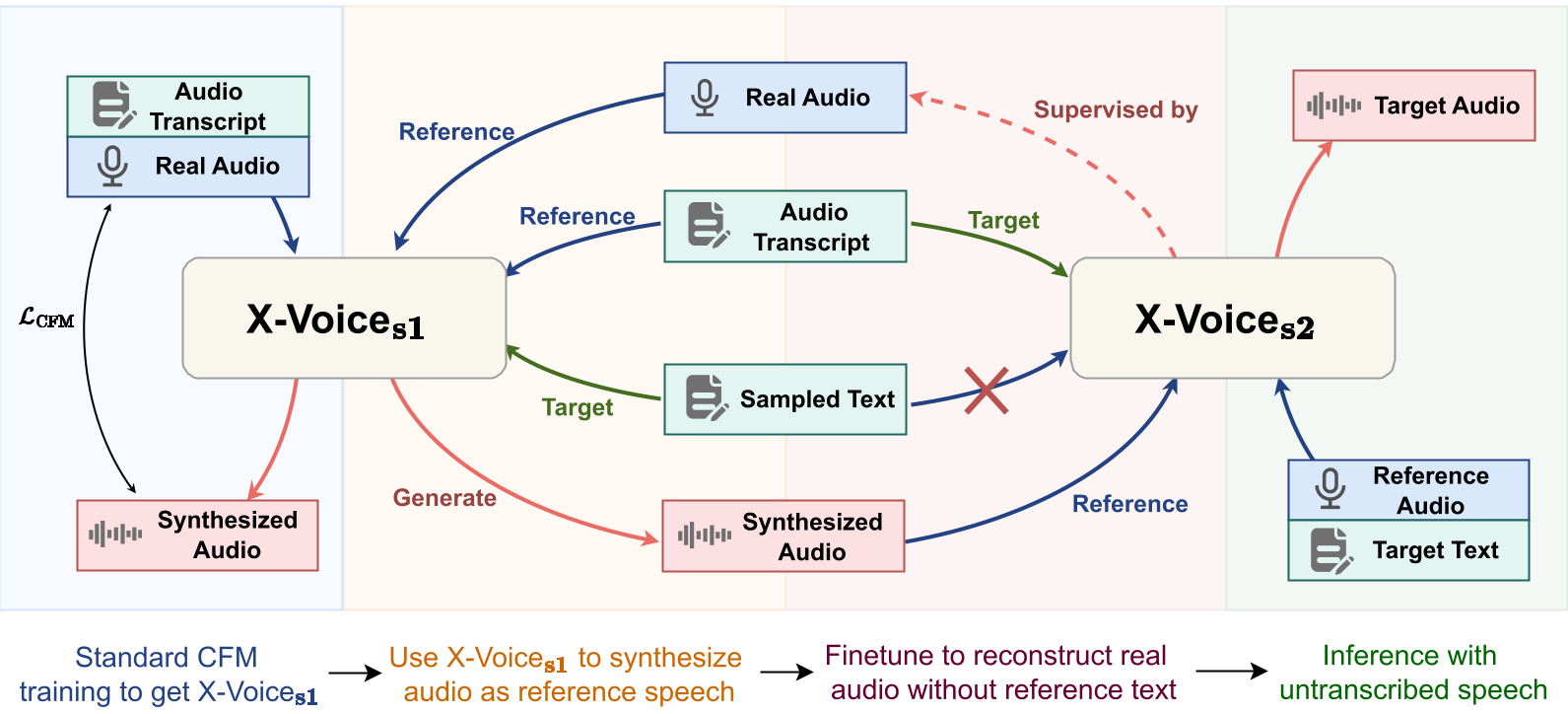
This is the "special sauce." The authors used X-Voices1 to synthesize 10K hours of speaker-consistent audio pairs. They then fine-tuned the model (SFT) by masking the reference text and replacing it with learned "prompt tokens." This teaches the model: "Don't look at the text for the prompt; just look at the audio."
Experiments & Results: Punching Above Its Weight
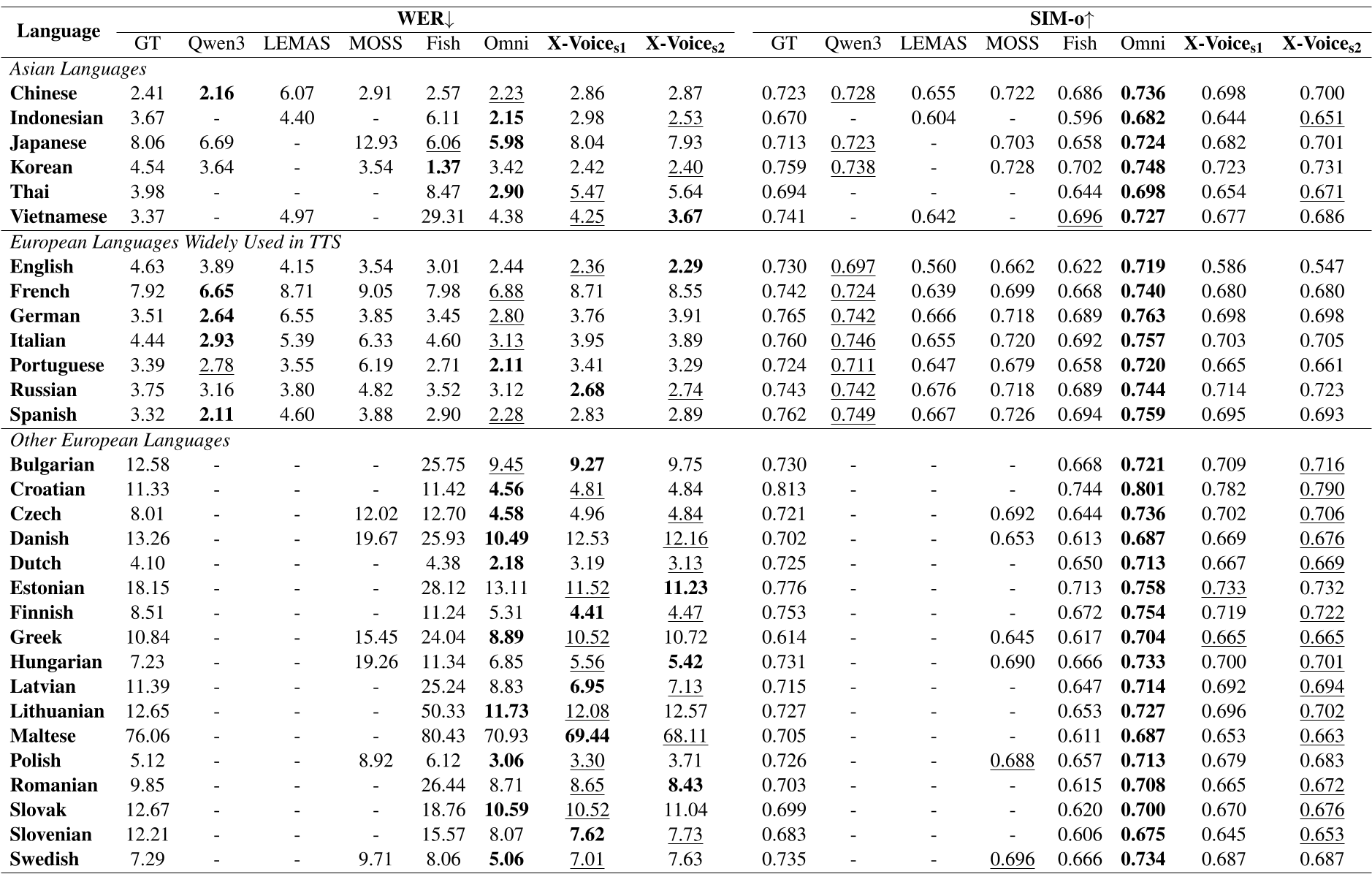
X-Voice was tested against giants like Qwen3-TTS (1.7B) and MOSS-TTS (8.0B).
- Efficiency: X-Voice achieves a Real-Time Factor (RTF) of 0.073, while Fish Audio S2 sits at 4.8. It is nearly 65x faster than some AR baselines.
- Intelligibility: On the WER metric, X-Voice outperformed LEMAS-TTS and stayed competitive with Qwen3-TTS, despite being significantly smaller.
- Cross-Lingual Robustness: The Dual-Injection strategy successfully reduced WER in cross-lingual tasks (e.g., English -> Italian), proving that decoupling timbre from accent works.
Critical Analysis & Takeaways
Why is this a big deal? X-Voice proves that you don't need a massive 10B parameter LLM to do high-quality voice cloning. By using Flow Matching and Optimal Transport, the model learns a smoother "path" from noise to speech.
The Innovation of A-Warmup: The authors also introduced Asymmetric Warmup (A-Warmup) for Classifier-Free Guidance. By ramping up linguistic guidance while keeping acoustic guidance strong from the start, they fixed the "integration shock" that often makes generated speech sound robotic or glitchy at the start of a sentence.
Limitations:
- Prosodic Nuance: While it suppresses accents, it might "over-standardize" voice, losing some of the unique quirks of a speaker's natural delivery.
- Code-Switching: The model still struggles with inter-sentential language mixing (e.g., "Ming tian we are going to travel").
Conclusion: X-Voice is a landmark for accessible, high-speed, and transcript-free voice technology. By open-sourcing the 420K-hour corpus and the model, the authors are setting a new standard for transparency in the TTS community.