
[ICLR 2025] ZebraArena: Probing the Reasoning–Action Gap in Tool-Augmented LLMs
ZEBRAARENA: A Diagnostic Simulation Environment for Studying Reasoning-Action Coupling in Tool-Augmented LLMs
ZebraArena is a procedurally generated diagnostic simulation environment designed to evaluate how tool-augmented LLMs couple multi-step reasoning with external actions. Using partially observed Zebra puzzles, it measures agent performance against a theoretical optimal query count (), revealing that even frontier models like GPT-5 struggle with efficiency despite high accuracy.
TL;DR
While Large Language Models (LLMs) are increasingly used as "agents" that call APIs and tools, we lack a clean way to measure their efficiency. ZebraArena solves this by turning the classic Einstein logic puzzle into a diagnostic testbed. By withholding clues and forcing models to "buy" info through tool calls, it proves that even GPT-5 is a "clumsy" agent—it gets the right answer but uses nearly 3x more tool calls than mathematically necessary.
The Problem: The Noise in Agentic Evaluation
Current benchmarks for agents (like WebArena or ToolBench) are "noisy." If a model fails to book a flight, is it because it can't reason, or because the website UI changed?
The authors identify four major flaws in existing benchmarks:
- Complexity Confounds: Real-world environments (web/API) hide reasoning flaws behind interface complexity.
- Memorization: Models might "remember" solutions from training data.
- Shallow Reasoning: Some tasks only require a single retrieval step.
- Inefficiency Blindness: Most benchmarks only reward the final answer, ignoring how much "resource" (tokens/queries) was wasted.
Methodology: The Logic Grid as an Oracle
ZebraArena uses the Zebra Puzzle (e.g., "The Englishman lives in the red house..."). In its standard form, these are Constraint Satisfaction Problems (CSPs) with a unique solution.
1. The Missing-Clue Setting
The environment removes a subset of clues (), making the puzzle unsolvable with the provided information. The model must then interact with an environment to retrieve the missing constraints.
2. The ToolBox
Agents have two main tools:
- Fact Queries: "Does Eric like Dragonfruit?" (Decisive, low-level).
- Relation Queries: "Is the Red house to the left of the Green house?" (Strategic, high-level).
3. Metric: The "Efficiency Frontier"
The paper introduces the Inefficiency Ratio (IR): Where is the total tool calls and is the theoretical minimum queries needed to reach a unique solution. An optimal agent has an .
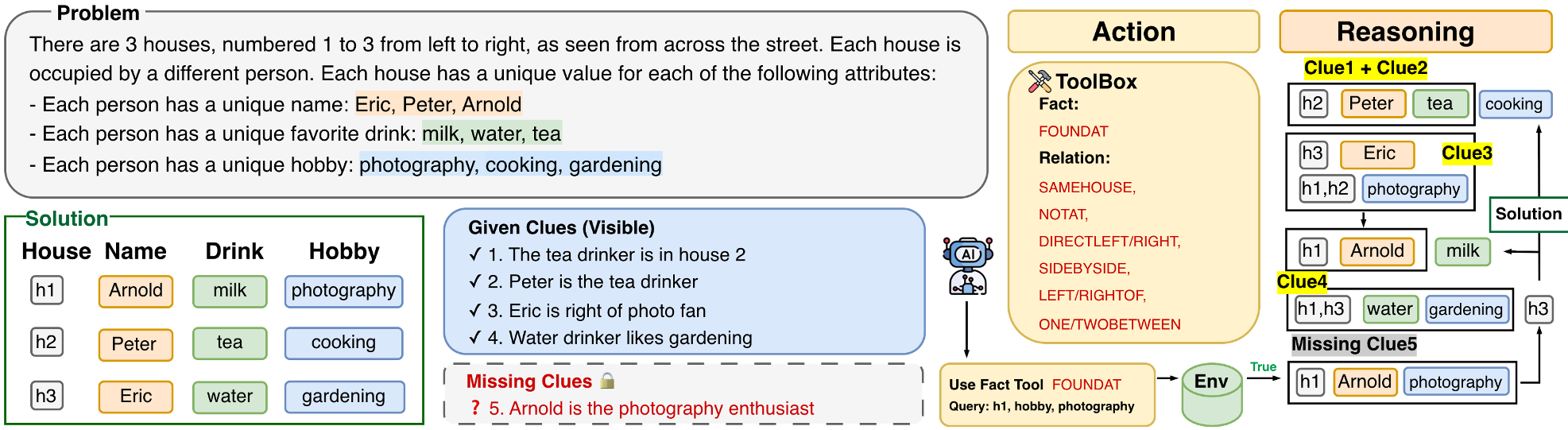 Figure 1: The ZebraArena workflow showing the Background, Given Clues, ToolBox interaction, and final Solution grid.
Key Results: Accuracy $
eq$ Intelligence The experiments across GPT-5, Gemini 2.5 Pro, and Llama 3.3 reveal a massive gap between "frontier" and "open-source" models.
- The Efficiency Gap: GPT-5 is highly accurate (~99%) but significantly inefficient. It issues redundant queries or fails to plan the most informative questions, resulting in an IR of 1.7 to 3.7.
- Budget Anxiety: When told they have a "Tight" budget (), models become "anxious"—their accuracy drops because they spend their few queries on non-decisive information.
- Token Explosion: Gemini-2.5-Flash requires over 20k tokens per puzzle compared to GPT-5's 1.2k, largely due to "vocalizing" redundant internal reasoning and excessive tool calling.
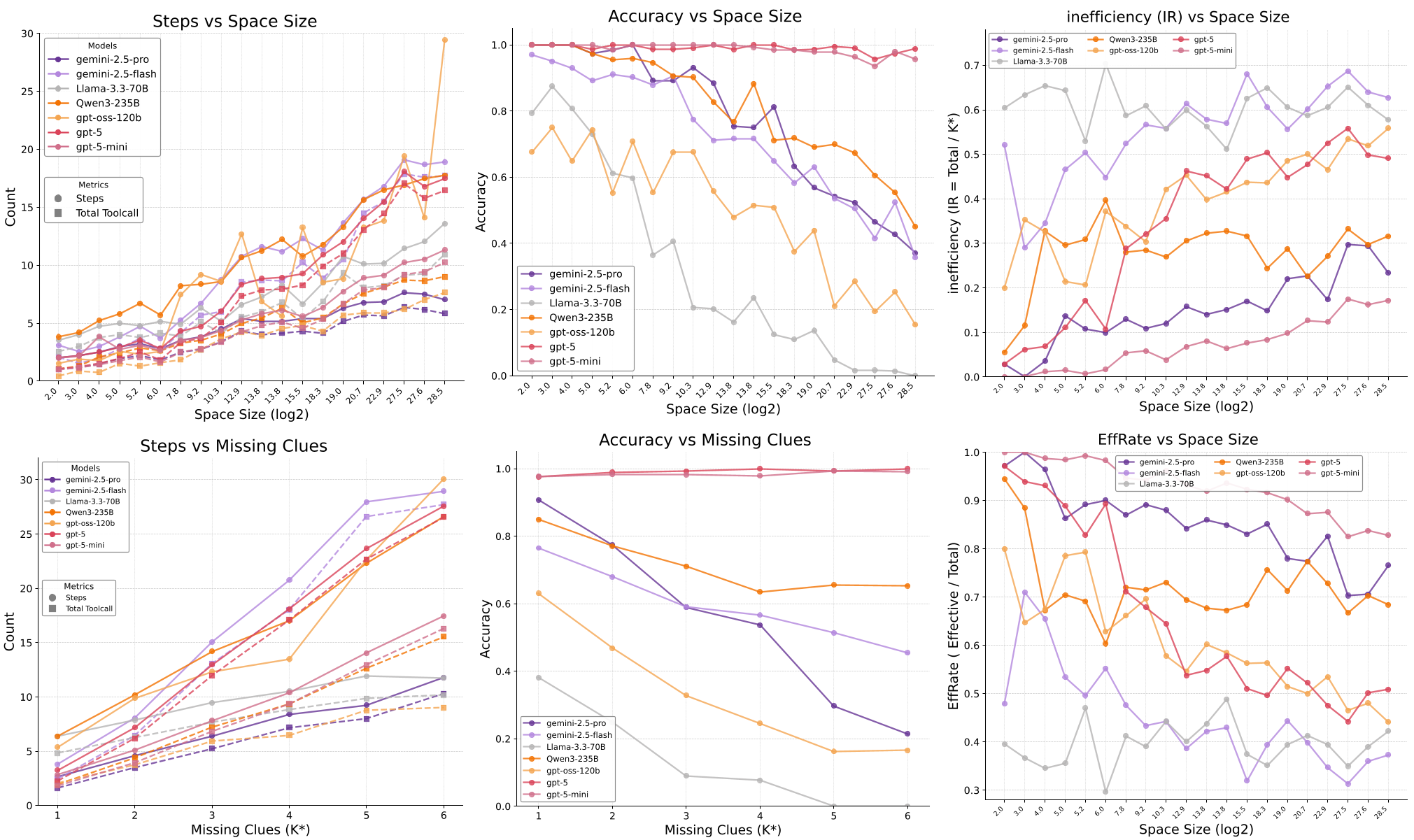 Figure 2: Scaling behavior showing accuracy dropping (middle) and tool calls rising (left) as the search space grows.
Critical Insight: Cost Sensitivity
One of the most fascinating experiments involved Pricing Signals. Can models adapt like economists?
- When Fact queries were made 20x cheaper than Relation queries, models shifted their strategy to use more Facts.
- However, they couldn't always find the "Pareto optimal" cost. Sometimes, they ignored a necessary (but expensive) Relation query and failed the puzzle entirely, showing that "cost-aware planning" is still a brittle skill in LLMs.
Conclusion & Future Impact
ZebraArena proves that being "smart" isn't enough for an agent; being efficient is the next frontier. The environment is now open-source, providing a "gym" for researchers to train agents that don't just solve problems, but solve them with the minimum necessary action.
Takeaway: We are moving from the era of "Can LLMs solve this?" to "How much does it cost for the LLM to solve this?"