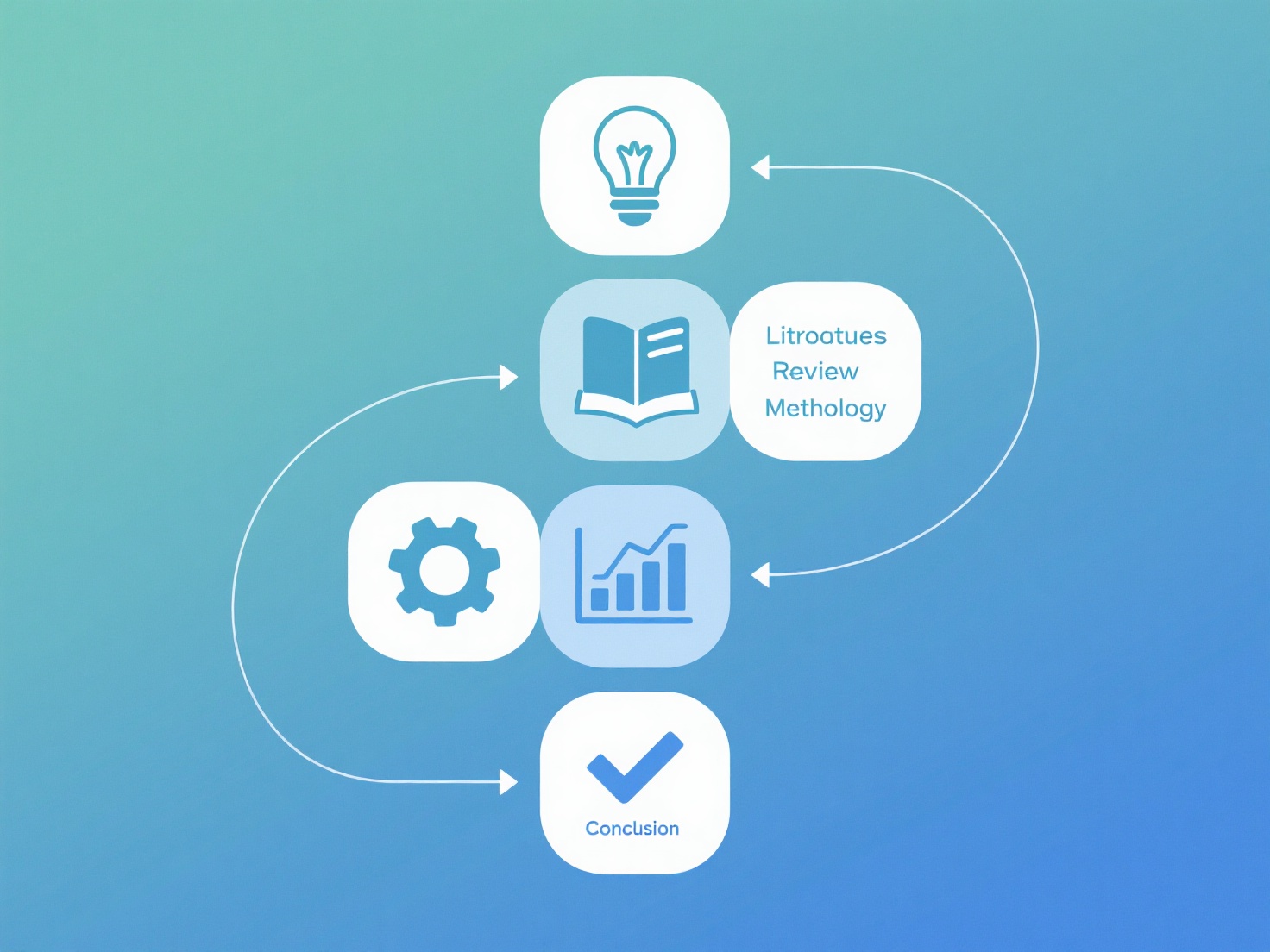
To organize your dissertation sections effectively, follow the standard academic framework that includes an introduction, literature review, methodology, results, discussion, and conclusion.
While humanities and STEM fields might have slight structural variations, most dissertations adhere to a logical flow that guides the reader from your initial research problem to your final contributions. Breaking your massive project into these standard chapters makes the writing process much less overwhelming.
1. Introduction
Start by introducing your research topic, stating your primary research questions or hypotheses, and outlining the scope of your study. This section serves as a roadmap, telling your committee exactly what to expect in the following pages.
2. Literature Review
Here, you will synthesize existing research to provide context and highlight the specific research gaps your work will fill. Because you will be juggling hundreds of sources, keeping everything structured is essential; using a tool like WisPaper's My Library helps you manage your references Zotero-style and even chat with your uploaded PDFs via AI to quickly pull key quotes and themes.
3. Methodology
Explain exactly how you conducted your research. Whether you used qualitative interviews, quantitative surveys, or archival research, you need to detail your research design, data collection methods, and analytical approach so others can evaluate or replicate your work.
4. Results or Findings
Present the data you collected clearly and objectively, without interpreting it too deeply just yet. Depending on your field, it is highly recommended to use charts, graphs, and tables to make complex quantitative data easy to digest.
5. Discussion
This is where you analyze and interpret your results. Tie your findings back to your original research questions and the studies mentioned in your literature review. You should also address any unexpected results and clearly state the limitations of your study.
6. Conclusion
Summarize your main findings, emphasize the overall contribution your dissertation makes to your discipline, and suggest practical applications or areas for future research.
Front and Back Matter
Don't forget the required bookends of your dissertation. The "front matter" goes before your introduction and typically includes your title page, abstract, acknowledgments, and table of contents. The "back matter" follows your conclusion and contains your reference list or bibliography, along with any appendices (such as survey instruments, interview transcripts, or extra data tables).
Before finalizing your structure, always check your specific university and department guidelines, as institutional requirements for chapter order, naming conventions, and formatting can vary.