
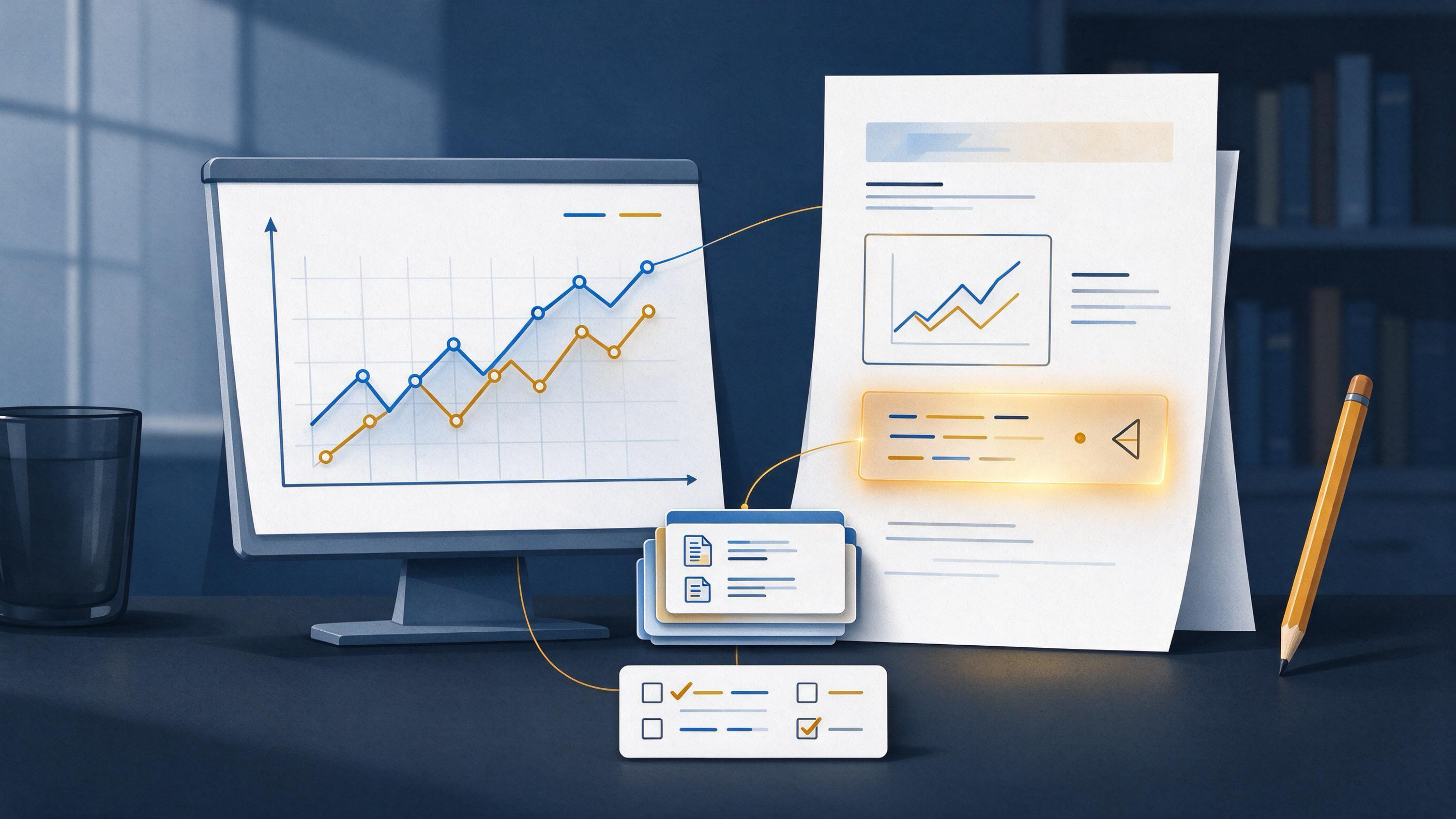
You opened the revised figure exported from your analysis script, updated the y-axis, swapped the treatment labels, and re-ran the regression. The graph in the manuscript now shows the corrected model, but the caption beneath it still describes the old sample, the old comparison, and a p-value that no longer exists. The figure and its caption now disagree in a way that is easy to miss on a screen and devastating to find in a reviewer's margin note.
This failure is not a careless typo so much as a coordination problem. A manuscript is a system of mirrored claims: the text says something, the table reports it, the figure visualizes it, the caption narrates it, and the reference list supports it. When one component is edited alone, the others quietly go stale. The fix is not to read the document one more time with fresher eyes; it is to rebuild the trail that connects each figure to the evidence behind it.
This article walks through that repair from a concrete, realistic failure: a coauthor updated a figure before submission, the caption went untouched, and now the whole evidence chain needs to be checked before the manuscript can go back to the journal. It covers the diagnosis, the decision points, the artifacts that prevent recurrence, and the standard you use to know the repair is actually done.
What Actually Broke When the Figure Changed?
The immediate problem is visible: the figure plots one thing while the caption says another. But the visible mismatch is usually the smallest part of the damage. The same revision that changed the figure likely left other components misaligned.
Start by inventorying every place the figure's content might be duplicated. The results section that reports the same analysis. The table that lists the same effect sizes or group means. The abstract, especially if it was written to match an earlier result. The statistical summary in the figure itself. The legend, axis labels, and sample-size note. The methods paragraph that describes how the plotted variable was computed.
Treat the figure as a claim with dependencies, not as a standalone image. When the figure changed, every sentence that was written to explain the old figure became a candidate for the same failure. The caption is only the most obvious symptom.
Which Version of the Figure Is Authoritative?
Before editing anything, establish which version of the figure is correct. This matters because the instinct is to make the caption match the figure that is currently in the file, but the current file may itself be an intermediate export that no one intended to be final.
Ask three questions, in order:
- What does the analysis code produce right now, from the raw data, with the current script?
- What did the analysis actually conclude when the results were interpreted?
- What does the submission-ready figure file show?
The goal is to find the version that is defensible from the data forward. A figure that matches the final analysis but not the methods is broken in a different way. A figure that matches the methods but not the final code is also broken. The correct state is one where the raw data, the analysis script, the reported statistic, the figure, the caption, and the prose all describe the same computation.
If the figure changed because the analysis changed, the caption fix is downstream of a larger decision: is the new analysis the one the manuscript will report? If yes, the caption, results text, abstract, and tables all need to be checked. If no, the figure needs to be reverted or regenerated.
What Is the Authoritative Reporting Standard for This Manuscript?
The next step is to pin the manuscript's claims to an external reporting framework so that the repair is not just internally consistent but externally auditable. The supplied evidence points to three general resources:
- The ICMJE Recommendations describe the standard parts of a biomedical manuscript and direct authors to follow the selected journal's current instructions for article type, format, required statements, and submission materials.
- The EQUATOR Network Reporting Guideline Database organizes reporting guidelines by study type and specialty so authors can choose a checklist that matches the design they are reporting.
- APA Journal Article Reporting Standards give reporting standards and design-specific modules for quantitative, qualitative, and mixed-methods research so readers can evaluate how a study was conducted and analyzed.
Choose the checklist that matches the study design, not the one that is most convenient. A reporting guideline gives you a list of claims the manuscript must support, which doubles as a list of places where a changed figure could have introduced drift. Run the figure's caption against the checklist: does the caption state the sample, the comparison, the statistic, and the precision in the way the guideline requires? Does the figure itself contain enough information for the caption's claims to be checked against the analysis and not just against the prose?
The selected journal's instructions usually name the relevant checklist. Use that when available; otherwise use the design-based match. The point is to make the repair standard visible, not to add a generic certification sentence.
How Do You Trace the Figure Back to the Evidence?
The diagnosis is only trustworthy if every sentence in the caption can be traced to where its number came from. Build a small trace table for the caption's claims. Each row is one factual fragment: the sample size, the comparison, the statistic, the p-value, the error bars, the unit, the time window. Each fragment gets a source: the data file, the analysis script, the output log, a table in the manuscript, or a prior figure version.
A fragment with no source is an unverified claim. A fragment whose source contradicts another row is a live error. A fragment whose source no longer exists, because a file was overwritten or a script was edited after the fact, is a reproducibility gap that the manuscript itself may not be able to close.
This trace table is the core artifact of the repair. It is small enough to build in a half hour and precise enough to settle disagreements between coauthors. When a coauthor asks, "Where did this p-value come from?" the trace table answers with a pointer, not a memory.
Which Fix Is Correct: Regenerate, Relabel, or Rewrite?
Once the trace table is complete, the repair usually takes one of three forms.
Regenerate the figure. If the figure file was produced from stale code or an outdated data snapshot, do not correct it by hand in the image. Re-run the script that produces it from the current data. The figure itself should be an artifact, not a drawing.
Relabel the figure. If the analysis is correct and only the visual encoding drifted — wrong axis label, wrong legend, wrong grouping — the fix is in the plotting code or the presentation layer. Make the label change in the script, then re-export so the figure and its labels stay tied to the same generation step.
Rewrite the caption and the prose that depends on it. If the figure is an accurate representation of the final analysis, then the caption, the results text, the abstract, and any table that reports the same statistic must be brought into line. The caption is not the end of this work; it is the clearest place to start.
In most real cases, the repair is a combination. The figure is regenerated from the corrected script, the caption is rewritten to match the regenerated figure, and the results paragraph is edited to match the caption. Do not treat these as three separate tasks. They are one change with three touchpoints.
How Do You Keep the Artifacts and the Manuscript Locked Together?
The reason the caption drifted is usually that the artifacts moved. The figure was updated in a folder, the caption lived only in the manuscript, and no system tied the two together. The repair needs to reduce the number of independent copies of each claim.
At minimum, keep the figure file, the caption text, and the trace table in a single revision record. Name the figure file with its analysis version. Store the caption alongside the script that produced the figure. When the figure is regenerated, regenerate or re-check the caption in the same pass.
For the evidence that underlies the figure, consider a library that holds the source papers and analysis notes in one place. My Library lets you save or upload papers and organize them in the WisPaper library, which helps when the figure's interpretation depends on a source you need to keep adjacent to the manuscript rather than in a separate citation manager. When a changed figure changes the meaning of a comparison, the source papers that motivated that comparison should be findable in minutes, not reconstructed from a browser history.
For a daily working loop that needs a shared question-and-answer layer over those saved papers, Library QA is built for asking questions based on papers uploaded to My Library or added from search results. That is useful when a caption correction raises a factual question — "Does the original source report this comparison with the same denominator?" — that you need to answer against the saved PDFs rather than from memory.
Keep the project-level revision record in one place. Research Projects is the WisPaper area where you can create a new project, which is a natural container for the manuscript revision, the figure trace table, and the follow-up search queries as one unit.
What Does a Corrected Submission Pack Look Like?
At the end of the repair, assemble the pieces that would let a reviewer or a coauthor verify the figure without asking you for a memory. The corrected pack includes:
- The regenerated figure file, with a versioned name.
- The corrected caption, pasted into the manuscript and also stored with the figure.
- The trace table that maps each caption fragment to its source.
- The updated results paragraph, abstract, and any table that shares the figure's statistics.
- The reporting checklist entry that shows how the figure's claims satisfy the selected standard.
The test for readiness is not that the document "looks consistent"; it is that another reader can follow the trail from the caption's p-value to the data and back. If a fragment cannot be traced, the submission pack is not done.
The manuscript now has a visible repair and, more importantly, a written chain that explains why the caption says what it says. When the next revision lands, the person who makes the next change can repeat the same trace instead of starting from scratch.
How Does This Fit a Larger Revision or Year-End Reset?
The same discipline scales beyond a single figure. If the manuscript is one of several heading toward submission, or if the lab is closing out the year with multiple projects in flight, the figure-caption check becomes a template for a broader audit.
Use the same trace-table pattern for each manuscript's key claims: every headline number in the abstract, every figure, every table, and every methods statement that a reviewer would quote back to you. Attach the trace table to the manuscript's revision record. Then treat the collection of trace tables as the state of the research pipeline: a manuscript is ready only when its trace table is complete.
When new work is starting, the same discipline applies in a slightly different direction. Idea Discovery provides a workflow that takes research topics, background, references, and experimental constraints to generate research ideas. Using it at the start of a new question helps the next manuscript begin with a sourced chain of motivation, which lessens the chance that the first figure and its caption will be written from different mental models.
For a wider revision task, WisPaper search is the interface for finding academic papers through WisPaper's scholarly search. That is where you go when a caption correction reveals a missing source or when a changed comparison needs a new reference to be defensible.
When the revision includes a long, multi-step literature task rather than a single look-up, Scholar Agent is built for longer research tasks that fit WisPaper's Scholar Agent area and its literature review, inspiration, or reproduction use cases. Place it in the workflow where the task is a genuine literature synthesis, not where a single search would do.
How Do You Know the Fix Is Ready for Reviewers?
The final standard is narrow and checkable.
First, every number in the figure and its caption appears in the trace table with a source. Second, the source is current: the script, data, and output that produced the figure are the same artifacts that produced the reported statistics. Third, the caption's claims satisfy the selected reporting guideline for the study design. Fourth, the results prose, abstract, and tables agree with the caption. Fifth, the submission pack is stored so that another person can verify the chain without asking you.
When those five checks pass, the manuscript is ready for the next review, not just the next version.
Transferable Lessons for the Next Revision
The quiet failure of the unchanged caption teaches three repeatable lessons.
First, treat figure, caption, prose, and table as versions of the same claim. Change one and you have implicitly proposed changing the others. The workflow should make that proposal explicit.
Second, prefer regeneration over hand-editing. A figure corrected inside an image editor is a figure whose caption has no reliable source. A figure produced by a script can be traced, re-run, and verified.
Third, keep a written chain between the evidence and the manuscript. The trace table is cheap insurance. It converts a disagreement about what the data says into a disagreement about where a number came from, which is much easier to settle.
The real lesson is not about captions. It is about building the manuscript so that when one part moves, the parts that depend on it move with it, and the trail shows how.
FAQs
Keep Reading
A New Citation Changes the Claim You Already Wrote: How to Repair the Deliverable Without Losing the Week
The slide said "supports," the memo said "remains unresolved," and the client deck said both. Then a colleague forwarded one new paper. Its abstract contradicted the sentence in your executive summary, and the DOI resolv
A Project Is Paused but Nobody Recorded Why: Rebuilding the Thread Before Your Next Submission
The failure is concrete and familiar. You open the shared folder, find a manuscript draft from six months ago, and realize nobody wrote down why the work stopped. The methods section is half-complete. The results folder
Annual Literature Review vs. Continuous Literature Monitoring: Which Fits Your Research Rhythm?
A clinician preparing a research update often faces the same fork: run one comprehensive search once a year, or keep a quieter feed running all year. The two approaches feel interchangeable at first, but they differ in w