
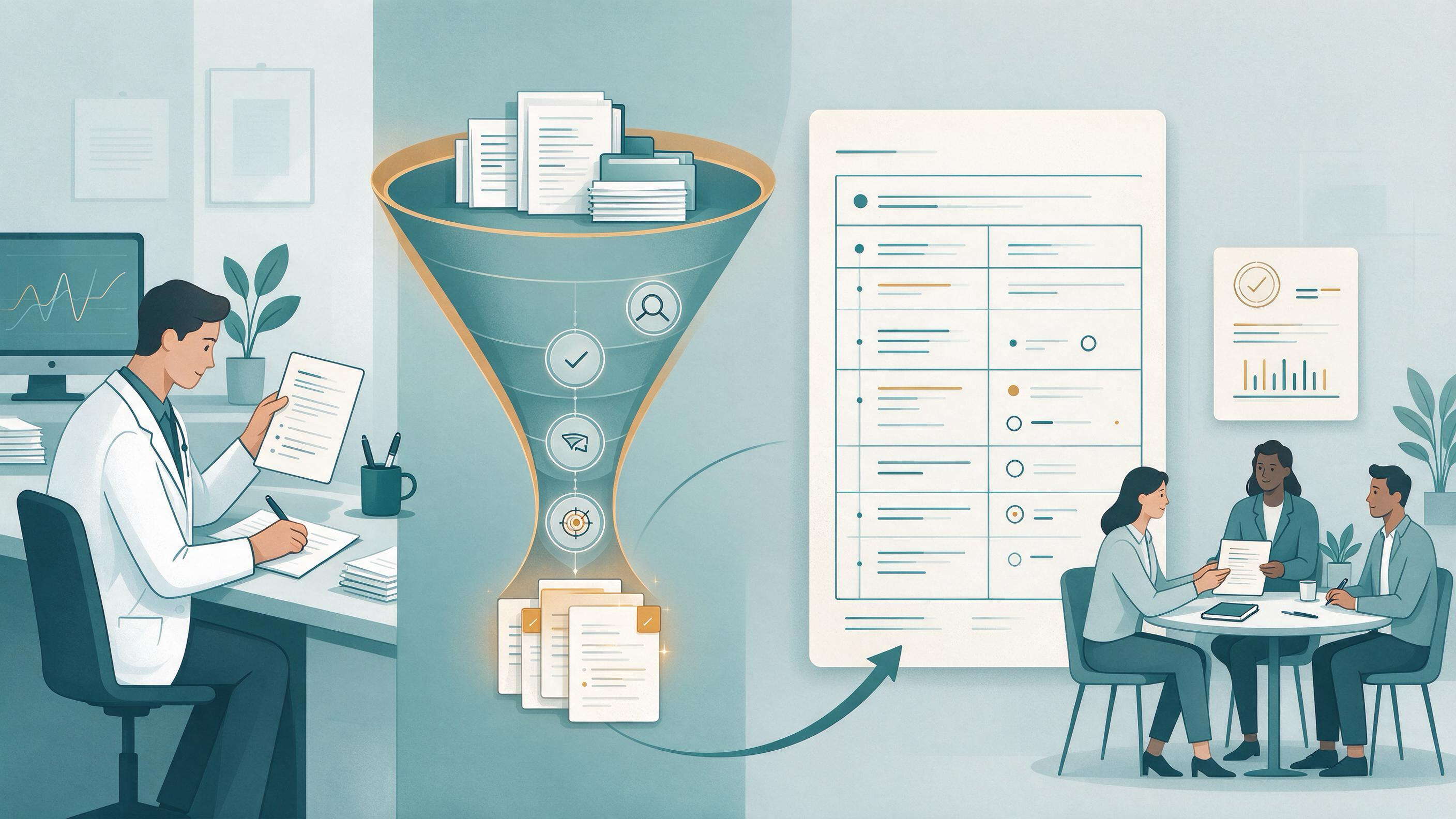
A clinical evidence briefing turns a focused question into a short, defensible summary that a care team or research group can discuss together. The work is less about finding one decisive paper and more about building a transparent chain: a precise question, a documented search, staged screening, a clear reading of each study's design and limits, and a summary that separates what the evidence shows from how well it applies to your population.
This guide is a pillar map for that chain. It uses one running example — an adult inpatient population and a single outcome — to show the decisions and artifacts you produce at each stage. It does not offer treatment recommendations; it shows how to assemble and communicate evidence so your team can reason about it.
Start by diagnosing where you actually are
Most briefing projects stall because the reader is further back than they think, or further along than their notes show. Before searching, locate yourself on this diagnostic. The honest answer determines which section to read next.
| Your starting state | What you likely have | What is missing | Go to |
|---|---|---|---|
| Vague topic | A clinical concern and a population in mind | A structured question and a named outcome | Build the question |
| Focused question, no search | A PICO-style question | Eligibility criteria and a search plan | Plan the search |
| Search done, no record | A list of hits | Documentation, deduplication, screening stages | Screen in stages |
| Studies selected, no appraisal | Full texts | Design, applicability, and limitation notes | Appraise and map |
| Appraisal done, no summary | Notes per study | A team-ready synthesis with clear boundaries | Write the briefing |
If you cannot name the population and the outcome in one sentence, you are at the first row. If you have hits but cannot say how you found them, you are at the third row regardless of how many papers you have read.
Build a question that a briefing can actually answer
The Cochrane Handbook's guidance on searching begins with eligibility criteria: the search is planned from what will count as an included study, not from whatever terms come to mind. That means your question must be specific enough to generate inclusion and exclusion rules.
Use a running example throughout this guide: in adults hospitalized with a specified acute condition, what does the evidence report about a named clinical outcome? Keep the population and the outcome fixed. Everything downstream — search terms, screening decisions, applicability notes — depends on those two anchors staying stable.
A workable question has four parts you can write down:
- Population: who is in scope, and which boundaries (age, setting, comorbidity) are firm versus flexible.
- Exposure or intervention: what is being compared, described at the level your sources will actually report.
- Comparator: what the alternative is, including usual care if that is how studies frame it.
- Outcome: one named outcome for the briefing's headline, with secondary outcomes listed separately.
Write the question, then write the eligibility criteria as a short list of include/exclude rules. If a criterion cannot be applied consistently by two readers, it is not yet a criterion — it is a preference.
Plan the search before you type
The Cochrane Handbook recommends planning searches from eligibility criteria, using multiple sources, combining free-text terms with subject headings, documenting the process, deduplicating records, screening in stages, linking multiple reports of one study, and rerunning searches before publication. Each of those is a decision, not a formality.
Turn criteria into terms
PubMed supports field tags, phrase searching, filters, Advanced Search, saved searches, Similar Articles, citation lookup, and links to full text when available; its search details reveal how terms were translated and combined. That translation view is where you check whether your intent survived. MeSH — NLM's controlled and hierarchical vocabulary — offers preferred headings, entry terms, scope notes, qualifiers, and tree positions that you can use to expand or focus a PubMed strategy. Free-text terms catch what indexing misses; subject headings catch what phrasing misses. Use both.
Document as you go
Record the date, the sources used, the exact strings, and the filters applied. A briefing whose search cannot be reconstructed is a briefing your team cannot check. When you need to find and collect candidate papers through a scholarly search interface, WisPaper search is the place to run those queries; for a public explanation of the same entry point, see WisPaper Scholar Search.
Decide how wide to cast
Multiple sources reduce dependence on one index, but each added source adds screening load. Decide up front how many sources you will search and stop there, rather than adding sources reactively when early results feel thin.
Screen in stages and keep the audit trail
Staged screening is the norm: title and abstract first, then full text. Deduplicate before you screen, and link multiple reports of the same study so one trial reported in three papers does not become three studies in your summary.
Keep a simple screening log with three columns: record identifier, decision, and reason. The reason column is what makes the log useful later — "wrong population" and "outcome not reported" tell your team different things about the evidence base.
When you move to full text, save the papers you retain so the briefing's evidence set is a stable, inspectable collection rather than a set of browser tabs. My Library is where you can save or upload papers and organize them. Once the retained set is assembled there, Library QA lets you ask questions based on papers uploaded to My Library or added from search results — useful for checking what a specific retained paper reports before you write it into the summary.
Appraise each study on four separate axes
The most common failure in a briefing is collapsing four different judgments into one verdict. Keep them apart.
| Axis | The question it answers | Where it shows up in the briefing |
|---|---|---|
| Evidence level | What kind of study design produced this result? | A design label per study, not a global grade |
| Applicability | How close is the studied population and setting to ours? | A short note on differences that matter |
| Indirectness | Does the study measure the outcome we asked about, in the comparison we asked about? | A flag when the outcome or comparator is a proxy |
| Limitations | What within this study weakens the result? | Study-specific caveats, stated plainly |
A study can be a strong design and still be indirect for your question. A study can be directly applicable and still have serious limitations. Writing these as four columns forces you to say which one is doing the work in your conclusion.
NIH guidance on scientific rigor and reproducibility treats careful assessment of prior knowledge, strengths, weaknesses, knowledge gaps, transparent methods, validation, and reproducibility as core parts of rigorous practice. That framing maps directly onto a briefing: the appraisal is not a verdict, it is a structured account of strengths, weaknesses, and gaps.
Map the evidence before you write prose
Before drafting, build a one-page evidence map: rows for studies, columns for population, comparison, outcome, design, applicability note, and key limitation. This artifact does the heavy lifting for the summary and makes disagreements in team discussion concrete rather than rhetorical.
Two checks belong at this stage:
- Gaps: which cells are empty? An empty cell for your named outcome is a finding, not a failure of the search.
- Convergence: do studies agree, and if not, does the disagreement track a difference in population, comparator, or outcome definition?
If your retained set is large or the question spans several sub-questions, a longer research task may fit Scholar Agent, WisPaper's area for literature review, inspiration, or reproduction use cases. Keep the evidence map as your own record either way — the map is what your team will interrogate.
Write the team-ready summary
A team-ready briefing is short, structured, and explicit about its boundaries. A structure that works:
- Question — the population, comparison, and named outcome, in two sentences.
- What we searched and when — sources, strings, filters, date.
- What we included — count of studies and a one-line description of each design.
- What the evidence reports — findings tied to the named outcome, with the design and applicability note attached to each.
- Where the evidence is thin or indirect — the gaps from your map.
- What this means for our discussion — framed as questions for the team, not as instructions.
Keep the headline outcome separate from secondary outcomes. If the evidence for the headline outcome is indirect, say so in the same paragraph as the finding, not in a footnote.
Check citations before circulation
A briefing that circulates with a fabricated or mismatched reference loses its value immediately. If you are working from a BibTeX file, TrueCite checks BibTeX against real academic databases to flag hallucinated references. Run that check on the reference list before the summary leaves your desk.
Keep the project together
If the briefing is one deliverable inside a larger effort, Research Projects is the WisPaper area for creating and holding a research project, so the question, retained papers, and summary stay associated.
Know when the briefing is ready
Readiness is a checklist, not a feeling. The briefing is ready to share when all of the following are true:
- The question names a population and one headline outcome, and the eligibility criteria follow from it.
- The search is documented well enough that a colleague could rerun it: sources, strings, filters, date.
- Records were deduplicated and multiple reports of one study are linked.
- Screening decisions have reasons attached.
- Every included study has four separate notes: design, applicability, indirectness, limitations.
- The evidence map's empty cells are named in the summary as gaps.
- The reference list has been checked for fabricated or mismatched entries.
- The summary states what the evidence reports and stops short of individual treatment advice.
If any line is unmet, the briefing is a draft. That is a useful status, not a problem — but it should be labeled as one.
Routes for readers entering at different stages
Not everyone starts at the question. Use these routes to skip what you have already done without skipping the artifacts.
| If you are entering with… | Do this first | Then |
|---|---|---|
| A topic but no question | Fix population and headline outcome | Plan the search |
| A question and a rough search | Write the eligibility criteria and rebuild the string | Screen in stages |
| A pile of full texts | Build the four-axis appraisal table | Map the evidence |
| An evidence map and no draft | Follow the six-part summary structure | Check citations |
| A draft that feels shaky | Audit against the readiness checklist | Fill the named gaps |
Readers who want a general orientation to the toolset before starting can begin at the WisPaper homepage or the WisPaper English homepage. Chinese-language readers have parallel entry points at the WisPaper Chinese homepage and the WisPaper Scholar Search Chinese page.
FAQs
Keep Reading

Clinical Guideline vs. Systematic Review: Where Should You Start?
Start with the clinical guideline when your question is about what a health system or professional body currently recommends for a defined population and outcome. Start with the systematic review when your question is ab

Collaborative Literature Review Workflow for Small Teams
A small team can run a literature review without a dedicated methods department if it agrees on a few artifacts early: a written eligibility rule, a search log, a deduplicated record set, a staged screening sheet, and a

Collaborative Screening vs. Solo Screening for a Small Review
You have a small review to finish — a course paper, a thesis chapter, or a first manuscript — and a pile of search results to sort into "include" and "exclude." The question is whether to screen alone or split the work w