
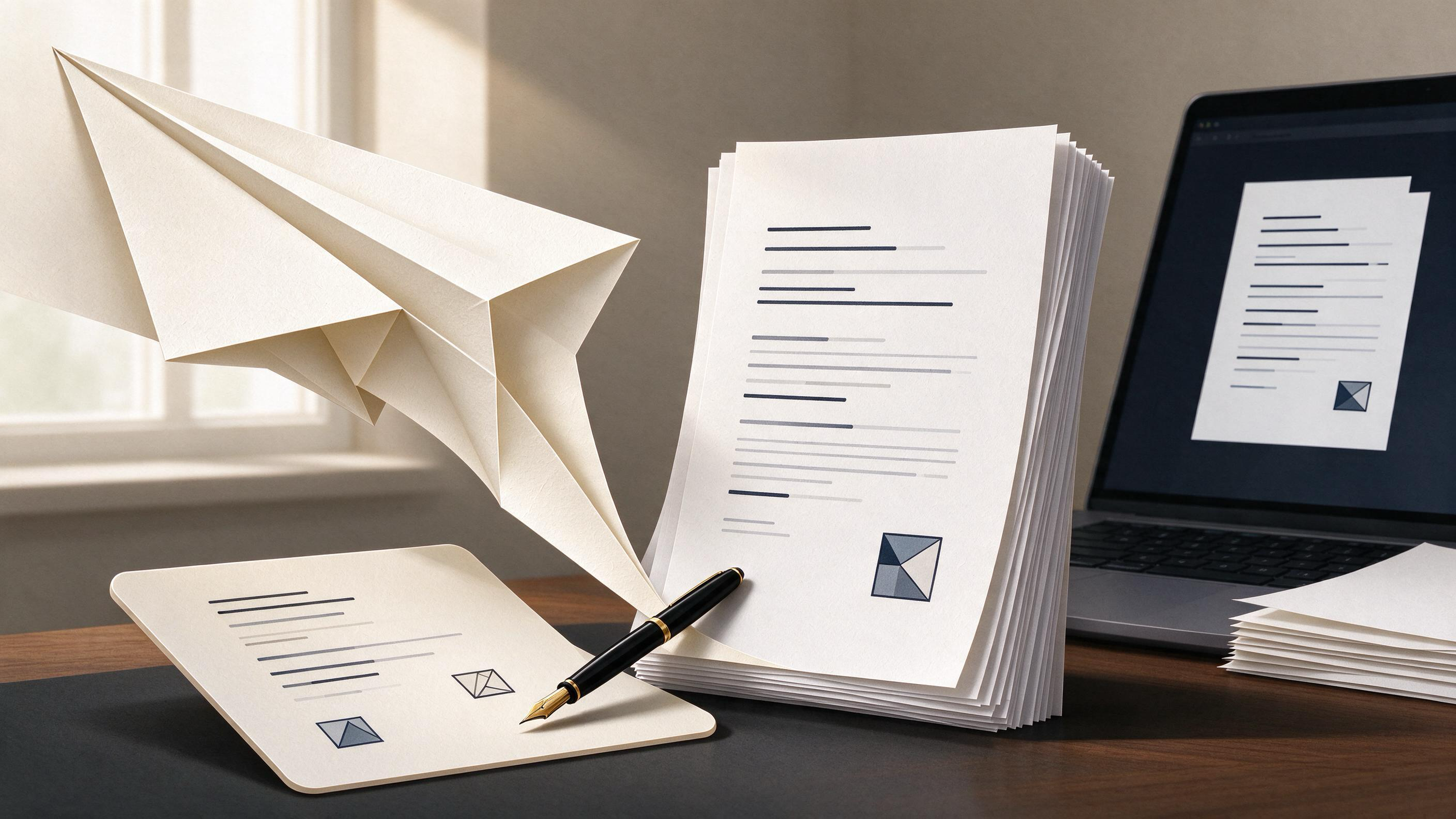
When a course paper becomes a journal manuscript, two short documents suddenly appear on the checklist: the cover letter and the manuscript highlights. They are not interchangeable, and treating them as if they were is one of the most common first-submission mistakes. The cover letter is addressed to an editor and explains why the manuscript belongs in a specific journal. Manuscript highlights are a very short reader-facing digest of the core findings, usually shown next to the published article. You need both, but you write them for different people, at different moments, with different criteria for done.
This guide walks through each document from the first messy draft to the version you can actually send. It uses a thesis-chapter-to-manuscript workflow as the running example, with a January project-start companion task. By the end you will have a decision table for choosing what to write first, a combined workflow, and a concrete next action you can complete this week. If you are managing this alongside a broader research pipeline, WisPaper's research workspace can hold the papers, references, and screening tasks as you move toward submission.
Where Are You Starting From?
Most readers arrive with one of three states.
State A: the manuscript is already polished. You have a final chapter or paper, the analysis is complete, and you are picking a target journal. You need the cover letter and highlights to be submission artifacts, not research prompts.
State B: the manuscript exists but the contribution is fuzzy. You have results, but the abstract says what you did rather than what a reader should take away. Highlights feel impossible because the takeaway is not yet crisp.
State C: the manuscript is not finished. You have supervisor feedback, a semester of scattered notes, or a winter-break cleanup pile. You are being asked for submission materials before the manuscript itself is ready.
Each state changes the order of work. State A writers should draft the cover letter first, because it forces a journal-specific argument. State B writers should draft highlights first, because the three-to-five bullet format exposes the missing takeaway. State C writers should not draft either document yet. They should rebuild the manuscript backbone and the reference set first.
What Does Each Document Actually Do?
The Cover Letter
The cover letter answers three editor questions in order: Why this journal? What is the contribution? Why is the manuscript in scope for the audience? The International Committee of Medical Journal Editors guidance for preparing a manuscript emphasizes that submission materials should follow the selected journal's current instructions for article type, format, required statements, and any extra files the journal asks for. The cover letter sits inside that submission package and must obey the journal's rules, such as whether to name suggested reviewers or state prior publication status.
A strong cover letter is one page at most. Its structure is stable: a sentence stating the submission; a paragraph on the gap and contribution; a paragraph on journal fit; a compliance paragraph covering statements the journal requires; and a short sign-off.
Manuscript Highlights
Manuscript highlights serve a different reader: the person skimming the article list. They usually appear as three to five bullets of no more than 85 characters each. They must restate the findings, not the methods. The test is whether a reader scanning only the highlights can identify the result and the new claim.
Highlights fail when they describe effort. "We analyzed 40 interview transcripts" is effort. "First-year students used supervisor feedback as a gatekeeping signal rather than a revision cue" is a finding. The discipline does not matter: a biomedical paper, a psychology manuscript, and a qualitative education study all need the same finding-first discipline.
What Counts as a Good Finding Statement?
Both documents collapse if the finding statement is vague. Before drafting either, write one sentence using this scaffold: "This study shows that [specific population] [specific outcome] [specific direction or pattern], which changes how [relevant group] should [act or interpret]."
Run that sentence against the manuscript's reporting checklist. The EQUATOR Network database organizes reporting guidelines by study type and specialty, so you can select the checklist that matches the design you are actually reporting. The American Psychological Association's Journal Article Reporting Standards similarly provide design-specific modules for quantitative, qualitative, and mixed-methods work so readers can evaluate how the study was conducted and analyzed. The point of checking is not compliance theater. It is to confirm that the finding sentence you want to put in the highlights is the same finding the manuscript's methods and results sections are capable of supporting.
If the finding sentence requires a caveat that the manuscript cannot yet demonstrate, the highlights are premature. Fix the manuscript or narrow the claim.
Thesis Chapter to Journal Manuscript: What Changes Before You Draft Submission Materials
A thesis chapter and a journal manuscript inhabit different ecosystems. A chapter earns a grade; a manuscript competes for an editor's attention against the journal's scope note. The January reset is a useful moment to convert one into the other because the semester's reading list is still fresh.
Start by rebuilding the reference backbone. Open the chapter and list every claim that carries a citation. For each one, confirm the source exists, supports the specific claim, and is cited to the exact work. A fast way to do this screening is to run the chapter's BibTeX through a tool that checks entries against real academic databases and flags references that do not resolve. One workflow is to open TrueCite with the chapter's BibTeX file and inspect each flagged entry against the library record before the manuscript ever reaches a reviewer.
At the same time, store the sources you actually used in one place. Upload the final PDFs and the cleaned BibTeX into My Library so the submission reference list and the working reference list are the same object. This prevents the classic winter-break failure where a highlighted PDF lives in three folders and the submitted citation list reflects an earlier draft.
The second change is argument compression. A chapter has space to show every analytical move. A manuscript needs one visible spine. Cut all material that supports your process but not the single finding sentence. Supervisor feedback is the best diagnostic here: if your supervisor repeatedly asked "what is the point of this section?", that section is a candidate for deletion, not rewriting.
Which Should You Draft First?
There is no universal order, but there is a better order for each starting state.
Draft the cover letter first when:
- The journal is already selected.
- The contribution is crisp and supported.
- The blocker is persuading an editor, not knowing the result.
Draft the highlights first when:
- The contribution still depends on adjectives like "important" or "novel."
- You cannot state the finding in one sentence.
- Your abstract leads with method instead of result.
Draft neither first when:
- The manuscript sections do not yet map to the target journal's required reporting structure.
- The reference list contains unflagged or unresolved sources.
- The results section describes tables but does not state what they mean.
Here is the decision table in compressed form:
| Your state | Draft order | First artifact |
|---|---|---|
| Journal chosen, contribution clear | Cover letter, then highlights | One-page letter with journal-fit paragraph |
| Contribution fuzzy | Highlights, then cover letter | Three finding bullets in <85 characters each |
| Manuscript or references unstable | Fix manuscript first | Cleaned BibTeX and finding sentence |
| Deadline this week, everything else done | Cover letter and highlights in parallel | Both v1s, then a single revision pass |
Drafting the Cover Letter from a Thesis Chapter
Use the journal's aims and scope page as your outline. Pull three phrases the journal uses to describe its audience. Each phrase becomes evidence for the fit paragraph. Do not quote the journal's marketing language back at it; instead, show that your population, question, or data type matches the phrases.
The gap paragraph should move from field-level statement to specific gap to your specific answer. Keep the gap narrow enough to be credible. "Little is known about X" is not a gap a working editor will accept from an early-career author. Better: "Prior work on supervisor feedback has examined written comments in isolation, but not how students act on comments across multiple revision cycles." The claim matches the study you can show.
The compliance paragraph is where ICMJE-style instructions earn their place. Before writing this paragraph, open the target journal's submission page and list every required statement: funding, conflict of interest, data availability, ethics approval, author contributions. Each item becomes one sentence in the cover letter. Missing one is a delay; covering all of them signals submission readiness.
If you are adapting work from a recent course or research effort, you may find it useful to gather the supporting papers in one search workspace before you lock the journal-fit argument, so you can confirm which prior work the editor would reasonably expect you to cite.
Drafting Highlights You Can Defend
Build highlights backward from the results section. For every result paragraph, ask what a reader must remember. Write one candidate bullet per result, then keep only the bullet that survives the finding-sentence test.
Three constraints control quality. First, length: if your bullet is 120 characters, it is a sentence that escaped from the abstract, not a highlight. Cut the qualifier before the claim. Second, parallelism: all bullets should be findings or all should be implication-pairs, never a mixture. Third, defensibility: a bullet must be directly supported by a result in the manuscript. If a reviewer could read the highlight and then not find its evidence, the highlight will appear to overclaim.
Test the draft by asking someone unfamiliar with the project to read only the highlights and then state what you found. If they describe methods or mood instead of findings, rewrite.
The Combined Workflow
The two documents share one source of truth: the finding sentence. Here is the combined workflow for a thesis or first manuscript:
- Reconstruct the backbone. Convert the chapter to manuscript sections, clean the reference set, and store it in one library. Start this in My Library so the submission files and working files never diverge.
- Write the finding sentence. Run it through the reporting checklist for your design.
- Draft highlights first. Three defensible bullets, under 85 characters, findings only.
- Draft the cover letter. Journal-specific fit, narrow gap, complete compliance list.
- Cross-check both against the abstract. The highlights are the abstract's bones; the cover letter is the abstract's argument for a specific venue. If these three tell different stories, the manuscript will too.
- Run the reference check. Before submitting either document, screen the BibTeX that the manuscript and any cited materials depend on. A citation screen through TrueCite belongs here, immediately before you upload the package.
- Do a fresh-eyes read. Read the cover letter as the editor, not the author. Read the highlights as a skimming reader, not the analyst.
The completion test is simple: both documents could be submitted tomorrow without a change to the manuscript, and a reader of only the highlights plus the cover letter could describe your contribution accurately. If you want to keep the whole submission effort inside one project view, you can create or open a research project and attach the manuscript files, the cleaned bibliography, and the draft submission documents.
What Failure Looks Like
Each document has characteristic failure modes.
Cover letter failures: describing your own effort instead of the contribution; praising the journal; restating the abstract; omitting a required statement; writing three pages as if length signals seriousness.
Highlights failures: methods bullets; whelming adjectives; bullets that do not match results; qualifiers so heavy the claim disappears; presenting a literature summary as if it were a finding of your own.
The common root is drafting before the finding sentence exists. If either document is painful to write, the document is not the problem. The unstated contribution is.
Your Next Action This Week
Choose the branch that matches your real situation, not the one you wish you had.
- Manuscript polished, journal chosen: draft the one-page cover letter now. Then reduce the abstract to three finding bullets under 85 characters. You should finish both by Friday.
- Contribution fuzzy: do not touch the cover letter. Draft five candidate highlight bullets today, keep three, and measure them against your results. The ones that fail show you which section to revise.
- Manuscript not ready: spend this week rebuilding the reference backbone and finding sentence. Upload your sources to My Library, screen the BibTeX, and write the one-sentence finding claim before opening either submission document.
For a January project start, sequence the same task over two weeks: week one is finding sentence and cleaned references; week two is highlights then cover letter against your target journal's instructions.
FAQs
Keep Reading

Data Availability Statement vs. Data Management Plan: Which Document Does Your Paper Actually Need?
If you are finishing a thesis chapter or preparing a first manuscript, you have probably seen two similar-sounding requirements: a **data availability statement** and a **data management plan**. They are not the same doc
Descriptive Title vs. Question Title for a Research Paper: A Decision Framework for Evidence-Focused Teams
You are drafting a focused evidence brief for a clinician group, and the title decision is no longer cosmetic. It determines which reviewers open the paper, which search queries surface it, and whether a busy reader can
Effect Size vs. P Value in Research Reporting: What a Reviewer Actually Looks For
A p value answers one narrow question: how surprising is this result if the null hypothesis were true? An effect size answers a different and often more useful question: how large or meaningful is the observed difference