
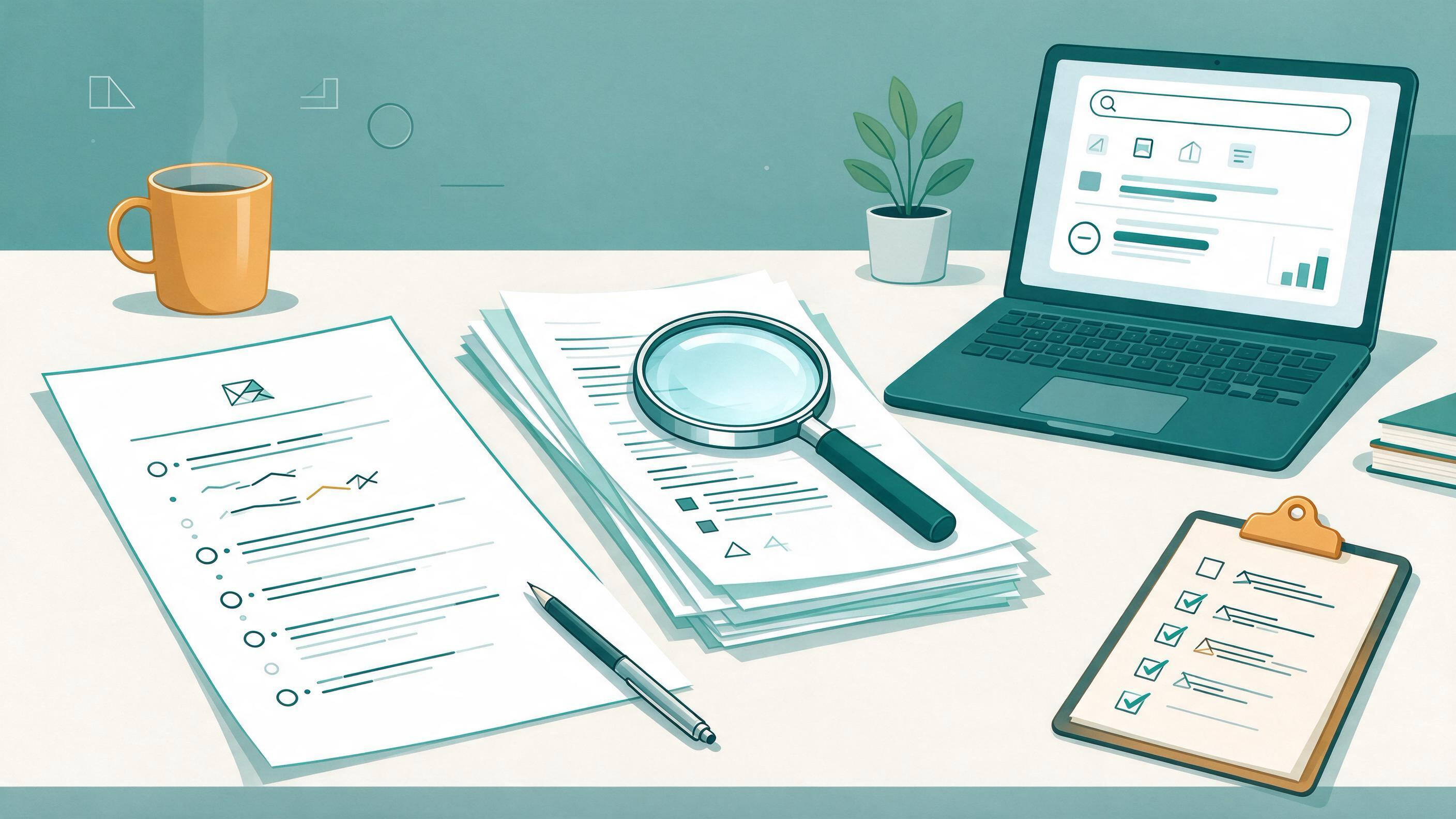
An AI-drafted background section is a starting point, not a finished chapter. Auditing it means checking three things in order: that every claim traces to a real source you have actually read, that the selection of sources follows a defensible logic rather than whatever the model happened to surface, and that the prose reports prior knowledge, gaps, and methods with the transparency that rigorous research practice expects. If you can pass those three checks, you can keep the section. If you cannot, you revise or cut.
This guide gives you a complete audit sequence with checkpoints, a worked example set in a January project start, a reusable checklist, and clear rules for when to stop and escalate to a supervisor.
Diagnose your starting state first
Before you touch the text, work out which of these describes your draft. The audit path differs for each.
- Raw generation. You pasted a prompt and kept the output largely intact. Expect citation problems and vague synthesis. Budget the most time here.
- Lightly edited generation. You reworded sentences and added a few references you already knew. The risk is that the added references sit beside claims they do not actually support.
- Structured draft. You gave the model a reading list or your own notes and it organized them. The main job is verifying that each organized claim matches its source.
- Inherited draft. A co-author or earlier version produced it. You need to reconstruct the source trail before you can trust any of it.
Write one sentence naming your state and the deadline you are working toward. That sentence sets your scope.
Set the audit's scope and evidence standard
Decide what the background section must accomplish before you judge the prose. A course paper background may only need to establish the problem and two or three key prior approaches. A thesis chapter or first manuscript background usually needs to map prior knowledge, identify the gap your work addresses, and justify your methods against what has been done.
NIH guidance on scientific rigor treats careful assessment of prior knowledge, strengths, weaknesses, knowledge gaps, transparent methods, validation, and reproducibility as core parts of rigorous practice. Use that as your evidence standard: the section should show what is known, where the weaknesses and gaps are, and how your approach follows.
Set two thresholds now:
- Claim threshold. Every factual sentence must be traceable to a source you have opened and can describe.
- Coverage threshold. The section must represent the main lines of prior work relevant to your question, not a single convenient strand.
Build a source trail before you edit a single sentence
Do not edit prose while checking citations. Separate the two jobs.
- Export the draft to a working copy.
- Number every factual sentence.
- For each numbered sentence, record the source the draft implies, or mark it "unsourced."
- Open each implied source and write one line on what it actually claims.
This produces a source-trail table you will use for the rest of the audit. If the draft came with a BibTeX file, screen it before you trust the entries. TrueCite checks BibTeX against real academic databases to flag hallucinated references, which is the fastest way to catch fabricated entries in a generated bibliography.
Checkpoint 1: You have a numbered sentence list and a source-trail table. Every sentence is either sourced or flagged. Do not proceed until this exists.
Verify each claim against its source
Now work sentence by sentence. For each one, ask:
- Does the cited source actually make this claim?
- Is the claim narrower than, equal to, or broader than what the source supports?
- Is the source primary, or is it a review citing someone else?
- Is the claim current enough for your field?
Mark each sentence keep, narrow, replace source, or cut. Most AI-drafted backgrounds fail on breadth: the model states a general conclusion where the source supports only a specific finding. Narrowing is usually the fix.
Where a sentence has no source, you have two options: find a source that supports it, or delete it. Do not leave unsourced factual claims in a background section.
Checkpoint 2: Every surviving sentence has a verified source and a keep/narrow decision recorded.
Rebuild the search logic, not just the citations
A background section can have correct citations and still be badly selected. The sources may cluster around one lab, one method, or one recent year. This is where you rebuild the selection logic.
Cochrane guidance on searching for studies recommends planning searches from explicit eligibility criteria, using multiple sources, combining free-text terms with subject headings, documenting the process, deduplicating records, screening in stages, and rerunning searches before publication. You are not conducting a systematic review, but the same discipline applies at a smaller scale: define what counts as relevant prior work, search more than one place, and record what you did.
Use WisPaper search to run structured scholarly searches for the themes your background section covers, and save the papers you decide to rely on into My Library so your source trail and your reading list stay in one place. If your background section is part of a larger project with multiple chapters, keep the work organized in Research Projects.
Checkpoint 3: You can state, in two or three sentences, how you selected the literature and why the selection is balanced.
Check the gap statement and the method justification
The gap statement is the most consequential sentence in most background sections, and the most common place for an AI draft to overreach. Test it directly:
- Is the gap stated as an absence of evidence, or as an absence of attention? These are different claims.
- Can you name the specific studies that leave the gap open?
- Does your own method follow logically from the gap, or is the connection asserted?
If the gap statement cannot survive these questions, rewrite it around what your sources actually show. A narrower, defensible gap is stronger than a sweeping one you cannot support.
Run a transparency and reporting pass
Rigorous practice includes transparent methods and reproducibility. In a background section, that means the reader can see how you arrived at your synthesis. Check that:
- Search terms or selection criteria are described, even briefly.
- Multiple reports of the same study are linked rather than counted as separate evidence.
- Any claims about the state of the field are attributed rather than asserted.
If your project is heading toward a systematic review, PRISMA 2020 provides a reporting checklist, expanded explanations, an abstract checklist, and flow-diagram templates for original and updated reviews, including transparent reporting of search, selection, and synthesis methods. Align your background section's reporting with that structure early so you do not have to rebuild it later.
Worked example: a January project start
A master's student begins a January project start with a background chapter drafted over winter break. The draft is 1,400 words, has 31 factual sentences, and a BibTeX file with 22 entries.
Step 1 — Diagnose. The student labels the draft "lightly edited generation": two paragraphs were rewritten, the rest kept.
Step 2 — Scope. The chapter must establish prior knowledge on the topic, identify a gap, and justify the chosen method. Claim threshold: every factual sentence sourced. Coverage threshold: at least the main methodological lines represented.
Step 3 — Source trail. TrueCite flags four BibTeX entries that do not resolve to real records. The student removes them and marks the six sentences that depended on them as unsourced.
Step 4 — Claim verification. Of the 31 sentences, 14 are kept, 9 are narrowed, 2 get replacement sources, and 6 are cut. The narrowed sentences are mostly cases where the draft generalized a single-study finding.
Step 5 — Search logic. The student runs fresh searches on the two main methodological lines, saves results to My Library, and finds three relevant papers the draft had missed. Two are added to the background; one is judged out of scope and recorded as excluded.
Step 6 — Gap statement. The original gap claimed the topic was "largely unstudied." The sources do not support that. The student rewrites it as a specific absence of evidence on one comparison, naming the studies that leave it open.
Step 7 — Transparency pass. A short selection note is added describing the search terms and inclusion logic.
Checkpoint 4: The revised section passes all four checkpoints, and the student can defend every sentence in a supervisor meeting.
Reusable audit checklist
| Stage | Artifact | Pass condition | Stop rule |
|---|---|---|---|
| Diagnose | One-sentence state note | State and deadline named | Stop if you cannot name the draft's origin |
| Scope | Written claim and coverage thresholds | Both thresholds stated | Stop if the section's purpose is undefined |
| Source trail | Numbered sentences + source table | Every sentence sourced or flagged | Stop if more than a third are unsourced |
| Citation screening | Screened BibTeX | No fabricated entries remain | Stop if entries cannot be resolved |
| Claim verification | Keep/narrow/replace/cut marks | Every surviving sentence verified | Stop if key claims have no source |
| Search logic | Selection note | Selection can be described in 2–3 sentences | Stop if all sources come from one strand |
| Gap statement | Rewritten gap | Gap names specific open studies | Stop if the gap is an absence-of-attention claim you cannot support |
| Transparency | Reporting note | Selection criteria visible to the reader | Stop if the reader cannot see how sources were chosen |
Know when the section is ready
The section is ready to keep when all of the following are true:
- Every factual sentence traces to a source you have opened.
- The bibliography contains no entries you cannot resolve.
- The selection of sources reflects the main lines of relevant prior work, and you can describe how you chose them.
- The gap statement names specific studies that leave the gap open.
- A reader can see how you arrived at your synthesis.
If any of these fail, the section is not ready, regardless of how polished the prose reads.
Stop and escalation rules
Escalate to your supervisor or advisor when:
- More than a third of factual sentences are unsourced after your first pass.
- The gap statement depends on a claim you cannot support from any source.
- The draft's selection of literature conflicts with the reading list your supervisor gave you.
- You cannot resolve a citation and the claim it supports is central to the chapter.
Stop working on the prose entirely when the source trail is incomplete. Editing sentences before the trail exists wastes effort, because you will rewrite them again once the sources are checked.
Your next concrete action
Open your draft, number every factual sentence, and build the source-trail table. That single artifact drives every later checkpoint. If your draft came with a BibTeX file, screen it first with TrueCite, then run fresh searches in WisPaper search and save what you keep to My Library. If you are starting a new project rather than revising an old one, set it up in Research Projects so the audit trail carries into your next chapter.
FAQs
Keep Reading

How to Build a January Reading Plan for a New Research Project
A January reading plan is a short, dated schedule that turns a vague new project into a defined reading scope, a documented search, a screened set of papers, and a first synthesis you can show a supervisor or advisor by
How to Build a Literature Review Outline That Follows an Argument
A literature review outline that follows an argument is not a list of papers grouped by theme. It is a claim-by-claim structure in which every section exists to advance a position, and every cited study has a defined job
How to Build a Reading Queue That Matches Your Next Decision
A reading queue is not a reading list. A reading list is a pile of things you intend to read. A reading queue is ordered, bounded, and tied to a decision you actually have to make — a client deck, a decision memo, a team