
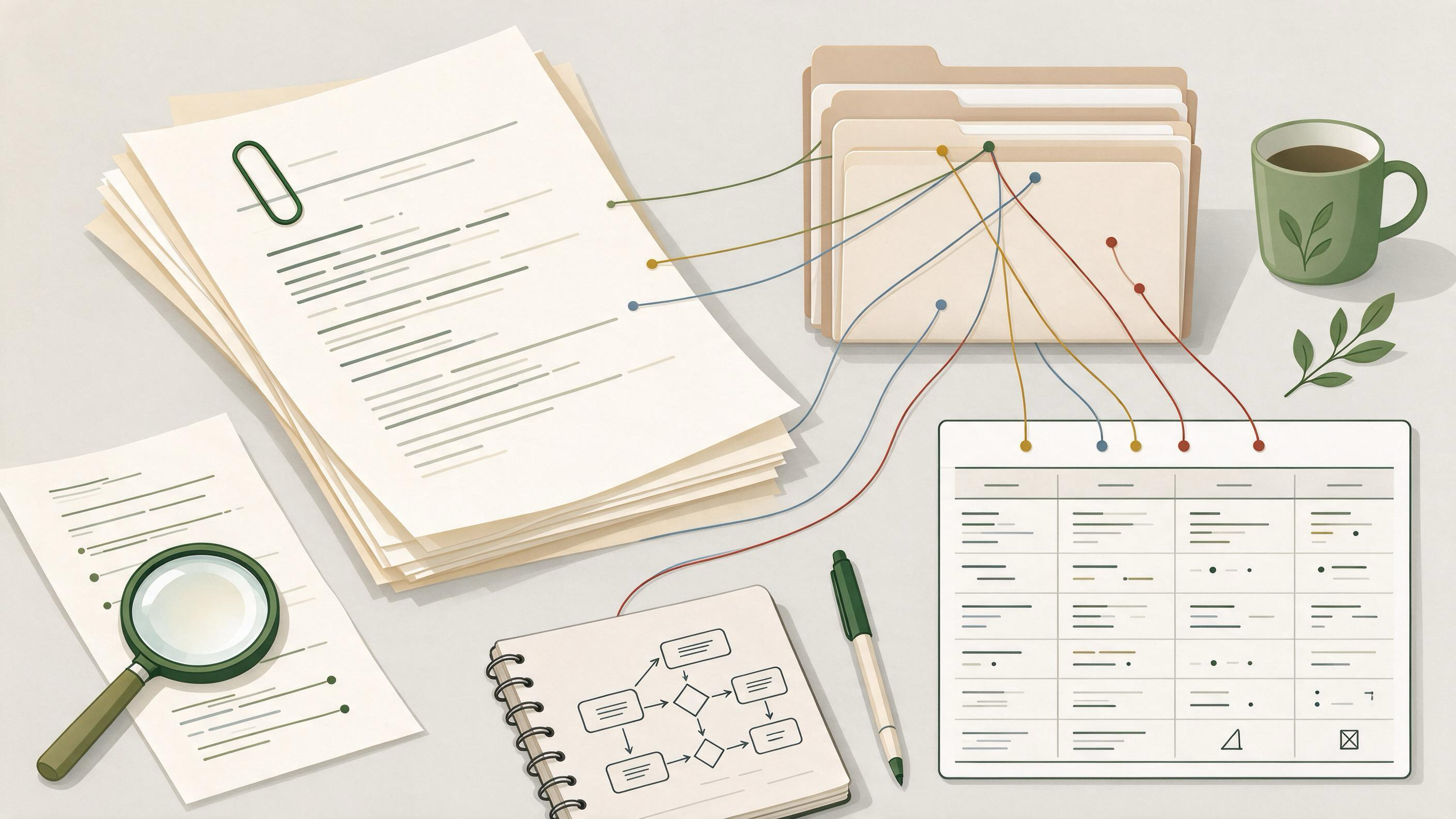
An evidence pack is the working dossier behind a manuscript's claims: the eligibility rules you set, the searches you ran, the records you screened, the studies you linked, the synthesis you built, and the limitations you can defend. Preparing one is less about collecting PDFs and more about making every decision traceable, so a co-author, reviewer, or editor can follow the same path you did.
This guide is written for clinicians and medical researchers assembling a focused evidence brief, a research update, or a team discussion document ahead of submission. It uses a single running example — a focused question about a defined population and outcome — and shows the artifacts, checkpoints, and completion criteria that tell you the pack is ready. It does not offer individual treatment advice; the goal is a defensible evidence process, not a clinical recommendation.
What does an evidence pack need to contain?
Start by separating the pack into two layers. The decision layer records what you chose and why: the question, eligibility criteria, sources searched, screening rules, and how you handled multiple reports of the same study. The artifact layer holds the outputs those decisions produced: search strings, deduplicated record sets, screening logs, a study-linking table, a synthesis table, and a limitations note.
Cochrane's search guidance anchors the decision layer: plan searches from your eligibility criteria, use multiple sources, combine free-text terms with subject headings, document the process, deduplicate records, screen in stages, link multiple reports of one study, and rerun searches before publication. PRISMA 2020 supplies the reporting spine — a checklist, expanded explanations, an abstract checklist, and flow-diagram templates — so the pack's search, selection, and synthesis steps can be reported transparently. NIH rigor and reproducibility guidance reinforces the same instinct: assess prior knowledge and knowledge gaps, state methods transparently, and treat validation and reproducibility as part of the work.
A useful mental model: if a step changed what entered your synthesis, it belongs in the pack.
How do you turn a broad topic into a focused, answerable question?
A broad topic produces an unmanageable pack. Narrow it until the population, exposure or intervention, comparator, and outcome are each specific enough that two reviewers would agree on whether a study qualifies.
For the running example, take a focused question about a defined adult inpatient population and a single named clinical outcome measured at a stated time point. Write it as one sentence, then list the eligibility criteria that follow directly from it. Every criterion should be traceable to a phrase in the question; if a criterion has no anchor, either the question or the criterion needs revision.
This is the first checkpoint. Before searching, confirm that:
- The question names a population, an exposure or intervention, a comparator where relevant, and an outcome.
- Each eligibility criterion maps to part of the question.
- Inclusion and exclusion rules are written so a second reviewer could apply them without asking you.
If you are still exploring how the question fits the wider literature, a structured idea-generation step can help you pressure-test scope before you commit. WisPaper's Idea Discovery workflow takes research topics, background, references, and experimental constraints as inputs — useful when you need to sharpen a question rather than start searching prematurely.
How should you plan and document the search?
Build the search from the eligibility criteria, not from whatever terms come to mind. Cochrane's guidance is explicit: derive terms from criteria, draw on multiple sources, and combine free-text terms with subject headings. Record the exact strings, the sources, the dates run, and any limits applied.
A practical sequence:
- Draft free-text terms for each concept in the question.
- Add subject headings for the same concepts.
- Combine concepts with Boolean operators and test the string against a few known-relevant papers.
- Run the string across multiple sources and log each run with its date.
- Save the strings in the pack so the search can be rerun.
Use a scholarly search interface to execute and refine these strings. WisPaper's scholarly search is the place to find academic papers through its search interface; if you prefer a public entry point first, the Scholar Search page explains and opens that route. Keep the exported strings and result counts in the pack regardless of which interface you use.
Checkpoint two: the search log shows strings, sources, dates, and limits, and a colleague could rerun any line and get a comparable set.
How do you screen records and link reports of the same study?
Screening happens in stages. Cochrane recommends deduplicating records first, then screening in stages — typically title and abstract before full text. Log how many records entered each stage and how many were excluded, with a short reason for each exclusion at full text.
Linking is the step teams most often skip. A single study may appear as multiple reports: a protocol, a primary analysis, a follow-up, and a subgroup paper. Cochrane's guidance to link multiple reports of one study means your unit of synthesis is the study, not the PDF. Build a linking table with one row per study and columns for each linked report.
As records accumulate, keep them organized rather than scattered across folders. WisPaper's My Library lets you save or upload papers and organize them in one library — a natural home for the included set once screening settles. When you need to interrogate that included set, Library QA lets you ask questions based on papers uploaded to My Library or added from search results, which helps when you are checking what a group of included papers actually reports.
Checkpoint three: every included study has a linking row, every excluded full-text record has a reason, and the stage counts reconcile from raw records to included studies.
How do you judge evidence level, applicability, and indirectness?
These are four distinct judgments, and collapsing them is a common source of overclaiming.
- Evidence level describes the design and rigor of the study itself — what kind of question that design can bear on.
- Applicability asks whether the study's population, setting, and delivery context resemble the population in your question.
- Indirectness asks whether the comparison, outcome, or timing in the study matches the outcome and time point you specified.
- Limitations are the study's own weaknesses — the things that constrain how far its result can be pushed.
Record each as a separate column in your synthesis table. A study can be high-level evidence and still be indirect for your question if its outcome is measured at a different time point. Keeping the columns separate forces you to name which judgment is doing the work.
This is also where a careful prior-knowledge assessment pays off. NIH guidance frames assessment of prior knowledge, strengths, weaknesses, and knowledge gaps as core to rigor — so the pack should state what was already known, what gap the manuscript addresses, and how the included evidence bears on that gap.
What belongs in the synthesis table?
A synthesis table is the pack's center of gravity. One row per study, with columns that mirror your judgments:
| Column | What it records |
|---|---|
| Study ID | Stable identifier linking to the reports table |
| Design | Study design as reported |
| Population and setting | Who was studied and where |
| Exposure/intervention and comparator | What was compared |
| Outcome and time point | The outcome measured and when |
| Evidence level | Design-based judgment |
| Applicability | Fit to your population and setting |
| Indirectness | Fit of comparison, outcome, and timing |
| Limitations | Study-specific weaknesses |
| Direction of finding | What the study reported, stated narrowly |
Fill the table from the linked reports, not from abstracts alone. Where a report is ambiguous, mark it and return to the full text rather than guessing.
How do you keep citations and references clean?
Reference errors undermine an otherwise solid pack. Before submission, screen the bibliography itself. WisPaper's TrueCite checks BibTeX against real academic databases to flag hallucinated references — a concrete step to run once the reference list is assembled, so flagged entries can be corrected before the manuscript goes out.
Pair that with a manual pass: confirm each citation in the text points to the intended report, and each linked report appears in the reference list exactly once.
How do you keep a multi-person pack coherent?
Evidence packs grow across weeks and across people. The failure mode is drift: two reviewers applying slightly different criteria, or a search rerun without updating the log.
Give the pack a home where the question, the search log, the screening decisions, and the synthesis table live together. WisPaper's Research Projects area is where you can create a new project to hold that work. For longer literature-review tasks that span the whole pack, the Scholar Agent area supports literature review, inspiration, and reproduction use cases — useful when the pack needs sustained synthesis rather than a single search.
Set a short rhythm: at each checkpoint, one person reconciles the stage counts and the linking table, and the group confirms the criteria have not quietly changed.
What does a finished evidence pack look like? A worked example
Return to the running example: a focused question about a defined adult inpatient population and one named outcome at a stated time point.
The finished pack contains:
- Question statement — one sentence naming population, exposure or intervention, comparator, and outcome with time point.
- Eligibility criteria — each mapped to a phrase in the question.
- Search log — strings combining free-text terms and subject headings, sources, dates, and limits, with a note that searches will be rerun before submission.
- Screening record — deduplicated counts, stage-by-stage exclusions, and full-text exclusion reasons.
- Study-linking table — one row per study, listing every linked report.
- Synthesis table — the columns above, with evidence level, applicability, indirectness, and limitations kept separate.
- Prior-knowledge and gap note — what was known, what gap remains, and how the included evidence addresses it.
- Reference check — BibTeX screened with TrueCite, plus a manual citation pass.
- Reporting map — where each PRISMA 2020 checklist item is addressed in the manuscript, with a flow diagram built from the screening counts.
Read the pack end to end as if you were a reviewer. If any claim in the manuscript cannot be traced to a row in the synthesis table, either the claim narrows or the table gains a row.
How do you know the pack is ready?
Use explicit completion criteria rather than a feeling of completeness. The pack is ready when all of the following hold:
- The question and every eligibility criterion are written and mutually consistent.
- The search log is complete enough to rerun, and a rerun is scheduled before submission.
- Stage counts reconcile from raw records to included studies, with reasons for full-text exclusions.
- Every included study has a linking row covering all its reports.
- The synthesis table records evidence level, applicability, indirectness, and limitations in separate columns.
- The prior-knowledge and gap note is written.
- References have been screened and manually cross-checked against in-text citations.
- Each PRISMA 2020 checklist item is mapped to a location in the manuscript, and the flow diagram matches the screening counts.
If any line fails, that line names your next action. A pack that meets these criteria gives co-authors a shared reference point and gives reviewers a path they can follow.
FAQs
Keep Reading

How to Record Why Studies Were Excluded from a Review
When you finish screening, the number that matters is not how many records you removed but whether you can explain each removal. A defensible exclusion record lets a reader retrace your decisions, lets a supervisor or re
How to Recover a Missing Source from Notes and Quotes
A quote sits in your notes with no author, no year, and no link. It may be in a client deck, a decision memo, or a handoff document, and someone will eventually ask where it came from. Recovering the source is a reconstr

How to Repair Citations After Reorganizing a Draft
Reorganizing a draft breaks citations in a specific, predictable way: the reference list usually survives intact, but the links between sentences and sources do not. When you move a paragraph, split a section, or merge t