
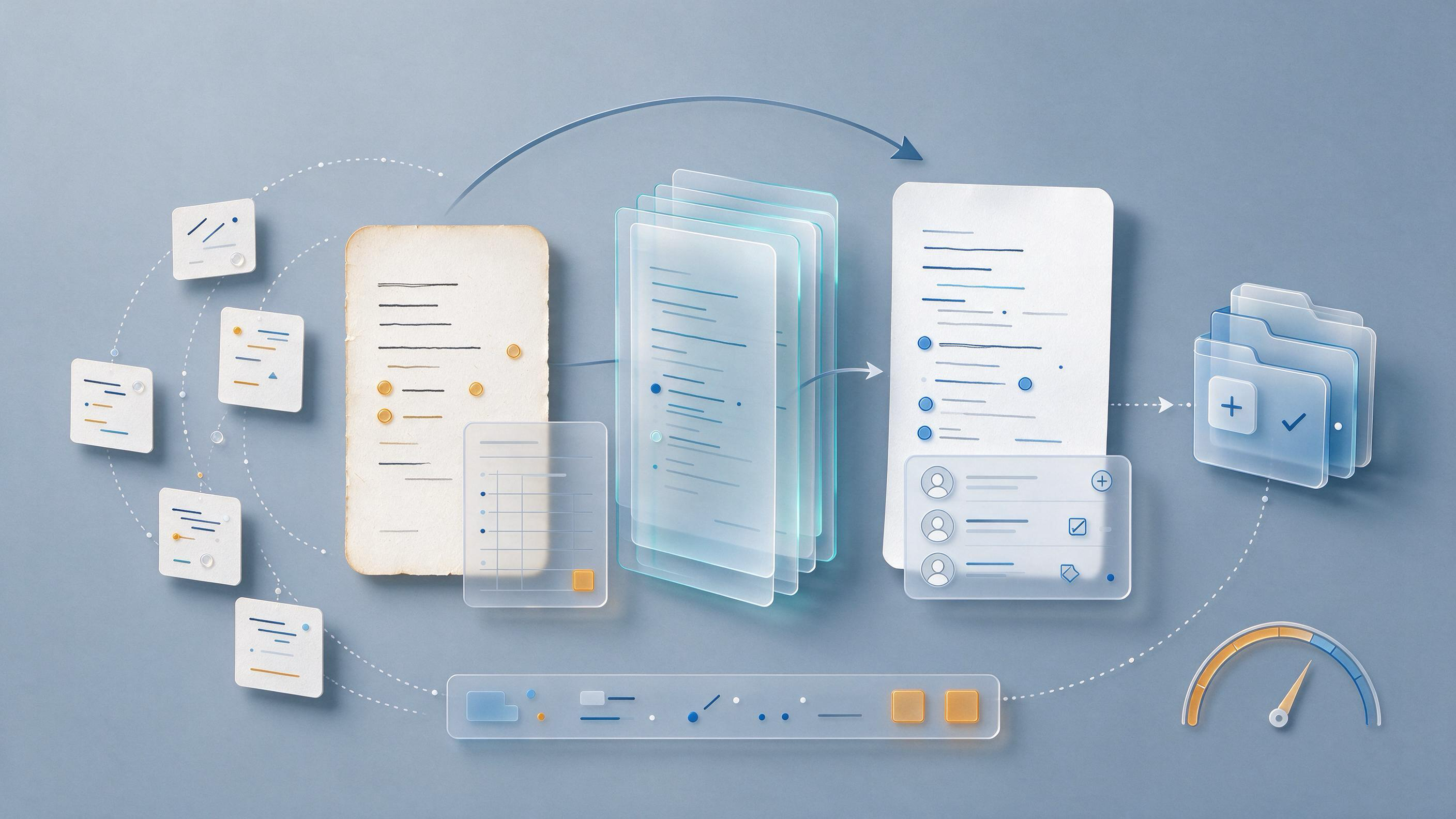
Enterprise research teams rarely lose a document. They lose the decision trail behind it. A client deck says one thing in version four and something else in version seven. A decision memo changes a recommendation without a visible debate. A team handoff swaps one methodology for another and leaves only a “minor fix” note in the version history. The actual question is usually not “what changed” but “why did it change, and can I still trust the conclusion?”
This article walks through a recoverable, evidence-first workflow for reconstructing the reason behind an old revision. It is written for research, analysis, and knowledge teams who need to produce traceable reports, presentations, handoffs, or reusable evidence bases rather than guesses. You will get a diagnostic sequence, a worked example around a client deck, a reusable recovery checklist, confidence-level artifacts, and explicit completion criteria so you know when the reconstruction is ready to ship.
What Kind of Revision Recovery Problem Are You Actually Facing?
Before searching for the reason, classify the revision. Most recovery failures happen because a team treats all old changes the same way when they are not. Use this quick diagnostic.
Scenario A: The change is visible, but the reason is missing. You can see the before and after in version history, but the note says only “update” or “feedback.” The surrounding conversation was verbal or in a tool that did not survive.
Scenario B: The change is visible and the reason exists somewhere, but it is fragmented. Comments live across slides, email threads, ticket fields, and source folders. No single artifact connects the revised claim to its origin.
Scenario C: The change is visible, but the reason was never documented at all. This is common in fast turnarounds. The revision itself is the only evidence.
Scenario D: You are not even sure which revision introduced the change. This is a provenance problem before it is a reasoning problem. You must locate the version boundary first.
The recovery strategy differs by scenario. Scenario A is usually a search and reconstruction task. Scenario B is a synthesis task. Scenario C is an inference task with explicit confidence limits. Scenario D is a version isolation task. A useful recovery workflow handles all four because most real cases mix them.
Why Old Revisions Lose Their Reasoning
Old revisions lose their reasoning for predictable reasons. Understanding these prevents you from overclaiming what the evidence can support.
One common cause is that the rationale was stored in a discussion layer, not in the document. The final artifact kept only the outcome. Another is that the reasoning was captured in a tool with no durable link to the version. A third is that the person who made the change simplified the message later, so the current wording obscures the original constraint. A fourth is that the revision was driven by an external condition, such as a client preference, a deadline, or a data limitation, that was never written into the file.
None of these causes means the reason is unknowable. They mean the reason is distributed. The recovery job is to consolidate scattered evidence into one traceable narrative and mark the parts you could not verify.
Where Does the Reliable Evidence Usually Sit?
Start with the version artifacts you still control. The most reliable evidence for an old revision is the one closest in time to the change itself.
The version immediately before and after the change. A side-by-side diff shows the exact scope of the edit. Small edits suggest a targeted fix; broad rewrites suggest a reframing.
The timestamp and author. These do not by themselves explain the reason, but they let you search for the right conversation. A change made right before a client call often has external context. A change made after a data refresh often has methodological context.
The internal comments or notes attached to that version. If they survive, treat them as evidence about what the author intended, but not as proof that the new claim is correct.
The underlying sources cited by both versions. When a revision changes a number, a scope statement, or a conclusion, compare which sources each version used. A source drop, source addition, or source substitution is often the visible fingerprint of the hidden reason.
For teams that already keep research sources in a shared place, the source comparison is faster when the relevant papers are saved or uploaded together. My Library can hold the papers behind each version so you can compare the evidence sets side by side rather than rebuilding them from memory. For larger research programs that need their own project boundary, Research Projects gives you a defined area for the collection around a specific revision.
How Do You Isolate the Revision When the History Is Messy?
Do not try to recover the reason from a long, merged version list. Isolate the smallest known revision pair first.
Create a working table with these columns: date, author, version label, changed section, before text, after text, and source set. Fill only what you can see. If the version history does not show a clean before and after, reconstruct the pair from exported files, slide archives, or the earliest available copy that differs from the current one.
When the change point is uncertain, work backward. Find the latest version where the text still matches the old claim. Then find the earliest version where the new claim appears. The revision boundary sits between them. The gap may contain multiple edits, so treat anything inside that gap as candidates rather than causes.
After you isolate the pair, ask three boundary questions: Which section changed exactly? Did the supporting sources change at the same time? Does the edit revise a claim, a caveat, a recommendation, or only wording? A wording-only change rarely requires deep recovery. A claim or recommendation change does.
How Do You Reconstruct the Likely Reason Without Guessing?
Once the revision pair is isolated, build the reason in layers. Each layer comes with a confidence tag so the final output does not pretend to know more than it does.
Layer 1: Documented reason. Look for an explicit note, comment, or follow-up message that states why the change was made. If you find one, record it and mark confidence as high, provided the note is contemporaneous with the edit.
Layer 2: Evidentiary reason. Compare the sources used before and after. If a source changed, a bibliography check can reveal whether the old source was real and whether the new one exists. For BibTeX-based reference lists, TrueCite checks entries against academic databases to flag references that do not correspond to a real indexed paper. That step helps you avoid building a recovery narrative on a phantom citation.
Layer 3: Contextual reason. Use timestamps, audience, and scope changes. A recommendation revised after a stakeholder meeting may reflect a constraint from that meeting. A methods change after a data refresh may reflect new input. Contextual reasons are plausible, not proven. Mark them medium confidence unless a written source confirms them.
Layer 4: Structural reason. Sometimes the revision exists because the document type changed, not because the facts changed. A memo converted into a slide may sacrifice nuance for space. A deck converted into a handoff may add caveats for the next owner. This is often the real reason behind otherwise mysterious edits.
A reason that appears in more than one layer is stronger. A reason that appears only in Layer 3 should be labeled as an inference and treated as a working hypothesis until corroborated.
What Does a Worked Recovery Look Like in Practice?
Here is a concrete case using a client deck. Your team is closing out a project and discovers that a July version of the recommendation slide said to prioritize Market A, while the September version prioritizes Market B. There is no note explaining the switch.
Step 1: Isolate the pair. The July deck is the last copy showing Market A. The September deck is the first available copy showing Market B. The change happened somewhere between those dates.
Step 2: Diff the recommendation slide. The metrics stayed the same, but the relative weight of two data points changed. The July version leaned on an early survey result. The September version leaned on a completed regional benchmark.
Step 3: Compare source sets. The July set contains an internal survey summary and an industry report. The September set drops the internal survey summary and adds a newer benchmark. The source substitution is the visible fingerprint.
Step 4: Search for a documented reason. The July file has a comment thread asking whether the survey sample was large enough. The September file contains a separate note saying the benchmark was finalized and the earlier sample would not support the Market A claim.
Step 5: Build the recovery statement with confidence. The documented notes and the source substitution point in the same direction. The recovery record reads: “Recommendation changed from Market A to Market B because the project team replaced an early survey-based comparison with a completed benchmark that was unavailable in July; the survey sample was treated as insufficient for the final recommendation. Confidence: high, based on two contemporaneous notes and a matching source change.”
If the notes had been missing, the same recovery would have been an inference: “The source substitution suggests the final recommendation followed the newer benchmark. Confidence: medium; no contemporaneous note survived.” The distinction matters in a handoff.
What Artifacts Should the Recovery Produce?
A recovery without an artifact is a conversation that will need to be repeated in six months. Produce a short, durable record that the next reader can audit.
The revision record. One paragraph per changed element: what the text was, what it became, when it changed, and the supported reason.
The evidence register. A list of sources consulted for the recovery, including the before-source and after-source when a source change occurred.
The confidence map. Assign each recovered reason a level: high when contemporaneous documentation exists, medium when the reason is inferred from source or structural changes, and low when only timing or context supports it.
The open-question list. Be explicit about what remains unresolved. An unresolved reason is not a failure; it is a known boundary in the provenance. Future work can fill it if needed.
For teams that already manage sources in one place, the evidence register is easier to maintain when the underlying papers are saved in a library rather than scattered across drives. My Library supports saving or uploading papers and organizing them for later use, so the register points at a stable set of sources. For longer recovery jobs that resemble a small literature reconstruction, Scholar Agent provides an agent area suited to extended research tasks in the literature-review, inspiration, or reproduction space.
How Do You Check Your Recovery Before It Ships?
A recovered reason is ready when it can answer three questions without leaning on the person who made the edit.
Can you trace the before and after? The exact wording or data before and after should be visible in the record. If it is not, the recovery is incomplete.
Can you state the reason in one sentence? A useful recovery ends in a claim like “the routing rule changed because the triggering condition was removed,” not “there was probably some discussion about routing.”
Can you separate evidence from inference? Every stated reason should carry a confidence level and a pointer to the evidence class behind it. High confidence means contemporaneous documentation. Medium means source or structural inference. Low means timing or context only.
For reference-heavy recoveries, add a source check before signing off. If the revision depends on a bibliography and the bibliography contains a suspect entry, the recovery narrative is built on unstable ground. TrueCite checks BibTeX against real academic databases to flag hallucinated references, which is a concrete pre-ship check when a citation change lies at the center of the old revision.
Reusable Revision Recovery Checklist
| Step | Action | Ready when |
|---|---|---|
| 1 | Classify the scenario | You can say whether the reason is missing, fragmented, undocumented, or tied to an unclear version |
| 2 | Isolate the revision pair | You have the latest reading of the old text and the earliest reading of the new text |
| 3 | Diff scope and wording | You can name the exact section, claim, number, or recommendation that changed |
| 4 | Compare before and after sources | You can see whether the supporting evidence changed at the same time |
| 5 | Search for documented reasons | You have checked comments, notes, and follow-up messages from the same period |
| 6 | Build the layered reason | You have separated documented, evidentiary, contextual, and structural explanations |
| 7 | Assign confidence | Each reason is marked high, medium, or low with the evidence class behind it |
| 8 | Produce the revision record | The change, source shift, and reason fit in one durable paragraph |
| 9 | Run the three-question readiness test | The before and after, one-sentence reason, and evidence-inference split are all explicit |
| 10 | List open questions | Any unresolved part is named rather than silently treated as known |
When Is the Recovery Complete Enough to Use in a Report or Handoff?
The recovery is ready when it changes the next decision without introducing new uncertainty. That means the revision record should give a reader enough to say: “I understand why this changed, and I can see which parts are verified.”
A client deck recovery is complete when the final handoff explains the recommendation shift without requiring the original team to interpret it. A decision memo recovery is complete when the closing note traces the change to its source and marks the confidence. A year-end reset is complete when old decisions can be reopened without someone redoing the archaeology from scratch.
Completion criteria should be explicit. Use this as the bar: every changed element in scope has a stated reason or a clearly labeled uncertainty; every stated reason carries a confidence level; every source substitution in the revision is recorded; and the open-question list is part of the deliverable, not an afterthought.
For teams that need to validate the source layer before finalizing, a dedicated citation check sits naturally at the end of the workflow. TrueCite screens BibTeX against real academic databases to flag hallucinated references, so a reference shift in an old revision can be confirmed or questioned before the recovery is presented as final.
FAQs
Keep Reading

How to Remove Causal Language from Observational Research
Your draft says the intervention *improved* outcomes, the exposure *reduced* risk, or the program *led to* behavioral change. Then your supervisor or reviewer writes in the margin: *"This is observational. You cannot cla

How to Report Effect Sizes and Confidence Intervals Clearly
Whether you are preparing a manuscript for submission, revising after peer review, or building a team-ready evidence brief, effect sizes and confidence intervals decide whether your result can be interpreted at all. A si

How to Resolve Every Comment in a Shared Manuscript
Opening a manuscript after a round of coauthor comments can feel like facing a dense, contested audit trail. Some notes are precise, some are questions, some mark disagreements that were never settled in the meeting. The