
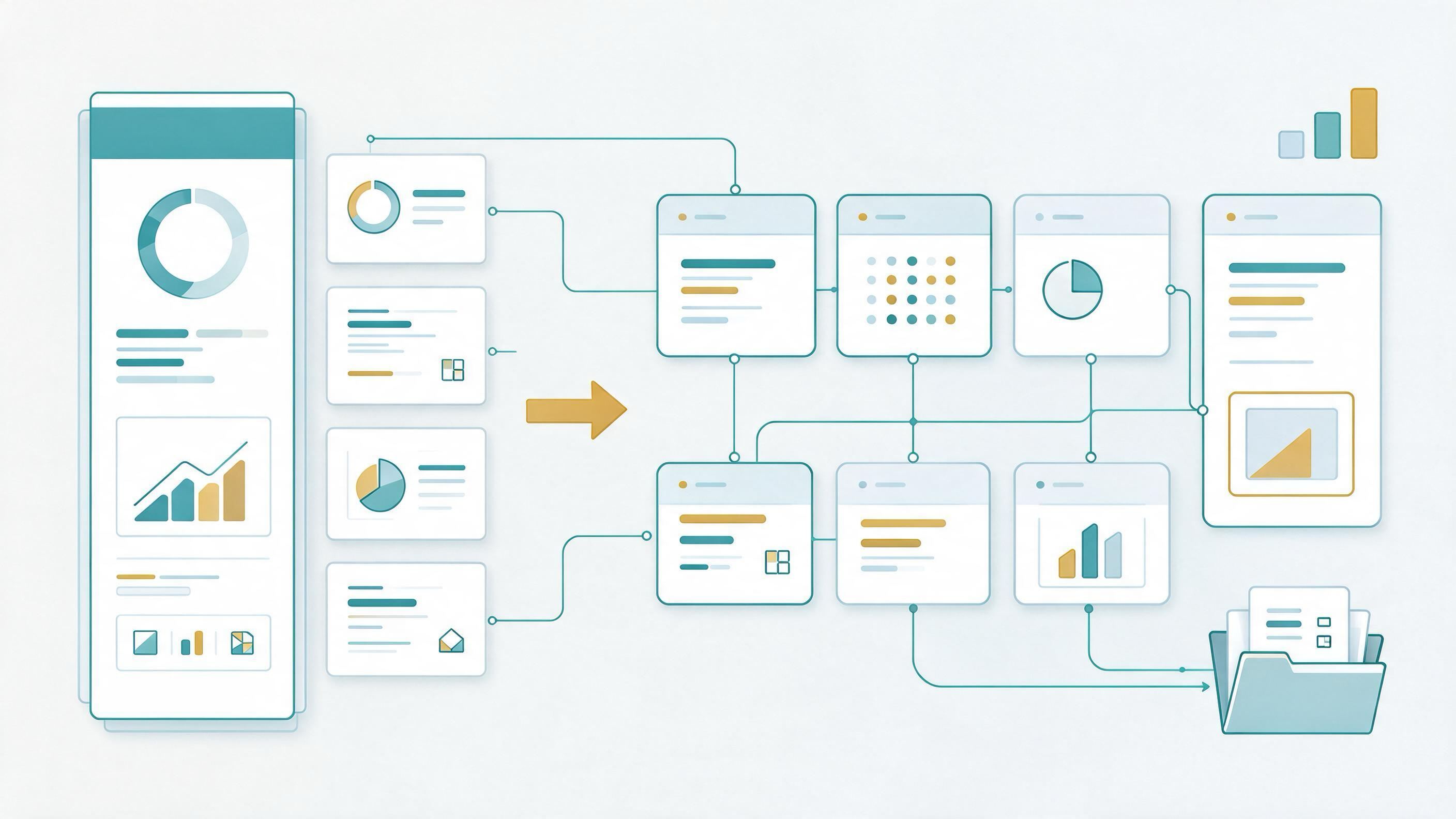
A finished project usually leaves behind a deck, a memo, and a folder of PDFs. What it rarely leaves behind is a knowledge base — a structured set of records that a different team can pick up, audit, and extend without re-reading everything or re-running the search. The gap is not effort; it is that the closing work of a project is usually framed as "deliver the artifact," not "convert the artifact into reusable evidence."
This guide treats that conversion as a deliberate closing phase. You will diagnose what state your project is actually in, decide what the knowledge base must contain, build it in a fixed sequence with checkpoints, and apply stop and escalation rules so you know when the result is ready to hand off. The running example is a client-facing research deck that must survive into next quarter's work.
Diagnose your starting state before you build anything
Most teams arrive at this task in one of three states. Naming yours prevents you from building the wrong layer first.
State 1 — Artifact only. You have a finished deck or memo. Sources exist somewhere, but the link between a specific claim and a specific source is held in someone's memory or in a comment thread. This is the most common state and the most expensive to leave alone.
State 2 — Artifact plus a source pile. You have the deliverable and a folder of papers, but no record of why each paper was included, what it supported, or how confident the team was in the claim drawn from it.
State 3 — Partial structure. You have some organization — a reference manager, a shared drive with naming conventions — but the structure was built for the project, not for reuse. Items may be duplicated across folders, and status is implicit.
A quick diagnostic: pick three load-bearing claims from your deck and try to trace each one to a source record and a stated confidence level in under two minutes. If you cannot, you are in State 1 or 2 regardless of how tidy the folder looks.
Decide what the knowledge base must answer
A reusable knowledge base is defined by the questions it can answer later, not by the volume it contains. Before building, write down the questions the next team will ask. For a client research deck, a realistic set is:
- Which claims in the deck are supported, and by which sources?
- How confident were we in each claim, and what would change that confidence?
- Which sources were considered and excluded, and why?
- What would we need to re-check before reusing this in a new context?
- Who owns each part of the evidence base now that the project is closed?
These questions map directly onto the artifacts you will build: a claim register, a source register with provenance, an exclusion log, a re-check list, and an ownership record. If a proposed artifact does not help answer one of these questions, it is optional.
Set the provenance and confidence conventions first
Two conventions do most of the work of making a knowledge base reusable, and both are cheap to set before you start and expensive to retrofit.
Provenance. Every source record should carry enough information to find the item again and to understand how it entered the project. At minimum: a stable identifier or citation, the search or channel it came from, the date it was captured, and the specific claims it supports. If your project involved a structured search, document the process the way systematic review guidance recommends — plan searches from eligibility criteria, use multiple sources, combine free-text terms with subject headings, document the process, deduplicate records, and screen in stages. The Cochrane Handbook's guidance on searching and selecting studies is a useful reference for what a documented search process looks like, and PRISMA 2020 provides reporting templates, including flow-diagram templates, that make search and selection transparent. You do not need to run a systematic review to borrow the discipline: the point is that a future reader can see how the evidence was found and why it was kept.
Confidence. Attach an explicit level to each claim, not to each source. A simple three-level scale works: High (multiple independent sources agree, or a single authoritative source directly states it), Medium (one credible source, or sources that agree but share a limitation), Low (inference, indirect support, or a single source with known constraints). Record the reason for the level in one sentence. The reason is what makes the level reusable; a bare label invites false precision.
Build the claim register: the spine of the knowledge base
The claim register is the single most valuable artifact you will produce. It converts a narrative deck into a set of testable statements. One row per claim, with these columns:
| Field | What it holds | Example |
|---|---|---|
| Claim ID | Stable identifier | C-014 |
| Claim text | The statement as used in the deck | "Adoption is concentrated in mid-sized firms" |
| Source IDs | Links to source register rows | S-003, S-011 |
| Confidence | High / Medium / Low | Medium |
| Confidence rationale | One sentence on why | Two sources agree but share the same survey base |
| Deck location | Slide or section | Slide 12 |
| Re-check trigger | What would change this | New survey with a different sample frame |
| Owner | Person accountable after closeout | Named analyst |
Build the register by walking the deck claim by claim. Where a claim has no source, mark it explicitly as unsupported rather than deleting it — the gap is itself information for the next team. Where a claim draws on several sources, list all of them; where several claims draw on one source, that is fine and expected.
Checkpoint 1: Every load-bearing claim in the deck has a row, and every row has either a source ID or an explicit unsupported flag. Do not proceed until this is true.
Build the source register with provenance and deduplication
With claims mapped, build the source register. Each row should let a reader find the item, understand why it is there, and see which claims depend on it.
Deduplication matters more than it seems. The same paper can enter a project through several searches, and duplicate records inflate apparent support. Reference managers handle this well: Zotero's Duplicate Items collection supports review and merging, and its collections can place one item in multiple project groupings without duplicating it. That second property is worth copying conceptually even if you are not using Zotero — a source should exist once and be referenced from multiple claims, not copied into multiple folders.
Tags are the other reusable layer. Zotero tags can describe topic, method, status, or workflow, which is exactly the vocabulary a knowledge base needs: a future reader can filter by method or by status without knowing the original project structure. Adopt a small controlled tag set — topic, method, status, and workflow are a reasonable starting four — and apply it consistently.
If your project involved a structured literature search, this is also where you record the search strategy and the screening decisions, including items excluded at full-text stage and the reason. An exclusion log prevents the next team from re-screening the same records.
Checkpoint 2: No source appears twice under different identifiers, and every source row names at least one claim or an explicit reason for inclusion as background.
Worked example: closing out a client deck
Consider a team that has delivered a 40-slide client deck on a market question. The deck contains roughly 60 factual claims drawing on 28 sources, of which 4 were excluded during screening.
The closeout proceeds in order. First, the team writes the five reuse questions and confirms the artifact list. Second, they set the confidence scale and write one example row so everyone applies it the same way. Third, they build the claim register: 60 rows, of which 52 map to at least one source, 6 are marked unsupported and flagged for the client conversation, and 2 are marked as team inference with Low confidence. Fourth, they build the source register: 28 rows, deduplicated from an original 34 records, each tagged by topic and method, each listing the claims it supports. Fifth, they write the exclusion log with the 4 screened-out items and reasons. Sixth, they write the re-check list: the 6 unsupported claims, the 2 inferences, and any claim whose confidence rationale mentions a shared limitation.
At handoff, the next analyst can open the claim register, filter to Medium and Low confidence, and see exactly where the deck is soft — without reading 40 slides or re-running a single search. That is the test of reusability.
Use research tools at the steps they actually serve
Tooling should slot into the sequence above, not replace it. A few placements are natural.
When the project needs to extend or refresh its evidence before closeout, run the new searches through a scholarly search interface such as WisPaper search, and keep the resulting records in the same source register rather than a separate folder. If the closeout includes a longer synthesis task — for example, drafting the literature summary that will accompany the knowledge base — the Scholar Agent area is built for longer research tasks including literature review. Save or upload the retained papers into My Library so the source set lives in one organized place rather than across inboxes. When the next team needs to interrogate the retained papers directly, Library QA supports asking questions based on papers uploaded to My Library or added from search results — a fast way to check what the evidence base actually says before commissioning new work.
One more placement is specific to the citation layer. If your knowledge base includes a BibTeX file, run it through TrueCite, which checks BibTeX against real academic databases to flag hallucinated references. This belongs at the final verification checkpoint, after the source register is stable, so you are checking a settled list rather than a moving one.
Apply stop and escalation rules
A knowledge base is ready when it passes gates, not when it feels complete. Use these rules.
Stop and fix before proceeding if:
- A load-bearing claim has no source and no unsupported flag.
- The same source appears under two identifiers.
- A confidence level has no rationale sentence.
- A source row supports no claim and has no stated background reason.
Escalate to the project owner if:
- An unsupported claim was client-facing and the client has not been told.
- Two sources conflict and the deck presented only one side.
- A source's provenance cannot be reconstructed — you know it was used but not how it was found.
- A claim's confidence depends on a limitation the team cannot assess.
Stop the closeout entirely if: the claim register cannot be reconciled with the delivered deck — that is, the deck contains claims the team cannot account for. Reconcile first; a knowledge base built on an unreconciled deck propagates the gap.
Know when the result is ready
Run this readiness checklist before declaring the knowledge base complete. Each item is binary.
- The reuse questions are written down and each maps to at least one artifact.
- Every load-bearing claim has a register row with a source ID or an unsupported flag.
- Every claim row has a confidence level and a one-sentence rationale.
- The source register is deduplicated and every row has provenance.
- Tags use a controlled vocabulary covering topic, method, status, and workflow.
- The exclusion log records screened-out items and reasons.
- The re-check list captures unsupported claims, inferences, and shared-limitation claims.
- Every artifact has a named owner for the post-closeout period.
- A second person has traced three random claims from deck to source and back.
The last item is the real test. If a colleague who did not build the register can trace a claim to its source and back in under two minutes, the knowledge base is doing its job.
Common failure modes and how to avoid them
Building the source register first. Teams often start by tidying the PDF folder. That produces a library, not a knowledge base, because nothing links sources to claims. Start with the claim register.
Treating confidence as a source property. A single source can support a High-confidence claim in one context and a Low-confidence claim in another. Confidence belongs to the claim-source relationship, which is why the rationale sentence matters.
Letting the exclusion log go unwritten. Excluded items are the most commonly lost information in a closeout, and they are exactly what prevents duplicated screening work next time.
Skipping the reconciliation step. If the register and the deck disagree, the register is not authoritative. Reconcile before handoff, not after.
FAQs
Keep Reading

How to Turn Paper Summaries into a Real Synthesis
A stack of paper summaries is not a synthesis. A synthesis is an argument about what a body of work collectively shows, where it disagrees, and what remains unresolved — and it is built from decisions you make about scop

How to Turn Supervisor Comments into a Revision Plan
Supervisor comments are not a to-do list yet. They are raw feedback: a mix of questions, objections, suggestions, and quick margin notes, often written in a hurry and sometimes pointing at problems the supervisor has not

How to Update a Clinical Evidence Brief with New Studies
An evidence brief ages the moment it is finalized. New trials appear, systematic reviews are refreshed, and the search that produced the original document becomes stale. Updating a brief is not a matter of pasting in the