
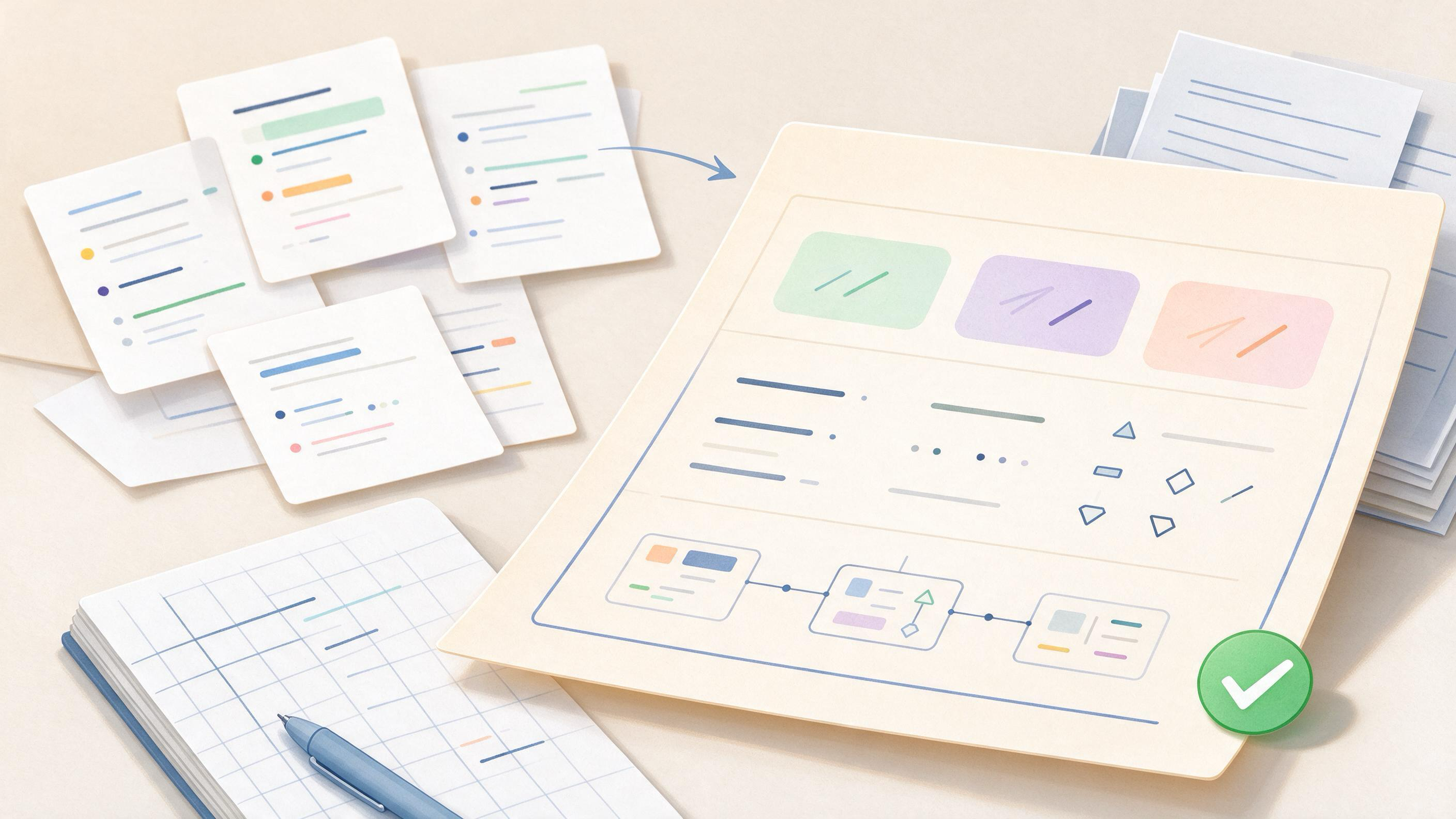
You have a stack of notes from the last four or five weeks. They cover different papers, some digressions, and a few half-formed questions. The problem is not the notes themselves—it is that they do not yet form an argument you can reuse in a course paper, thesis chapter, or first manuscript. A monthly synthesis is the step that converts active reading into a durable, findable map of what you now know.
This article gives a practical sequence for a student or early-career researcher who has been taking weekly notes and now needs to consolidate them. It uses a thesis-chapter example, includes a worked snippet, and ends with a checklist and a concrete next action. The goal is not to summarize everything you read. The goal is to produce one document that records your refined questions, the evidence you can actually cite, and the gaps worth filling next month.
What Is a Monthly Synthesis, and What Should It Not Try to Be?
A monthly synthesis is a short working document that answers one question: what has changed in my understanding this month? It is usually 1–3 pages, not a literature review. It combines your weekly notes into themes, decisions, and unresolved problems.
It should not be:
- A chronological list of every paper you opened.
- A polished final literature review.
- A collection of copied abstracts.
- A permanent record you can never edit.
A useful monthly synthesis looks more like a research memo. It records what you searched for, what you kept, what you rejected, and why. Cochrane’s guidance on searching for and selecting studies is useful here even beyond systematic reviews: plan from clear criteria, document the process, screen in stages, and link related reports of the same work. When your synthesis follows that discipline, it becomes easier to defend your reading choices later.
If you are starting with papers already saved in your WisPaper library, open My Library first. Having the month’s added papers in one place makes the first consolidation pass much faster.
When Should You Synthesize Instead of Keep Taking Notes?
The two states feel different.
You should keep taking weekly notes when:
- You are still inside one paper and following its argument.
- You are collecting sources for a clearly defined search that is not finished.
- Your notes are still mostly quotations and summaries.
You should synthesize when one or more of these is true:
- You have notes from at least three or four sessions and they are starting to repeat.
- You can no longer remember, without scrolling, which idea came from which paper.
- You need to show a supervisor or co-author what you have learned.
- You are about to start a new search or a new project phase.
- The semester or funding cycle is ending and you need to close the reading loop.
The monthly cadence is not magic. The trigger is the moment when your notes are numerous enough to hide the structure you need. If you feel that moment before a full month passes, synthesize then.
What Materials Do You Actually Need Before Starting?
You do not need perfect notes. You need these five inputs:
- The monthly question or objective. One sentence, such as “What is the strongest available evidence on wetland carbon accounting for my methods chapter?”
- Your weekly notes, however rough.
- The source records for anything you might cite, including title, author, publication, and identifier where available. A DOI is especially useful because it can remain stable even when a paper’s location or descriptive metadata changes.
- Your rejection notes. Papers you decided not to use are as informative as papers you kept.
- A time boundary. Usually the last four weeks, unless you deliberately reset the window.
If your weekly notes reference works without reliable source details, do not try to reconstruct them from memory. Search for the registered metadata in WisPaper search, and save the verified record into your library before you write it into the synthesis. This keeps the synthesis from becoming a place where citation errors hide.
What Is the Cleanest Workflow for One Monthly Pass?
A repeatable pass takes roughly 90–120 minutes when your notes are already organized. Break it into five stages.
Stage 1: Inventory, Don’t Judge
List every paper you engaged with this month in a table. Columns can be: short label, source, one-line claim, kept or rejected, and note quality. Do not yet group or rank.
Stage 2: Cluster by Question, Not by Discipline
Move from papers to claims. If three papers touch the same research question, put them together even when they come from different fields. Each cluster needs a working heading that states a claim or a tension, such as “Satellite-derived maps underreport small water bodies.”
Stage 3: Write the Synthesis in Plain Sentences
Under each cluster, write three or four sentences:
- What the selected work found.
- Where the work agrees or disagrees.
- What your own project needs from this cluster.
- What is still unread or untested.
Stage 4: Mark Evidence Quality, Not Just Quantity
For each cluster, note whether you have one strong source, several partial sources, or a source you have not yet checked against the original record. Consider screening your prepared citations against a real database. WisPaper’s TrueCite checks BibTeX references against academic databases to flag references that cannot be matched. Run this before you let an unverified reference travel into a thesis chapter or manuscript draft.
Stage 5: Set the Next Month’s Search Boundary
End the document with a short “next search” block. List two or three questions the synthesis exposed, and the source types you will look for next. This is what turns a monthly synthesis from a filing exercise into a planning tool.
What Does a Monthly Synthesis Actually Look Like?
Here is a compressed worked example for a thesis chapter on small-wetland mapping.
Monthly objective: Find evidence for whether freely available satellite products detect wetlands under one hectare.
Sources engaged: 11 papers read, 2 rejected as off-topic.
Cluster 1: Spatial resolution limits. Three studies using 10–30 m products reported that small or seasonal wetlands were missed. The authors disagreed on whether the cause was sensor resolution or classification method.
Cluster 2: Reference data quality. Two studies relied on regional field inventories; one used a national dataset that excluded most small water bodies. The stronger empirical comparisons came from the studies with local validation data.
What this means for my chapter: I can argue that product choice affects small-wetland detection, but I cannot yet claim a single best product. My next step is a comparison table limited to products with documented validation against local field data.
Next month’s search: Find validation-focused studies for at least three satellite products; screen by the region and minimum wetland size, then record why each study was kept or excluded.
The example is deliberately short. The power is in the transition from “I read papers” to “here is the claim I can now support, here is what is still weak, and here is what I will read next.”
How Do You Know When One Week’s Notes Are Worth Keeping?
A note earns a place in the synthesis only if it does one of four things:
- It supports or challenges a claim you actually need.
- It identifies a method, dataset, or comparison you may reuse.
- It changes the boundary of your research question.
- It explains why you rejected a source.
Everything else can stay in your weekly files. The synthesis is not an archive; it is a decision layer above the archive.
When you are choosing what to carry forward, use the main appraisal questions that systematic reviewers use: does the record match the planned question, is it a separate study rather than a duplicate or secondary report of the same work, and can you trace it back to an identifiable source? Those questions keep the synthesis from quietly filling with the same paper repeated under different titles.
Where Does Citation Checking Fit in the Monthly Routine?
The monthly pass is the cheapest moment to catch citation problems. You have just enough distance from the reading to see what you actually need, but the material is still fresh.
Use a short before-writing check:
- Is every source I plan to cite traceable to a record I have seen?
- Does the record include a stable identifier, such as a DOI, rather than only a display URL?
- Does the reference match the title, author, and publication in the metadata?
When you prepare a BibTeX file for your synthesis or for a draft, run it through TrueCite before the reference list becomes part of a submission. A persistent identifier such as a DOI helps here because it gives you a stable handling target even when a publisher changes a landing page or metadata.
Should the Synthesis Feed a Larger Research Project?
Yes, but only when you make the handoff explicit. A good monthly synthesis has three outputs that map cleanly onto a larger project:
- A decision memo: what you now believe and why.
- A gap list: what you could not support yet.
- A source package: the verified records behind the decision memo.
If you are moving from a chapter-level synthesis into a new project, start by documenting the project boundary. You can open the Research Projects area and create a new project that carries over your refined question and source list. The synthesis should define the project’s starting point, not simply dump all notes into it.
When the handoff is to a longer research task rather than a single document, Scholar Agent is useful for work that fits its literature review, inspiration, or reproduction use cases. The monthly synthesis gives that longer task a focused brief instead of an undifferentiated reading pile.
Can Monthly Synthesis Work When You Are Resetting for a New Term or Project?
Yes. The end of a term or a winter break is a natural synthesis point, but the purpose changes slightly. In a year-end or project-boundary reset, you are not defending this month’s choices. You are deciding what deserves to move forward.
For a reset pass, ask a broader question:
- Which of my reading threads are still alive?
- Which claims can I take into a new manuscript without restarting the search?
- Which saved sources can I now confidently drop?
Write the output as a shorter “carry-forward memo”: one page of active questions, one page of retained clusters, and one page of sources to archive. This is also the right moment to improve the consistency of saved records before the next project begins, especially if the new project will involve formal citation.
What If Your Weekly Notes Are Too Thin to Synthesize?
Thin notes usually mean you recorded too little about why a paper mattered. Before you write the synthesis, do a fast backfill pass on only the papers you know you will use. For each, recover the verified record, confirm its source details, and add one sentence about what it supports or challenges. Do not try to enrich every paper in the month’s history—only the ones that survive the first clustering pass.
If the thinness is not just your notes but your source record, use WisPaper search to locate the paper and then save the matched record to My Library. Once the source is in the library, you can ask targeted questions about it through Library QA.
What Should the Final Checklist and Completion Test Be?
Use this checklist before you close the month.
| Checkpoint | Yes only when |
|---|---|
| Objective stated | The synthesis opens with one specific question, not a topic label. |
| Inventory complete | Every engaged paper appears once, with kept or rejected status. |
| Duplicates handled | Different reports of the same work are linked, not counted separately. |
| Clusters are claim-based | Each heading names a finding, tension, or method need, not a keyword. |
| Evidence is traceable | At least the kept sources have verified records and a stable identifier where available. |
| BibTeX checked | The exported references have been screened against a real database. |
| Gaps stated | The document says explicitly what was not found or not yet supported. |
| Next search defined | The closing block names the next month’s source types and boundary. |
| Handoff ready | The synthesis is short enough to send to a supervisor or paste into a project brief. |
Your synthesis is complete when you can answer yes to all three of these:
- Can I state, in two sentences, what changed in my understanding this month?
- Can I trace every claim in the synthesis back to a source record I have verified?
- Can I hand the document to someone else, and would they know what to read next?
If the answer to any of these is no, the missing piece is usually a specific checkpoint in the table—most often duplicate handling, evidence traceability, or an undefined next search.
Your Next Action After Closing the Synthesis
Do not leave the synthesis as a finished artifact. Make one concrete next move while the gaps are still visible.
The best default action is to turn the “next search” block into a real first search:
- Copy the block into your working notes.
- Run one bounded search for the highest-value gap.
- Save only the records that match your stated boundary.
- Start the next weekly note with the first candidate you accept.
For many readers, the immediate step is simpler: open My Library, confirm that every kept source from the synthesis has a verified record, and run your exported citations through TrueCite. Once that is done, you can close the month knowing the synthesis is built on sources you can defend.
FAQs
Keep Reading

How to Verify New Citations Added During Peer Review
Receiving reviewer comments can feel like a confirmation that your manuscript is close to publication—until you see requests for new citations. A reviewer suggests adding three references, a coauthor forwards two PDFs th
How to Write a Cover Letter for a Journal Submission
A journal cover letter is not a summary of your paper. Editors read it before the manuscript to answer one question: should this submission be sent to review, and does the author understand the journal's readers? The let
How to Write a Data Availability Statement That Reviewers Accept
A data availability statement tells a reader where the data behind your results lives and under what conditions it can be accessed. Journals ask for it because a result that cannot be traced to its underlying material is