
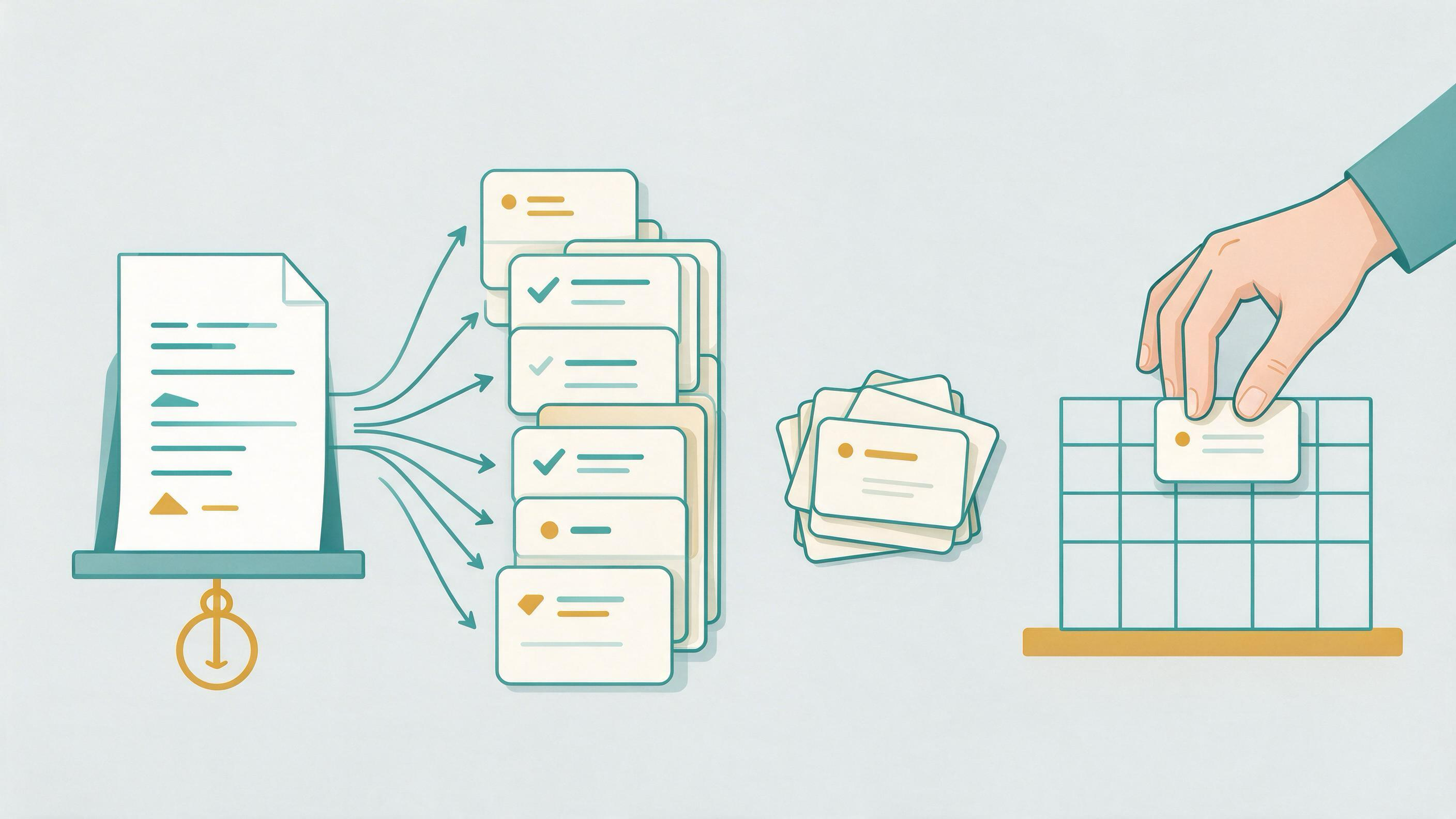
Forward citation searching answers a specific question: who has cited this paper since it was published? For a review author, that question turns a fixed reference list into a moving target. You start from the studies your review already trusts, then trace the newer work that builds on them, challenges them, or applies them in a different population. The output is not a pile of PDFs. It is a dated, documented update set that a co-author or editor can audit.
This guide walks through a complete sequence for a focused update. The running example is a review of a non-pharmacological intervention for adults with a chronic condition, where the primary outcome is a patient-reported symptom score. The steps apply to any topic, but the example keeps the decisions concrete.
What does forward citation searching actually retrieve?
Forward citation searching starts from a seed paper and looks for later works that cite it. It is the mirror image of backward searching, where you read a paper's reference list to find older work. Backward searching extends your history; forward searching extends your future.
Two practical facts shape the workflow. First, citation links live in indexes, and different indexes cover different venues and deposit different metadata. Crossref exposes publisher-deposited metadata through its REST API, including titles, authors, venues, dates, identifiers, and post-publication updates from trusted sources. Second, a DOI resolves through doi.org to the current destination registered for that identifier, which helps you locate a work, but the bibliographic fields and the source text still need checking for identity and claim support. In other words, a citation hit is a lead, not a verified inclusion.
That distinction is the spine of the whole process. You are building a candidate list, then screening it against your review's own criteria.
Before you search: define the update boundary
Most failed updates start too broadly. Decide the boundary before you open a search interface.
Fix the seed set. Choose the studies that anchor your review's main conclusion, not every reference. A workable seed set is three to eight papers: the largest trials or studies, the ones your conclusion depends on, and any paper that defined the outcome measure. Record each seed's DOI and the date you identified it.
Set a search date window. Forward searching is naturally bounded by the seed's publication date, but you still need a cutoff for the update itself. Write down the date you run the search and the latest publication date you will accept. This becomes your "search date" for reporting.
Restate the review question in one sentence. For the example: in adults with the chronic condition, does the intervention improve the patient-reported symptom score compared with usual care at 6 to 12 months? Everything you screen gets judged against this sentence.
Name the outcomes that matter. Separate the primary outcome from secondary ones. A new citation that reports a different outcome may still be relevant, but it should not silently change what your review is measuring.
At the end of this stage you should have a one-page update protocol: seed list with DOIs, question sentence, outcomes, population, date window, and inclusion criteria. That page is your first artifact.
How do you run the citation search without losing the thread?
Run each seed separately and log the results. If you merge seeds too early, you cannot tell which anchor produced which candidate, and you lose the ability to explain gaps later.
For each seed:
- Open the seed's record and confirm the DOI resolves to the intended paper.
- Use the citing-works feature of your chosen index to list later papers.
- Apply the date window.
- Export or record the candidate list with the seed it came from.
Google Scholar's documented features are useful here: it supports searching by author and title, date sorting and date limits, Cited by and Related articles, citation export, library access links, email alerts, and ways to locate alternative versions of a work. The Cited by link is the forward-search entry point; the date limit keeps the list inside your window; export gives you a file you can screen.
If you prefer to work inside a scholarly search interface, WisPaper search lets you find academic papers and then carry the ones you keep into your library. The point is not which interface you use but that every candidate is traceable to a seed and a search date.
Checkpoint: your candidate log should have one row per citing paper, with columns for seed, title, year, DOI, and source index. If two seeds surface the same paper, keep one row and note both seeds.
Screening: separate evidence level from applicability
Screening is where most update projects quietly go wrong. Reviewers tend to ask "is this a good study?" when they should ask three separate questions.
Evidence level describes the design and its risk of bias: a randomized trial, a cohort, a case series, a modeling study. Judge it against your review's existing hierarchy.
Applicability asks whether the population, setting, intervention delivery, and comparator match your review question. A well-conducted trial in a different care system may be high-level evidence but low applicability for your review.
Indirectness is the specific mismatch: the outcome is measured differently, the follow-up is shorter, the population is broader or narrower, or the intervention is delivered by a different cadre. Name the mismatch rather than scoring it vaguely.
Limitations belong to the study itself: sample size, attrition, blinding, reporting. Keep them distinct from indirectness, which is about fit to your question.
A simple screening table keeps these apart:
| Field | What to record | Example entry |
|---|---|---|
| Seed | Anchor paper that surfaced this candidate | Seed 2 |
| Design | Study type and setting | Randomized trial, outpatient |
| Population fit | Match, partial, or mismatch | Partial: older adults only |
| Outcome fit | Same instrument, similar, or different | Similar: adapted scale |
| Follow-up | Duration relative to review window | 6 months, within window |
| Direction | Supports, challenges, or neutral | Challenges |
| Decision | Include, exclude, or hold | Hold for full text |
Use "hold" honestly. A candidate that needs full text before a decision is a normal outcome, not a failure.
Where do full-text checks and citation verification fit?
Once screening narrows the list, you need the actual papers. Save the included and held candidates in one place so the update set stays coherent. My Library is where you can save or upload papers and organize them, which keeps the update set separate from your general reading.
Verification has two layers. The first is identity: does the DOI resolve to the paper you think it does, and do the title, authors, and year match? The second is claim support: does the paper actually report what the citing context or your notes say it reports? A citation link tells you a paper exists and cites your seed; it does not tell you what the citing paper found.
If you maintain a BibTeX file for the review, run a citation check before the references go to co-authors. TrueCite checks BibTeX against real academic databases to flag hallucinated references, which is useful when an update adds a batch of new entries at once.
Checkpoint: every included paper has a resolved DOI, a verified title and year, and a one-line note on what it adds to the review. Papers without that note stay in the hold pile.
Worked example: updating one outcome in a focused review
Suppose the original review included six studies and concluded that the intervention probably improves the symptom score at 6 months, with uncertainty at 12 months. The seed set is the three largest trials plus the paper that validated the symptom scale.
You run forward searches on each seed with a date window from the original search date to today. The candidate list has 41 records after de-duplication. Screening against the question sentence removes 22 that study a different population or report only clinician-rated outcomes. Of the remaining 19, four are held for full text because the abstract does not state follow-up length.
Full-text review resolves the holds: two report 12-month data using the same instrument, one uses a different scale, and one is a secondary analysis of a seed already in the review. The secondary analysis is excluded as duplicate data; the different-scale study is included but flagged as indirect for the primary outcome.
The update set is now three new studies: two that extend follow-up to 12 months and one that adds indirect evidence. The review's conclusion changes in a narrow way: the 12-month uncertainty is reduced but not resolved, because the two new trials are small and from a single setting. That sentence, with its qualifier, is the deliverable.
Notice what the example does not do. It does not pool the new studies automatically, and it does not treat a citation as proof of relevance. Each decision traces back to the screening table.
How do you keep the update auditable across a team?
An update that only one person can reconstruct is fragile. Two habits make it durable.
First, keep the candidate log and the screening table as living documents with dates. When a co-author asks why a paper was excluded, the row should answer without a meeting.
Second, group the work so the artifacts travel together. Research Projects is the WisPaper area for creating and organizing a project, which suits an update that spans several weeks and several contributors. Keep the protocol page, candidate log, screening table, and included-paper notes in the same project space.
If your team wants a structured pass over the included papers before drafting, Library QA lets you ask questions based on papers uploaded to My Library or added from search results. Use it to check what the included studies report about follow-up and setting, then confirm each answer against the paper itself before it enters the draft.
For a larger update that needs a broader literature pass around the seed set, Scholar Agent supports longer research tasks in WisPaper's literature review, inspiration, or reproduction use cases. Treat its output as additional candidates to screen, not as screened evidence.
Checkpoint: a colleague who has never seen the project can open it and reconstruct why each included paper is in and each excluded paper is out.
What tells you the update is ready to report?
Readiness is a set of conditions, not a feeling. The update is ready when all of the following hold:
- The seed set, question sentence, outcomes, and date window are written down and dated.
- Every seed has a logged forward search, and the candidate count per seed is recorded.
- Every candidate has a screening decision with a reason.
- Every included paper has a resolved DOI, verified bibliographic fields, and a note on what it adds.
- Indirectness and limitations are recorded separately for each included paper.
- The revised conclusion states what changed and what did not, with the qualifier attached.
- The reference list has passed a citation check.
If any line is missing, the update is close but not finished. The most common gap is the last one: a conclusion that sounds more certain than the new evidence supports.
Reusable checklist for the next update
Keep this list at the top of the project.
- Select three to eight seed papers and record their DOIs.
- Write the question sentence, outcomes, population, and date window.
- Run a forward search on each seed separately; log candidates by seed.
- De-duplicate and apply the date window.
- Screen on design, population fit, outcome fit, follow-up, and direction.
- Hold ambiguous records for full text rather than guessing.
- Verify DOI resolution and bibliographic fields for every included paper.
- Record indirectness and limitations in separate fields.
- Draft the revised conclusion with explicit qualifiers.
- Run a citation check on the reference list before circulation.
FAQs
Keep Reading

How to Verify a Direct Quote and Its Page Number
A direct quote is only as strong as the page you can point to. When a supervisor circles a quotation and writes "source?" or "page?", the fix is not a quick reword — it is a short, repeatable verification routine that ta
How to Write a Defensible Research Gap Statement
A defensible research gap statement does more than assert that something is missing. It shows, through a documented search and screening process, that the gap is real, relevant, and reachable with the evidence and method

How to Write a Limitations Section That Matches the Evidence
A limitations section matches the evidence when every constraint you name is traceable to a decision you actually made — a search you ran, a sample you could reach, a method you chose — and when the scope you claim is no