
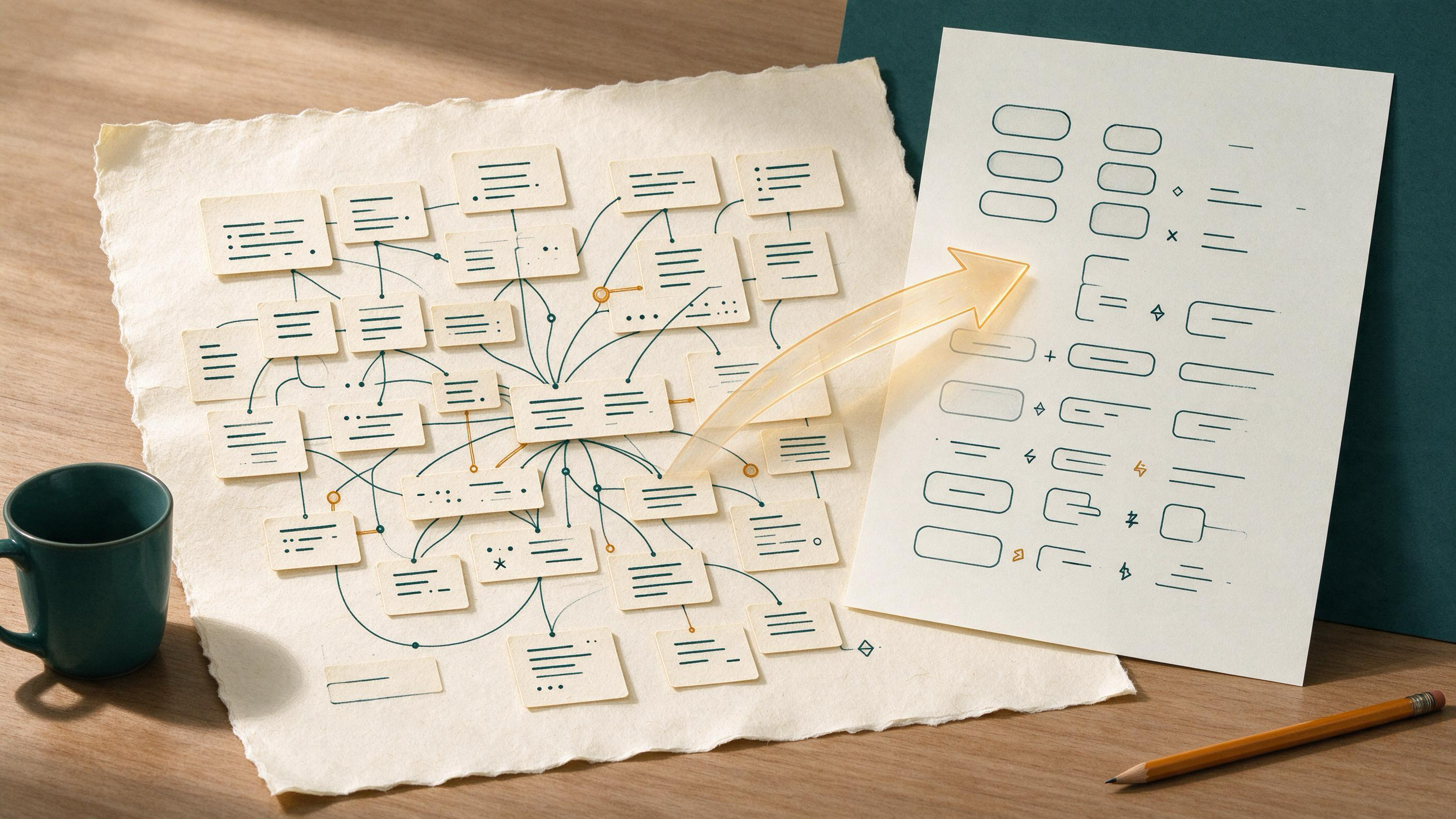
Build the literature map first when your problem is coverage and relationships: you need to know which studies exist, how reports connect to the same study, and where the evidence is thin. Build the traditional outline first when your problem is argument structure: you already know the relevant body of work and need to sequence claims, sections, and evidence into a manuscript. In most revision and review projects, the map comes first and the outline is derived from it, because an outline built before coverage is settled tends to encode gaps as if they were conclusions.
This article compares both artifacts on the same task, shows where each fails, and gives a combined workflow that leaves an auditable method trail for coauthors, peer review, and lab handoff.
Diagnose your starting state before choosing
Ask three questions before you open a blank document.
- Do you know the eligible evidence set? If you cannot yet state your eligibility criteria and the sources you will search, you are not ready to outline. Cochrane guidance frames search planning around eligibility criteria and recommends drawing on multiple sources, combining free-text terms with subject headings, and documenting the process.
- Do you know how reports relate to studies? A single study can produce multiple reports. Cochrane guidance calls for linking multiple reports of one study, which is a mapping task, not an outlining task.
- Do you know the argument you are making? If the evidence set is settled and the relationships are clear, an outline is the faster artifact.
If you answer "no" to the first two questions, start with the map. If you answer "yes" to both and "no" to the third, start with the outline.
What a literature map actually contains
A literature map is a structured record of the evidence landscape. It is not a mind-map sketch. A usable map carries:
- Eligibility criteria stated before searching, so inclusion decisions can be checked later.
- Search documentation: sources used, terms combined, and how free-text and subject headings were applied.
- Deduplicated records, since the same work surfaces across databases.
- Screening decisions in stages, so each exclusion has a reason attached.
- Study-to-report links, so a cluster of papers from one study is not counted as independent evidence.
- A rerun log, because searches are typically rerun before publication to catch new records.
That last point matters for revision work: a map built at draft stage and rerun before submission is a different artifact from a map built once and abandoned.
What a traditional outline actually contains
An outline is an argument skeleton. It carries section order, claim sequence, and the evidence slotted under each claim. It is excellent at exposing weak transitions, duplicated points, and sections that carry no evidence.
An outline assumes the evidence set is stable. When you insert a new study mid-outline, you are doing map work inside an outline document, and the record of why that study entered is usually lost. That is the structural weakness of outlining first.
Compare both on the same task
Take one concrete task: preparing a review section for a manuscript with two coauthors and an anticipated peer-review request for the search strategy.
| Criterion | Literature map first | Traditional outline first |
|---|---|---|
| Coverage check | Strong: eligibility criteria and multiple sources are recorded up front | Weak: coverage is assumed, not shown |
| Relationship tracking | Strong: multiple reports of one study can be linked | Weak: each citation tends to appear as an independent item |
| Argument sequencing | Deferred until evidence is settled | Strong: claim order is visible immediately |
| Coauthor handoff | Strong: decisions and reasons travel with the map | Weak: rationale lives in comments or memory |
| Peer-review response | Strong: search and screening steps can be described | Weak: strategy must be reconstructed after the fact |
| Speed to a first draft | Slower | Faster |
| Rework risk | Lower when coverage was uncertain | Higher when new studies arrive late |
Neither column wins everywhere. The table shows the trade: the map buys auditability at the cost of time, and the outline buys speed at the cost of traceability.
Where the literature map fails
A map fails when it becomes an end in itself. Teams build elaborate relationship diagrams and never convert them into claims. A map also fails when it is built without stated eligibility criteria, because inclusion then becomes a matter of preference rather than a rule. And a map fails when it is not rerun: a landscape captured once may miss records that appear before submission.
A map is also the wrong first artifact for a short commentary or a methods note where the evidence set is small and already known. In those cases the mapping overhead exceeds its value.
Where the traditional outline fails
An outline fails when it is used to answer a coverage question. If a coauthor asks whether the review missed a class of studies, an outline cannot answer that; it can only show where citations currently sit. An outline also fails at handoff, because the reason a citation was included or excluded usually is not written down. And it fails at peer review when a reviewer asks how studies were identified, since the outline records conclusions rather than process.
The most common failure is silent: an outline built early hardens a partial evidence set into a confident structure, and later additions get forced into slots that no longer fit.
A combined workflow that preserves the method trail
Use the map to establish the evidence set, then derive the outline from it. The sequence below keeps both artifacts and the trail between them.
Step 1: State eligibility criteria and plan the search
Write the criteria before searching. Plan which sources you will use and how you will combine free-text terms with subject headings. Record the plan in the project workspace so coauthors see the same starting point; you can set this up in WisPaper Research Projects.
Step 2: Run and document searches
Run searches across your chosen sources and keep the details. PubMed's search details show how terms were translated and combined, which is useful when you need to describe the strategy later. WisPaper's scholarly search interface is a place to find academic papers; if you are orienting yourself first, the Scholar Search entry point explains the paper-finding starting point.
Step 3: Deduplicate and screen in stages
Remove duplicate records, then screen in stages with a reason recorded at each exclusion. Save the records you retain so the set is stable and shareable; My Library is where you save or upload papers and organize them.
Step 4: Link reports to studies and build the map
Group multiple reports of the same study before you count anything. This is the step that most changes conclusions, because a cluster of reports is not a cluster of independent findings. Build the map as a table or graph with one row per study and links to its reports.
Step 5: Interrogate the mapped set
Once papers sit in your library, ask questions across them to surface relationships and gaps before you commit to claims. Library QA supports asking questions based on papers uploaded to My Library or added from search results, which fits the stage where you are testing what the mapped evidence actually says.
Step 6: Derive the outline from the map
Now write the outline, and cite map entries rather than memory. Each outline claim should point to a study row. If a claim has no row, either the claim is too strong or the map has a gap; both are useful findings at this stage.
Step 7: Verify references before submission
Before the manuscript leaves your hands, check the bibliography itself. TrueCite screens BibTeX citations against real academic databases to flag hallucinated references, which is a concrete final check on the trail you built.
Step 8: Rerun searches and log the rerun
Rerun the searches before publication and record what changed. If new records enter, update the map first, then the outline. This ordering is what keeps the trail auditable.
When the project is large enough for an agent
For longer review tasks, the same workflow can run through an agent that handles the literature review, inspiration, or reproduction use cases in Scholar Agent. Use it when the mapping and drafting span more than a single sitting and you want the steps carried through rather than restarted.
If your project is still at the question stage, Idea Discovery takes research topics, background, references, and experimental constraints to generate research ideas, which can precede the map when the topic itself is unsettled. If your review centers on reproducing a method, PaperClaw supports reproduction planning from an uploaded PDF and reproduction instructions.
How to know the result is ready
The map is ready when a coauthor can trace any included study back to the criteria, the search that found it, the screening decision that kept it, and the reports linked to it. The outline is ready when every claim points to a study row and no claim depends on a citation that is not in the map.
The combined result is ready for submission when the searches have been rerun, the rerun is logged, and the bibliography has been checked. If a reviewer asks how studies were identified, you should be able to answer from the record rather than from memory.
FAQs
Keep Reading
Literature Review Table vs. Narrative Research Memo: Choosing the Right Artifact for Your Next Project
You have a folder of PDFs, a stack of notes, and a deadline. The question is not whether to read the literature — you have already started — but how to turn what you have read into something you can actually use. Two art

Literature Review Writing: From Notes to Synthesis
A literature review becomes writable when your notes stop being a pile of summaries and start answering a question. The practical move is to convert reading into a small set of decisions: what counts as eligible evidence

Live Web Links vs. Saved Source Snapshots for Evidence Work
When you are assembling an evidence brief for a clinical team or a research update, the question is rarely "should I use the live web or save a copy?" It is more specific: for this claim, in this brief, which record will