
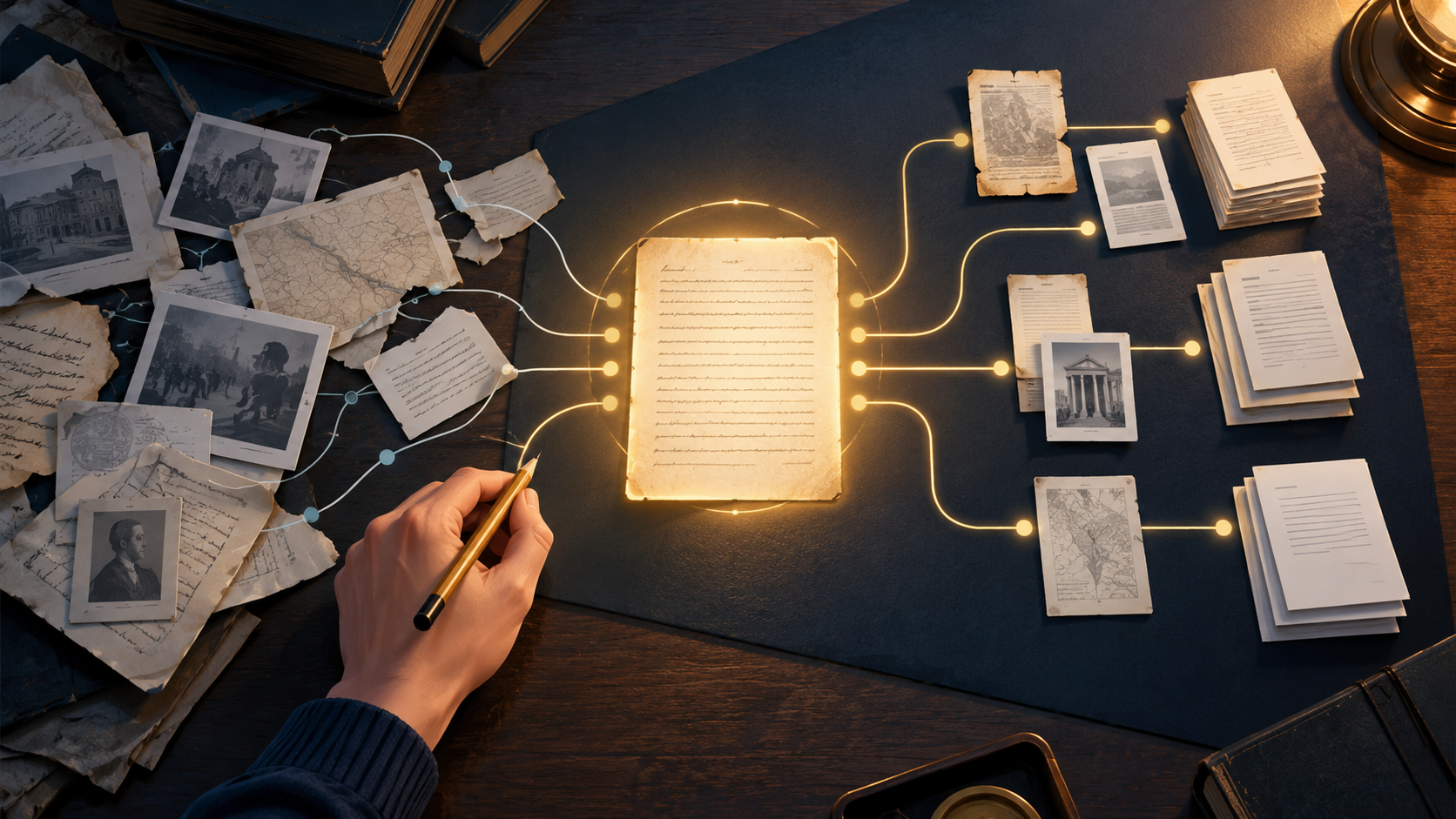
A claim in a decision memo is only as strong as the path you can draw back to the work that supports it. Primary source tracing is the practice of walking that path deliberately: from a sentence in a report, through the reference it cites, across any citation chains and identifiers, and into the original record — then recording where you found it, which version you used, and how confident you are that the source actually says what the claim needs it to say.
This guide is a navigable pillar for enterprise research, analysis, and knowledge teams producing time-sensitive, evidence-backed reports. It covers review references, citation chains, identifiers, multiple reports, versions, and source-location records. It offers a diagnostic framework, decision tables, and routes for readers entering at different stages. The running example is a due-diligence memo where every material claim must carry provenance and an explicit confidence level.
Why tracing matters more than collecting
Collecting references is easy; tracing them is the work. A reference list tells you what an author cited. Tracing tells you whether the cited work exists as described, whether the version you hold matches the version cited, and whether the original text supports the specific claim in front of you.
NIH guidance on scientific rigor and reproducibility frames careful assessment of prior knowledge — its strengths, weaknesses, and gaps — alongside transparent methods and validation as core to rigorous practice. That framing applies directly to evidence work: a claim is stronger when you can show the prior knowledge it rests on and the method by which you checked it. Tracing is how you make that method visible to a reader who was not in the room when you did the work.
The diagnostic framework: five questions per claim
Before you chase a source, classify the claim. Ask five questions in order, and stop at the first one that fails.
- Is the claim specific enough to test? A claim that a treatment "improves outcomes" cannot be traced; a claim that it improved a named outcome in a named population can.
- Does the reference point to a real, identifiable work? Check the identifier and bibliographic fields.
- Does the version you hold match the version cited? Preprints, accepted manuscripts, and published versions can differ.
- Does the original text support the claim as worded? Read the passage, not the abstract alone.
- Can you record where you found it? If you cannot log the location, you cannot defend the claim later.
A claim that passes all five earns high confidence. A claim that fails at question 2 or 4 should be downgraded or removed, not softened with vague language.
Reading a reference before you follow it
A reference is a compressed record. Before following it, extract what it actually asserts: authors, title, venue, date, and any identifier. Crossref exposes publisher-deposited scholarly metadata through its REST API — titles, authors, venues, dates, identifiers, licenses, funding, ORCID and ROR identifiers, abstracts when deposited, and post-publication updates from trusted sources. That makes metadata a first checkpoint: if the reference's fields do not reconcile with a deposited record, treat the discrepancy as a finding, not a nuisance.
Two practical habits help here. First, separate identity fields (who, what, where, when) from support fields (what the work found). A reference can be perfectly identifiable and still fail to support the claim. Second, note the reference's own citations. That is where citation chains begin.
Following citation chains without losing the thread
Citation chains move in two directions. Backward chaining follows a work's references to its antecedents. Forward chaining follows works that later cited it. Google Scholar documents Cited by and Related articles features, along with searching by author and title, date sorting and limits, and locating alternative versions of a work. Those features make chains navigable, but they also multiply the number of records you must track.
Keep the thread by recording, for each hop, the claim you are testing and the reason you moved to the next source. A chain that drifts from "what did the original study measure" to "what did a later review say about it" has changed the kind of evidence you hold. Label each node as primary (the original study or dataset), secondary (a review or synthesis), or tertiary (a summary that cites summaries). Claims in a decision memo should rest on primary or clearly identified secondary sources, with the chain recorded.
When you need to find candidate papers quickly across a chain, a scholarly search interface helps you assemble the starting set before you trace each node. WisPaper's scholarly search is the place to begin locating academic papers; from there, trace each candidate back rather than treating search results as endpoints.
Identifiers: what a DOI does and does not settle
A DOI is a persistent identifier, not a proof of content. A DOI can be resolved through doi.org to the current destination registered for that identifier. Resolution helps locate a work, while bibliographic fields and the source text still need to be checked for identity and claim support.
That distinction matters in due diligence. Resolving a DOI confirms that an identifier points somewhere; it does not confirm that the destination is the version you cited, that the authors match your reference, or that the text supports your claim. Treat resolution as one step in a sequence: resolve, reconcile metadata, confirm version, then read the passage.
| Identifier situation | What it tells you | Next action |
|---|---|---|
| DOI resolves and metadata matches the reference | Identity is plausible | Confirm version, then read the supporting passage |
| DOI resolves but metadata differs | Possible version or record mismatch | Compare deposited metadata fields; log the discrepancy |
| No identifier, but full bibliographic fields present | Identity may still be traceable | Search by author and title; record how you located it |
| Identifier present but destination unavailable | Location is known, content is not | Record the identifier and the access failure; seek an alternative version |
Multiple reports, versions, and the version you actually read
Version control is where many traceable claims quietly break. The same work may circulate as a preprint, an accepted manuscript, and a published article, and the passage you rely on may differ across them. Google Scholar's documentation notes ways to locate alternative versions of a work — useful for finding a version, but the finding is only half the job. Record which version you read and why you chose it.
A simple version register prevents confusion:
- Work identity: title, authors, identifier.
- Version read: preprint, accepted manuscript, published, or other.
- Location: where the specific passage sits (section, page, paragraph, figure, table).
- Access date: when you read it.
- Delta notes: any differences from other versions you saw.
When a memo draws on multiple reports of the same finding, cite the version you actually read for each claim. If two versions disagree, that disagreement is itself evidence worth reporting at an explicit confidence level.
Source-location records: making claims defensible
A source-location record answers the question a reviewer will ask: where exactly did you see this? It should be specific enough that a colleague can open the same version and land on the same passage without guessing.
| Record field | Purpose | Example form |
|---|---|---|
| Claim as worded | The exact sentence under test | "Reported effect in the named population" |
| Source identity | Work and identifier | Title, authors, DOI |
| Version | Which copy was read | Published version |
| Location | Where the passage sits | Section, paragraph, table |
| Support judgment | Does the text support the claim? | Direct, partial, or not supported |
| Confidence | Your stated level | High, medium, low |
Keeping these records in one place turns tracing from a personal habit into a team asset. WisPaper's My Library lets you save or upload papers and organize them, which gives a shared home for the versions your records point to. Pair the library with the record table so that each claim links to a stored copy rather than a memory.
Worked example: a due-diligence memo with provenance
Consider a memo assessing a technology vendor. The analyst drafts three material claims.
Claim A: "The underlying method was validated in a peer-reviewed study." The analyst locates the cited work, resolves its DOI, reconciles the metadata, and reads the methods section in the published version. The passage describes validation. Support: direct. Confidence: high. Record: identifier, version, section, access date.
Claim B: "Independent groups have replicated the result." The analyst follows forward citations and finds reviews that mention replication but cannot reach the original replication studies within the deadline. Support: partial — the chain points to secondary summaries, not primary reports. Confidence: low. The memo is revised to say the claim rests on review-level summaries, with the chain recorded.
Claim C: "Performance figures come from the vendor's own testing." The analyst finds two versions of a report with different figures. Support: conditional. Confidence: medium, with the version delta noted explicitly.
This is what traceable claims look like in practice: each one carries a source identity, a version, a location, a support judgment, and a confidence level. The memo's reader can see not only what the team concluded but how firmly each conclusion is held.
A practical route for different entry points
Readers arrive at tracing from different stages. Use the route that matches where you are.
| You are entering at… | First move | Then |
|---|---|---|
| A pile of unread references | Triage by claim specificity | Trace only claims that pass question 1 |
| A single claim with a citation | Check identifier and metadata | Confirm version, read the passage, log location |
| A citation chain already in progress | Label each node primary/secondary/tertiary | Decide which nodes the memo may rest on |
| Multiple conflicting versions | Build the version register | Record deltas and set confidence per claim |
| A finished draft needing provenance | Audit each material claim against the record table | Downgrade or remove unsupported claims |
For teams running longer tracing efforts across many claims, a structured workspace helps keep the chain, the versions, and the records together. WisPaper's Research Projects area is where you can create a new project to hold that work.
Where assisted workflows fit — and where they do not
Assisted tools speed up the mechanical parts of tracing: finding candidate papers, screening reference lists, and answering questions against a curated set. They do not decide whether a passage supports a claim; that judgment stays with the analyst, recorded in the source-location table.
Two workflows are worth knowing. First, when a draft's bibliography is the starting point, screening the BibTeX against real academic databases flags hallucinated references before they enter the chain — WisPaper's TrueCite is built for that BibTeX citation screening step. Second, when your traced papers are already saved, you can ask questions based on papers uploaded to My Library or added from search results using Library QA; treat its answers as pointers back to the stored passages you then verify and log.
For longer research tasks that span literature review and synthesis, WisPaper's Scholar Agent area supports extended work; the tracing discipline above still governs which claims survive into the memo.
Decision table: when a claim is ready to publish
| Check | Pass | Fail action |
|---|---|---|
| Claim is specific and testable | Keep | Rewrite or drop |
| Source identity confirmed | Keep | Re-identify or flag |
| Version matches what you read | Keep | Re-read the correct version |
| Original text supports the wording | Keep | Narrow the claim |
| Location recorded | Keep | Record before publishing |
| Confidence stated | Keep | Assign a level |
A claim that clears every row can carry high confidence. A claim that clears identity but not support should be narrowed to what the text actually says. A claim that cannot be located should not appear in the memo at all.
FAQs
Keep Reading
PubMed Keywords vs. MeSH Terms: When Does Each Find More?
Neither free-text keywords nor MeSH terms wins outright. Free text reaches records that have not yet been indexed and captures phrasing that no heading describes; MeSH reaches records through a controlled, hierarchical v

Research Deadline Rescue: A Complete Evidence-Recovery System
When a course paper, thesis chapter, or first manuscript is due soon, the problem is rarely that you have no sources. It is that you have too many half-checked leads, a rubric you have not reread, and no clear point at w

Review Article vs. Primary Study: Which One Should Support Your Claim?
A review article and a primary study do different jobs, so the right choice depends on the sentence you are trying to support. If your claim is about what a body of work collectively shows, a review is often the efficien