
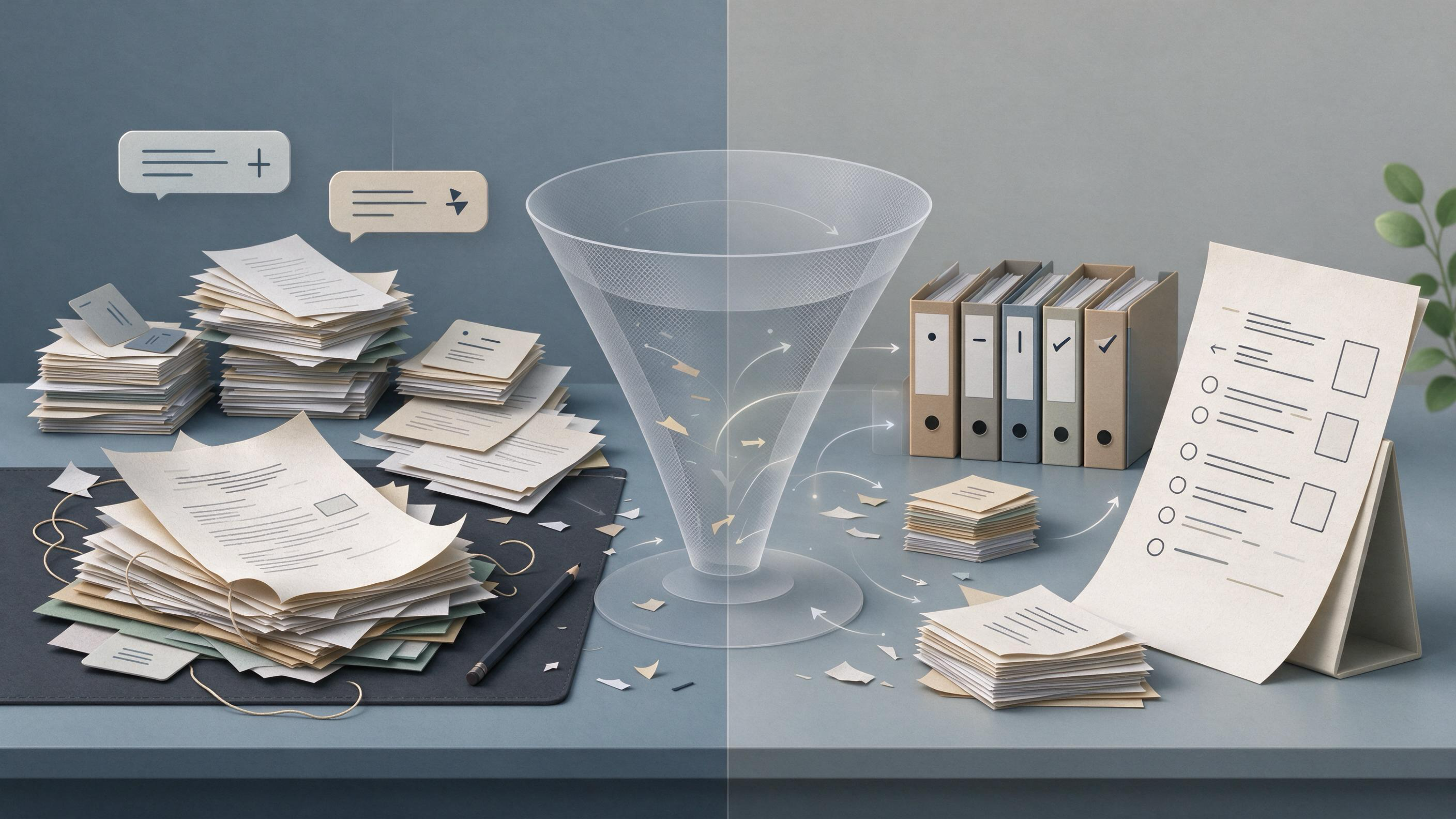
Researchers rarely fail for lack of PDFs. Most of us have a reading stack that never shrinks and a manuscript that needs decisions, not another open tab. The question underneath “Reading Backlog vs. Research Pipeline” is practical: are you accumulating sources, or are you moving a defined research task toward a concrete artifact? This article helps you diagnose which state you are in, shows what each state produces under pressure, and gives you a repeatable way to convert accumulated reading into an auditable, submission-ready pipeline.
What is a reading backlog, and when is it actually the problem?
A reading backlog is a growing set of papers, alerts, and recommendations that exists without a decision attached. The items might be excellent. The failure is that each one only produces more items: more tabs, more highlights, more saved references, and no change in the manuscript, protocol, or review.
A backlog becomes the problem when one of these is true:
- You re-find the same paper three times and still do not know whether it belongs in your introduction.
- You cannot say which saved references support which section, selection criterion, or claim.
- You postpone writing because one more search might reveal the definitive study.
- A coauthor, supervisor, or reviewer asks for the search record and you cannot reproduce it.
If any of these is true, the bottleneck is not reading speed. It is that reading has no exit condition. The fix is not “read faster.” It is to attach every act of reading to a decision that changes a downstream artifact.
What is a research pipeline, and what counts as output?
A research pipeline is a sequence of stages in which material enters only because a prior stage produced a defined need. Its outputs are not vibes. They are artifacts a collaborator or reviewer can inspect.
For a scoping or systematic-style review, a minimal pipeline looks like this:
- Write eligibility criteria before searching: population, intervention or exposure, comparator, outcome, study design, language, and date constraints where they apply.
- Search across multiple sources, not one database.
- Record the search: source, query, date, and result count.
- Deduplicate records and document how many were removed.
- Screen title and abstract, then full text, in stages.
- Link multiple reports to the same underlying study.
- Re-run or update searches before publication and record the date.
The Cochrane Handbook recommends planning searches from eligibility criteria, using multiple sources, documenting the process, deduplicating records, screening in stages, linking reports of the same study, and updating searches before publication. That sequence is useful even for narrative or dissertation work when you shrink it to what the manuscript requires. The point is that the process leaves a trail.
How do you diagnose which state you are in?
Use a five-minute test on your current project. Take the manuscript section or review question that is due next and answer:
- Do I have written eligibility or inclusion criteria for this section's sources?
- Do I have a dated search record I could hand to a coauthor?
- Do I know how many unique sources I started with and how many survived screening?
- Can I explain why any saved paper was retained rather than skipped?
Four yeses: you are largely in pipeline mode. Two or fewer yeses: you have a reading backlog wearing a lab coat. The middle case, two or three yeses, is the common one: the search exists but the trail stops at screening, or the criteria exist only in conversation.
A sharper signal is the artifact test. A backlog produces a longer list. A pipeline produces a smaller list plus justification. If your progress this month can be described only as “I found more relevant papers,” you have added input, not output.
Why submission readiness needs an auditable method trail
Journals, supervisors, and peer reviewers increasingly expect reproducibility in how sources were located and selected. A reviewer may not check every filter, but they will notice when the methods say one thing and the reference list implies another.
An auditable trail is not the same as a perfect search. It is a record another person could follow: what was searched, when, with what query, how many records appeared, how many were duplicates, how many passed each screen, and why. That record also protects you during revision. When a reviewer raises a missing-study concern, you can return to the dated search and show whether the study was excluded by criteria, found after the search date, or outside the scope.
Persistent identifiers make the trail stronger. A DOI is a persistent identifier that can remain stable when the location or descriptive metadata of an object changes. Registered scholarly metadata, including DOI, title, author, publication, funder, license, and relation fields, is exposed through APIs such as Crossref's REST API when deposited. That means your saved references can be checked against a registered source rather than reconstructed from memory. For researchers who use WisPaper's workflow, TrueCite offers a focused way to screen BibTeX against real academic databases and flag references that do not correspond to a registered record. That matters most at the final citation pass, when hallucinated or malformed references quietly break an otherwise careful manuscript.
How do both options behave on the same task?
Put a realistic task in front of both approaches: a coauthor asks you to supply the evidence base for a claims section in a manuscript that must go out in three weeks. The section needs ten to fifteen sources, each tied to a specific claim, and the coauthor wants the search date and screening logic.
Backlog approach. You open the folder of 240 saved PDFs and the two-year-old Zotero collection. You re-read abstracts, remember why you saved them, and lose an afternoon deciding that 200 of them are irrelevant. You find eleven usable sources. You export a reference list, but the export has formatting errors, duplicated versions, and one citation you cannot find in any database. The coauthor asks how you knew you had not missed a recent study, and you cannot answer. The section is late, and the trail is rebuilt from chat history.
Pipeline approach. You write three eligibility lines for the section, run a dated multi-source search, deduplicate, and screen title and abstract, then full text, in stages. You link reports that describe the same study. You export an eleven-item list whose citations match registered records, with the query and selection notes attached. When the coauthor asks for evidence of recency, you show the search date and a plan to re-run it before submission.
Same task, same rough output count. The difference is not intelligence; it is whether reading was attached to a decision gate.
Where does a reading backlog still create value?
None of this means a backlog is worthless. A broad, loosely organized reading pile is excellent for two jobs: discovering that a field exists and finding your next question. Idea generation benefits from abundance and from crossing fields, and a researcher who reads without a decision gate is often the one who spots the connection nobody has made.
The problem is transferring that value into a manuscript. The discovery phase should terminate in a written question, a set of candidate references, and a defined constraint, not in “more reading.” When you have a topic, background references, and practical constraints, a structured step can convert curiosity into a concrete research direction. In WisPaper, the Idea Discovery workflow is designed for exactly that move: taking research topics, background, references, and experimental constraints to generate research ideas. Use the backlog as fuel here, then launch the pipeline when the question is fixed.
How do you convert a backlog into a pipeline without losing the good material?
Do not delete the backlog. Do not try to process all of it in one evening. Convert it in three passes.
Pass 1: attach an exit condition to each pile. Go through the backlog and write one of three labels beside each item: “supports claim X,” “background for introduction,” or “not for this manuscript.” Items that cannot take a label within a minute go to a separate folder called “unprocessed.” The unprocessed folder is not a task; it is a boundary. It tells you what you are choosing not to feed into this project.
Pass 2: rebuild the decision trail for the keepers. For the ten to thirty keepers, create the missing record: the source, search date, query, and screening decision. You do not need a full systematic protocol for every section, but you need enough that a coauthor can see why each source survived. If you have been saving papers inside WisPaper, My Library is the natural place to organize uploaded papers and keep this decision record with the manuscript's working set. Once papers are saved there, you can ask questions against that controlled set with Library QA instead of re-reading everything from scratch.
Pass 3: close the loop on citations. Before submission, run a citation integrity pass. Export the reference list, check each entry against a registered scholarly record, and fix or remove entries that cannot be verified. For BibTeX specifically, TrueCite performs that screening against real academic databases. A clean reference list is the last visible artifact of the pipeline, and it is the one reviewers notice fastest.
What decision table should guide the handoff?
Use this table when deciding whether an item belongs to reading mode or pipeline mode.
| Situation | Correct mode | Next action |
|---|---|---|
| You are exploring a new field and do not yet have a question | Reading backlog | Read broadly; capture topics, then fix the research question |
| You have a fixed research question but no written criteria | Pipeline start | Write eligibility criteria before the next search |
| You have criteria and search results but no screening record | Pipeline middle | Screen in stages and log decisions |
| You have duplicates and an inconsistent reference list | Pipeline cleanup | Deduplicate, link reports, verify citations |
| You are three days from submission and “just one more paper” calls | Pipeline discipline | Re-run the dated search; do not add unscreened sources |
| A reviewer asks for your search strategy | Auditable trail | Produce the dated record and screening notes |
| You want new research directions for a follow-up project | Reading backlog, structured | Feed topics, references, and constraints into idea generation |
The table's lesson is that both modes are legitimate, but they have different clocks. Reading mode has no deadline pressure by definition. Pipeline mode inherits the submission deadline and converts it into decision gates.
What is a combined workflow for a revision-heavy week?
For a manuscript in revision, use a two-layer workflow: a shallow backlog layer for orientation and a strict pipeline layer for the claims that reviewers will check.
Layer 1: orientation. Skim newly found papers without logging every one. Their job is to tell you whether the field has moved. You may save promising items, but you do not let them enter the manuscript yet.
Layer 2: claims. For each reviewer comment that requires new evidence, open a micro-pipeline. Write the inclusion logic for that comment, run a dated search, screen, and log. Attach the result directly to the response letter so the reviewer sees the method, not only the added citation.
This combined workflow is the only one that survives a real week. Pure pipeline discipline on every alert is unsustainable, and pure backlog mode on a revision is why reviewers see a new citation with no explanation of how it was found.
When the revision requires multiple new searches and a response letter, research work multiplies quickly. A pragmatic structure is to house each reviewer comment as its own workstream rather than holding everything in your head. If you are using WisPaper for the revision, Research Projects gives you a place to create a project and keep related searches, saved papers, and notes together for the manuscript. The project boundary in the tool mirrors the pipeline boundary in your thinking: this source supports this claim, not another open tab.
How do you know the result is ready?
Readiness has four checks.
Check 1: the artifact test. The deliverable is smaller and more structured than the input. You started with a search result set and ended with a screened set, each item tied to a claim or section.
Check 2: the handoff test. A coauthor could open your trail and understand what was searched, when, why items were excluded, and which reports represent the same study.
Check 3: the citation test. Every reference tracks to a registered scholarly record. Duplicates are removed, linked reports are consolidated, and no entry depends on a fuzzy memory.
Check 4: the recency test. The search has a date, and that date is either recent enough for the journal's expectations or the submission plan says when the search will be re-run.
If all four pass, stop reading. Submit.
FAQs
Keep Reading

Research Limitation vs. Future Research Direction: Submit With a Credible Handoff
Editors and reviewers read the final section of a manuscript looking for one thing: can this author tell the difference between a boundary the study could not cross and a direction the field should now pursue? When those
Research Paper Abstract Guide: Structure, Evidence, and Revision
An abstract is the first calibration point between your manuscript and the reader who decides whether the full study deserves attention. Clinicians skimming a journal table of contents, systematic reviewers screening cit
Research Paper Proofreading and Consistency Audit
Proofreading a research paper is not a single pass with a red pen. It is an audit of whether the manuscript, its references, and its evidence trail all tell the same story. Reviewers rarely reject a paper for one typo, b