
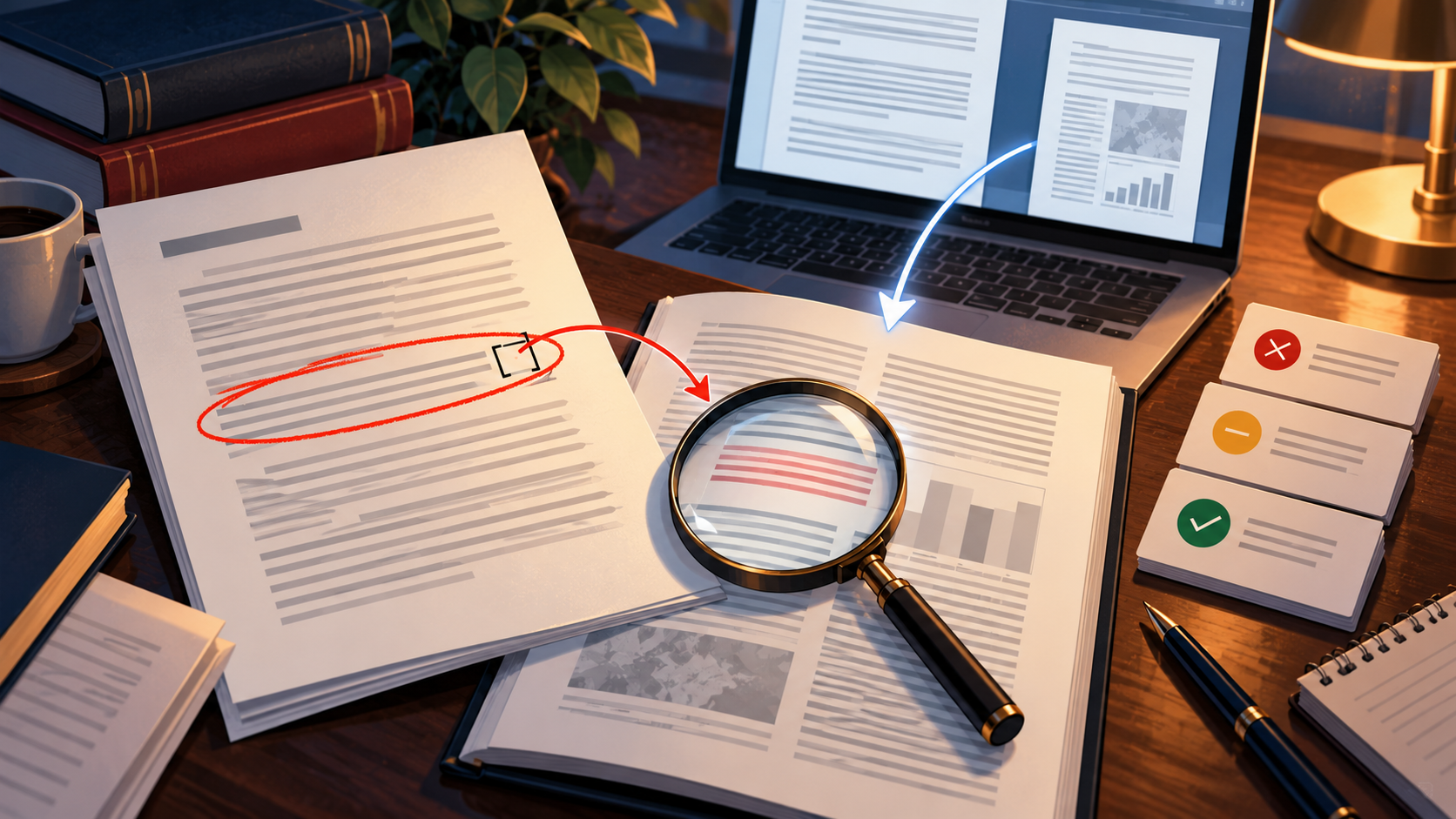
A due-diligence memo is two hours from circulation. One line reads: "Post-publication updates to this dataset show the effect was revised downward." The footnote points to a paper that genuinely exists, with a working DOI, correct authors, and the right journal. The reviewer clicks through, lands on the article page, and finds nothing about a downward revision. The citation is real. The sentence is not supported by it.
This is one of the most common and most damaging failures in evidence-backed work, because it survives the checks most teams run. A DOI resolves, so the reference looks verified. The paper is on-topic, so the claim looks plausible. But identity and support are two different questions, and only one of them was answered.
This article walks through that failure as a concrete case: how to trace the mismatch, why it happens, how to find the right source or rewrite the claim, and how to document the repair so the corrected deliverable holds up. The same sequence transfers to client briefings, investment memos, and any time-sensitive report where a wrong sentence can travel faster than the correction.
Start by separating three questions the footnote conflated
When a citation fails to support its sentence, resist the urge to fix the prose first. Separate the problem into three distinct checks, because each has a different remedy.
- Does the work exist and is the identifier correct? A DOI resolves through doi.org to the current destination registered for that identifier, which helps you locate a work. But resolution only locates the work; the bibliographic fields and the source text still need to be checked for identity and claim support.
- Is this the work the sentence describes? Titles, authors, venues, dates, and identifiers must match what the footnote claims. Crossref exposes publisher-deposited metadata through its REST API, including titles, authors, venues, dates, identifiers, licenses, funding, ORCID and ROR identifiers, abstracts when deposited, and post-publication updates from trusted sources. That metadata is where you confirm identity rather than assume it.
- Does the source text actually support the sentence? This is the step the original author skipped. A resolving DOI tells you nothing about whether the abstract or body makes the claim you attributed to it.
In our case, the first two checks pass and the third fails. That pattern is the signature of a claim-support mismatch rather than a fabricated reference. The repair is different from fixing a hallucinated citation, so diagnosing which one you have is the first real decision.
Diagnose why the mismatch happened before you rewrite
The sentence did not appear by accident. Naming the cause tells you how far the error may have spread. In practice, mismatches cluster into a few recognizable patterns.
The abstract was read, the update was not. Crossref metadata can include post-publication updates from trusted sources. If the author relied on an early abstract and never checked for updates, a sentence about a "revised" finding could be built on a stale reading. The fix is to check the deposited metadata for updates, not just the landing page.
Two similar works were conflated. A search by topic can surface several papers with near-identical titles. If the author matched on title alone, the footnote may point to the wrong member of a family of related papers. Google Scholar documents searching by author and title, which is a more precise way to disambiguate than a keyword scan.
The claim drifted during editing. A source may support a narrower statement than the final sentence. "Associated with" becomes "caused by" across three drafts. Here the citation is correct and the prose overreached.
The source was never opened. The reference came from a secondary summary or a colleague's list. The DOI is real because the paper is real, but no one checked the text.
For each pattern, ask a second question: where else did this source appear? If the same paper underpins three sentences in the memo, all three need rechecking, not just the one a reviewer flagged.
Re-locate the work with the right search moves
Once you know the mismatch is about identity or support, re-find the work deliberately rather than trusting the existing footnote. Google Scholar's documented features are useful here: searching by author and title, sorting and limiting by date, using Cited by and Related articles, exporting citations, and locating alternative versions of a work. Date limits matter in time-sensitive reports, because a claim about a "recent" finding needs a source inside the relevant window.
If you need to search scholarly literature directly, WisPaper search provides a scholarly search interface for locating papers. For readers who want a public entry point to finding academic papers, WisPaper Scholar Search explains and opens that path.
As you re-locate candidates, capture the fields that let you prove identity later: title, authors, venue, date, and identifier. Crossref's deposited metadata is the natural place to confirm these, and it also tells you whether an abstract was deposited at all. If no abstract is deposited, you cannot judge support from metadata alone and must open the source text.
Decide between finding a better source and rewriting the claim
This is the pivotal judgment in the repair. You have two legitimate moves, and the evidence should choose between them.
Find the right source when the underlying fact is real but the footnote points elsewhere. If the memo needs to say a dataset was revised, and a post-publication update exists in deposited metadata, cite the work that actually records the update. The claim stays; the citation changes.
Rewrite the claim when no located source supports the sentence as written. Narrow the statement until it matches what the source text actually says. "Was revised downward" might become "was subsequently updated," or the sentence might be cut entirely if the update cannot be confirmed.
A practical rule: never let the desire to keep a strong sentence drive the source search. If you find yourself hunting for any paper that might justify the original wording, the claim is doing the leading and the evidence is following. Reverse the order. Read what the source supports, then write the sentence the source earns.
When the memo draws on a stack of references, it helps to keep the papers you are rechecking in one working set. My Library lets you save or upload papers and organize them, so the sources under review stay together while you compare them against each sentence.
Assign explicit confidence levels to each repaired claim
A corrected sentence without a confidence level invites the same overreach next time. Make confidence explicit and tie it to what you actually verified.
- High: the source text directly states the claim, identity fields match, and you checked deposited metadata for updates.
- Medium: the source supports a narrower version of the claim, or support comes from an abstract while the full text was not read.
- Low: the claim rests on a secondary summary, an unverified version, or a source whose update status you could not confirm.
Record the level next to the claim in the working draft, not just in your head. When a reviewer or client asks why a sentence is hedged, the confidence level and its basis are the answer. This also makes the memo's overall strength legible: a page of high-confidence claims reads differently from a page of mediums, and readers deserve to see which is which.
Document the repair so the correction is traceable
A repaired memo needs a short audit trail. Without one, the next editor cannot tell which sentences were checked and which were inherited. Keep the record lightweight but specific:
- The original sentence and its citation. Quote both so the change is visible.
- What the check found. State whether identity matched and whether the source text supported the claim.
- The cause. Name the pattern: stale abstract, conflated works, claim drift, or unopened source.
- The action taken. New source, rewritten claim, or removal.
- The confidence level and its basis.
This log does double duty. It answers the reviewer who flagged the sentence, and it becomes a checklist for the rest of the memo. If one sentence drifted, its neighbors drawn from the same source deserve the same scrutiny.
Run a citation screen before the memo goes out
Individual repairs are necessary but slow. Before circulation, screen the whole reference list so a second mismatch does not slip through. TrueCite supports BibTeX citation screening, checking BibTeX against real academic databases to flag hallucinated references. That catches the references that do not exist; the claim-support check you just walked through catches the ones that exist but do not fit. Run both, because they fail in different ways.
For longer evidence-gathering work behind a memo, Scholar Agent fits longer research tasks in WisPaper's literature review, inspiration, or reproduction use cases. When the memo's sources are already collected and you need to interrogate them, Library QA lets you ask questions based on papers uploaded to My Library or added from search results. That is useful for confirming what a specific paper says before you attribute a sentence to it.
The corrected deliverable and the lessons that transfer
In our case, the repaired memo reads: "The dataset was subsequently updated; the update is recorded in the deposited metadata for [work], and the direction of the revision is not stated in the abstract." The confidence level is medium, because the abstract was read but the full text was not. The audit log records the original sentence, the failed support check, the cause (stale abstract, update unchecked), and the action (new source, narrowed claim).
The lessons transfer to any time-sensitive report:
- Resolution is not support. A working DOI locates a work; it does not confirm the sentence.
- Check deposited metadata for updates. Post-publication updates can change what a source means.
- Disambiguate by author and title. Similar titles are a common source of conflation.
- Let evidence choose between a new source and a narrower claim. Never reverse that order.
- Attach confidence to every repaired claim. It tells readers how much weight the sentence can bear.
- Log the repair. The audit trail protects the correction and seeds the next review.
A memo that survives scrutiny is not one with no corrections. It is one where every correction is traceable, every claim carries a confidence level, and every citation was checked for support, not just for existence.
FAQs
Keep Reading

The Evidence Looks Strong but the Patients Are Different: A Clinical Applicability Case
A guideline panel is drafting a recommendation for a common chronic condition. The lead trial is large, randomized, and widely cited. The effect on the primary outcome is statistically significant and clinically meaningf

The Most Relevant Paper Is Behind a Paywall: A Reproducible Workflow for Lawful Access and Honest Citation
You are drafting a manuscript, and the single most relevant paper sits behind a paywall. The abstract confirms it is the right study, but the full text is locked. The temptation is to cite it anyway, paraphrase the abstr

Trial Registry vs. Journal Article: Which Record Answers Which Question?
A registry entry and a journal article about the same trial are not two versions of one record. They are produced at different times, by different hands, for different purposes. The registry entry is written before the r