
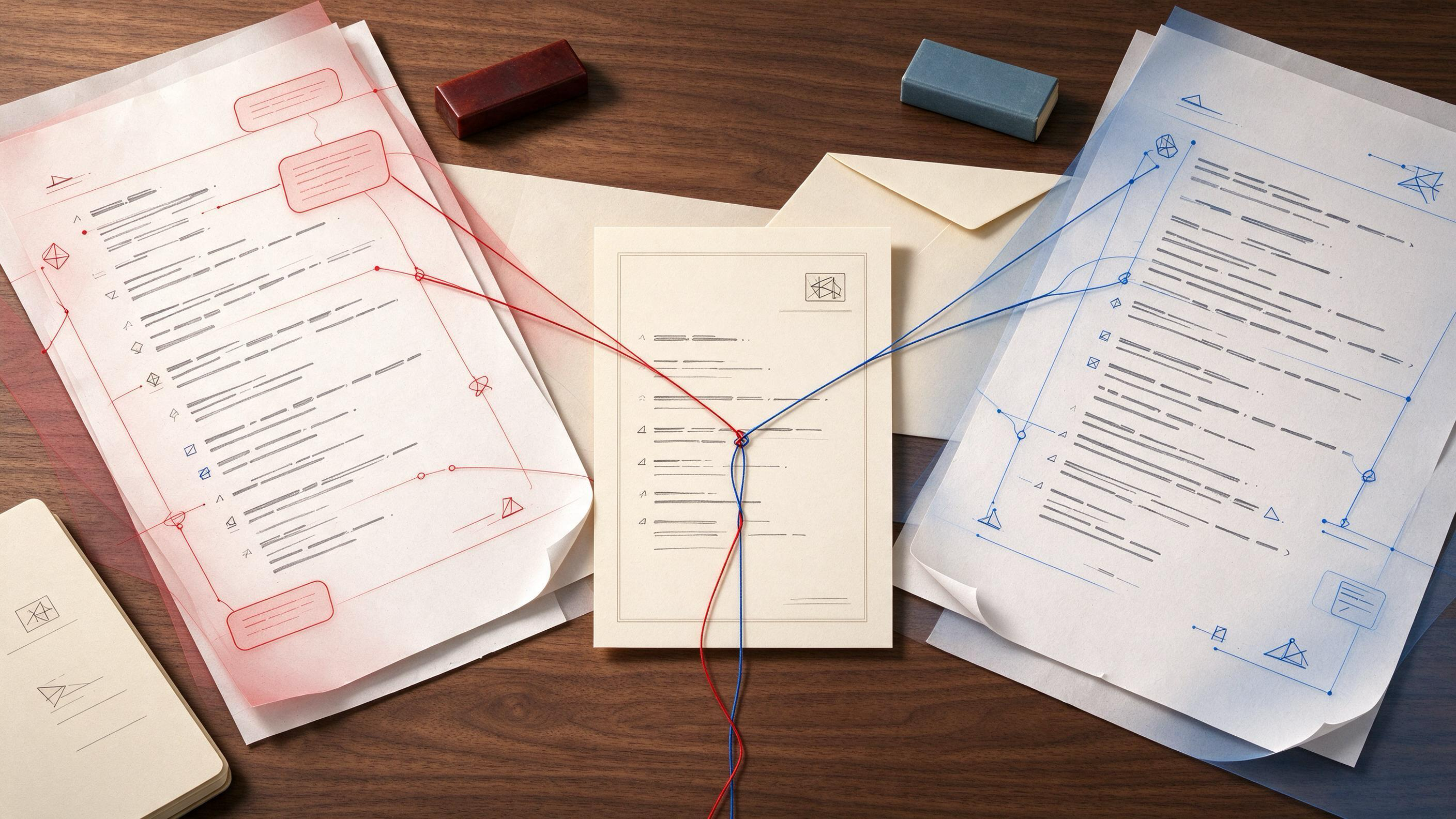
You open the decision letter expecting a clear to-do list. Instead, Reviewer 1 wants you to add a control condition and reconsider your main claim. Reviewer 2 says the argument is strong but asks you to cut a section and rewrite the framing. The editor writes that the manuscript is promising and asks you to address all comments. None of the three messages tells you what to do when the reviewers disagree.
This is the moment most early-career researchers stall. The confusion is not a sign that the paper is broken. It is a signal that the reviewers are reading two different papers: one focused on method, one focused on argument. Your job is to recover the shared underlying concern, decide which changes serve the research question, and produce a revision letter that lets the editor see you handled the disagreement deliberately.
This article walks through that diagnosis and repair process using a thesis chapter as the example, shows how to organize the conflicting advice so it stops feeling like noise, and ends with a concrete next action for your own manuscript.
What Kind of Conflict Are You Actually Dealing With?
Before deciding what to change, separate three common patterns of reviewer disagreement.
The first is a scope conflict. One reviewer wants the paper to answer a narrower question with tighter methods; the other wants it to answer a broader question with richer interpretation. Neither is wrong, but the paper cannot do both at full depth.
The second is a standard conflict. One reviewer is applying a methods standard, such as transparent design and reporting of analysis, while the other is applying an argument or disciplinary convention. The authors of the NIH rigor framework describe scientific rigor as the strict application of the scientific method, including transparent design, methods, analysis, interpretation, and reporting. A reviewer asking for more method transparency and a reviewer asking for clearer interpretation may both be pointing at the same gap from different angles.
The third is a priority conflict. Both reviewers see the same weakness, but one treats it as fixable by revision and the other frames it as fatal. This is the easiest to resolve because the underlying problem is shared.
Start by Writing Down What Each Reviewer Actually Requests
Create a working document with three columns: the exact request, the section it touches, and whether it is about method, argument, framing, or evidence. Do not yet mark anything as accepted or rejected.
In the thesis example, the two sets of comments look like this. Reviewer 1 asks for a control condition in the main analysis and suggests the central claim is unsupported. Reviewer 2 asks the author to remove a secondary section and reframe the contribution around the strongest result. Written this way, the requests appear to pull in opposite directions. The repair starts when you look for the concern beneath each request.
Why Do Two Reviewers Read the Same Paper Differently?
The least useful thing you can do is assume one reviewer is competent and the other is not. Both reviewers read the same text and formed expectations from it. When their expectations collide, the paper is usually sending mixed signals about what it is trying to do.
Reviewers read through a lens. COPE notes that peer review depends on trust and sets ethical expectations that reviewers remain objective and give constructive assessment. A reviewer focused on methodological trust will read your procedure as the center of the paper. A reviewer focused on conceptual contribution will read your framing and claims as the center. If the paper opens with a broad conceptual promise and then delivers a narrow empirical test, it is no surprise that the two reviewers expect different end states.
Your first diagnostic question is not "Which reviewer is right?" It is "Which expectations did the manuscript create, and where did it fail to meet one of them?"
Where Is the Shared Concern Hiding?
Conflicting advice often comes from a shared concern expressed in different vocabularies. The fastest way to find it is to ask what each request would prevent if followed.
If Reviewer 1 wants a control condition, the fear is an alternative explanation for the observed effect. If Reviewer 2 wants the claim reframed around the strongest result, the fear is that the paper overpromises. Both reviewers are worried about the relationship between the evidence and the conclusion. That shared concern becomes the center of the revision, even though the two requests look unrelated.
In the thesis example, the shared concern is that the current evidence supports a narrower claim than the one the chapter makes. Adding the control condition or narrowing the claim are two routes to closing that gap. The author can choose the route that fits the research question and the available data.
How Do You Decide Which Advice to Follow?
Now you can turn the narrative into a decision rule. For each request, ask four questions:
- Does this request serve the research question?
- Does the underlying concern appear in both reviews in some form?
- Can I address it with evidence I have or can obtain in this revision window?
- Will the change make the paper's contribution clearer to a reader who has not seen the reviews?
A request that passes all four questions is a candidate for acceptance. A request that fails the first question, even if it is valid on its own, may belong in a limitation paragraph or a future-work section instead of the main revision.
When the Fix Is Not Additive
Some conflicting advice cannot be reconciled by doing both things. If one reviewer wants the paper shorter and the other wants more analysis, doing both produces a longer, denser paper that satisfies neither. In that case, write down the decision rule: the paper will keep the change that strengthens the central claim and explain in the response letter why the other change was declined or deferred.
The key artifact here is not the revised manuscript. It is the short decision memo you write to yourself before revising. One page is enough: the shared concern, the decision rule, and the final list of changes with a reason for each.
How Does This Change the Actual Revision Letter?
Your response to the editor should not read like a referee report on the referees. It should read like a person who found the shared concern and made disciplined choices.
Structure the letter around themes instead of reviewer numbers. Open with the concern both reviewers surfaced, state the decision rule, and then list the changes grouped by that logic. When you decline a request, name the shared concern and explain how another change addresses it. This transforms a conflict into a narrative the editor can defend to the reviewers.
For example: "Both reviewers questioned whether the evidence supports the breadth of the central claim. We therefore narrowed the claim to the effect demonstrated in the primary analysis and added the requested control condition, which addresses Reviewer 1's concern about alternative explanations and gives Reviewer 2's preferred framing a stronger evidentiary base."
How Do You Organize the Supporting Literature Without Losing the Thread?
A revision like this usually requires checking how similar papers handle the same tension. You may need to find work that used the control Reviewer 1 requested or papers that framed a narrow result the way Reviewer 2 wants. This is where the literature work can itself become disorganized under time pressure.
A practical approach is to save the papers you are using to support each decision in one place rather than keeping them in a pile of tabs and browser downloads. WisPaper's My Library lets you save or upload the papers you are working with so the supporting evidence for each revision decision sits together. When you need to ask a targeted question across those sources, Library QA lets you ask questions based on the papers you have uploaded or added, which is useful for checking how those authors handled the same reviewer tension without re-reading every paper in full.
What If You Need One More Piece of Evidence to Settle the Conflict?
Sometimes the decision cannot be made from the existing manuscript and the reviewer letters alone. You need to know whether the field accepts the control condition as standard, or whether the narrower framing already exists in the literature. When that happens, identify the specific gap before you search.
Use WisPaper search to find academic papers that address that exact question, such as methodological papers on the control condition or recent work using the narrower framing. If the task is larger and you need a sustained lookup across a subfield, Scholar Agent is built for longer research tasks around literature review and related use cases. The goal is not to gather more sources. It is to find the one or two papers that let you write a confident sentence in the response letter about why the field approaches this problem the way you are proposing.
When Is the Revision Ready to Send?
You know the revision is ready when three artifacts agree with each other.
First, the revised manuscript makes one central claim, and every section points at it. If a section only exists to answer a reviewer request but drifts away from the claim, it is not finished.
Second, the response letter explains every major reviewer request with a reason tied to the shared concern. No request is ignored, but not every request is accepted.
Third, you can state in one sentence what the paper now claims and why the evidence supports that claim. If that sentence still contains a hedge that mirrors the original conflict, the repair is incomplete.
A useful final check is the citations. The changes you made may have introduced or removed sources. TrueCite checks your BibTeX against real academic databases to flag references that do not match real records. Running the bibliography through a screening step helps you catch errors introduced when you added or swapped supporting papers under revision pressure.
Transferable Lessons for Your Next Manuscript
The conflict did not begin at the revision stage. It began when the manuscript promised one thing and delivered another, or when a method choice was not explained at the level the reviewers expected. That means the next paper can avoid part of this repair work before submission.
Before submitting, strip each reviewer of their imagined personality and ask the four questions yourself. If you can predict two different readings of the same section, that section is not ready. When you prepare a manuscript, the standard resources describe the value of following the selected journal's current instructions for article type, format, and required statements. Preparing those materials early forces you to commit to one article type and one contribution, which reduces the mixed signals that generate conflicting reviewer advice.
For your next project, keep the same decision artifacts you used in this revision. When the thesis chapter becomes a journal submission, the shared-concern note becomes the seed of your pre-submission self-review. If you are starting a new project in January after the revision, Research Projects gives you a place to build that next project from the beginning, with the decision notes and supporting papers carried forward rather than scattered in folders.
FAQs
Keep Reading

Version History vs. File Naming for Manuscript Control
If you have ever opened a folder named `thesis_final` and found `thesis_final_REAL`, `thesis_final_v2_SupervisorEdits`, and `thesis_final_USE_THIS_ONE`, you already know the question this article answers: should you cont

Year-End Research Cleanup: Files, Notes, Sources, and Decisions
A year-end research cleanup is the moment when a busy evidence base becomes reusable: the sources you can defend, the notes you can trust, and the decisions you made with your data. Many researchers enter the new year wi

You Need to Restart an Unfinished Paper in January
You opened the file on the first Monday of January and found what feels like two different projects: a promising argument from October, a pile of quoted passages you no longer remember choosing, and supervisor comments y