
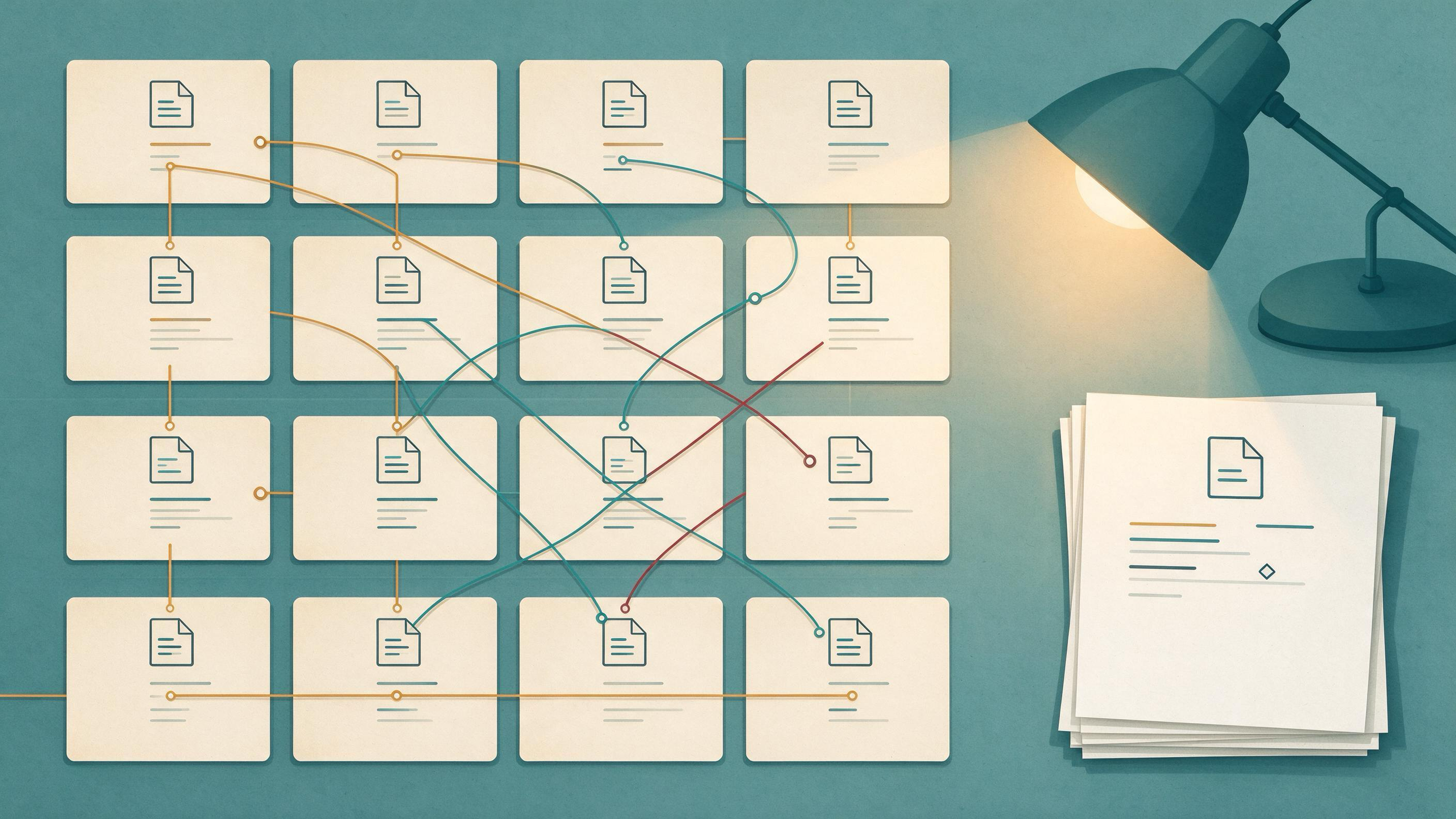
You have a folder of clean one-paragraph summaries, one per paper. You can describe any single study on request. What you cannot do is say what the body of work, taken together, actually shows — where the studies agree, where they diverge, and what the divergence means for your manuscript. That gap is not a reading problem. It is a method problem, and it is fixable with a small set of decisions and artifacts.
This article walks through the repair using a concrete case: a researcher revising a manuscript whose literature section reads as a list of studies rather than an argument. The same steps apply to a coauthor handoff, a peer-review response, a lab handoff, or a reproducible search for a new review.
Why summaries alone cannot produce a pattern
A summary is a compression of one source. A pattern is a claim about a set of sources — that they cluster, conflict, or leave a gap. Those are different objects, and the second cannot be assembled by stacking the first.
Three things go missing when you work only from summaries:
- The comparison frame. A pattern requires that you compare studies on the same dimensions. Summaries written independently rarely share dimensions.
- The eligibility logic. Which papers belong in the set at all? Without a stated rule, your "pattern" is a pattern in whatever you happened to collect.
- The trail. A pattern claim in a manuscript has to be traceable back to specific studies and specific decisions. Summaries alone do not record why a paper was included, excluded, or weighted.
NIH guidance on scientific rigor treats careful assessment of prior knowledge, strengths, weaknesses, and knowledge gaps as core to rigorous practice. That is exactly the work a pile of summaries defers. The pattern is the assessment; the summaries are only inputs to it.
Diagnose your starting state before you write another summary
Before repairing anything, name what you actually have. Most stuck literature sections fall into one of a few recognizable states.
The flat file
You have many summaries and no shared structure. Each summary answers a slightly different question. This is the most common state and the easiest to repair, because the sources are already gathered.
The orphaned set
You have a pattern claim in your draft — "the literature consistently finds X" — but you cannot point to the studies that support it, or you can point to only two. The claim outran its evidence.
The undocumented search
You have a set of papers but no record of how you found them or why you kept them. Cochrane's guidance on searching is explicit that searches should be planned from eligibility criteria, drawn from multiple sources, combine free-text terms with subject headings, and be documented. If none of that happened, your set is a convenience sample, and any pattern you draw from it inherits that weakness.
The handoff gap
A coauthor or successor needs to continue the work, but the reasoning behind inclusion decisions lives only in your head. The artifacts do not exist.
Write down which state you are in. The repair differs by state, and naming it prevents you from re-summarizing papers when the real problem is an undocumented set.
Decide the comparison frame first
A pattern is a comparison, and a comparison needs fixed dimensions. Before touching another paper, define the columns you will extract from every study.
Useful dimensions usually include:
- Population or material studied — who or what the finding applies to.
- Design or method — how the evidence was generated.
- The specific claim tested — stated narrowly enough that two studies can agree or disagree.
- Direction and size of the reported result — described in the study's own terms.
- Stated limitations and boundary conditions — where the authors say the finding stops applying.
Keep the frame small. Five to seven dimensions that every included study can populate will produce a usable pattern; twenty dimensions will produce a spreadsheet nobody finishes. The test of a good frame is that you can look down any column and see variation.
This is also where you decide what counts as agreement. Two studies "finding the same thing" at different populations and different designs may not be agreeing at all. Write your agreement rule down before you apply it, so you are not fitting the rule to the result you hoped for.
Rebuild the evidence set with a documented search
If your set is undocumented, rebuild it. Cochrane's search guidance gives a workable sequence: derive terms from your eligibility criteria, search more than one source, combine free-text and subject terms, record what you ran and where, deduplicate, and screen in stages. Rerunning searches before publication is part of that discipline.
For the practical search itself, a scholarly search interface lets you run and refine queries against academic literature. WisPaper's scholarly search interface is the place to run those queries; if you want a public explanation of what the search entry point offers before you start, the Scholar Search page describes it.
Record, as you go:
- The exact query strings and the sources searched.
- The eligibility criteria you applied, written before screening.
- The count at each stage: retrieved, deduplicated, screened out, included.
- The reason for each exclusion at full-text stage.
That record is what turns a pile of papers into a defensible set. It is also what a coauthor needs to pick up the work.
Screen in stages and keep the reasons
Screening is where most pattern claims quietly break. If you exclude studies that complicate your narrative without recording why, the pattern you report is an artifact of your screening.
Screen in two passes. First, screen on title and abstract against your written criteria. Then screen full texts. At each pass, record the reason for exclusion in a fixed vocabulary — wrong population, wrong design, no relevant outcome, duplicate report of an included study. Cochrane's guidance notes that multiple reports of one study should be linked rather than counted as separate evidence; a pattern built on double-counted reports is inflated.
When you save papers for the set, keep them organized so the included, excluded, and pending records stay distinguishable. WisPaper's My Library is where you can save or upload papers and organize them; use it to hold the set you are actively screening rather than as an undifferentiated dump.
Extract into a matrix, not into prose
The artifact that produces a pattern is a study-by-dimension matrix. One row per included study, one column per dimension from your frame, plus a column for the source location of each extracted statement.
Rules that keep the matrix honest:
- Extract, do not interpret, at this stage. Put the study's own reported result in the cell. Interpretation comes later, in a separate column or a separate pass.
- Cite the location. Page, section, or table for each cell, so the pattern claim can be traced back.
- Leave cells empty rather than guessing. A blank cell is information: it tells you the study did not report that dimension, which is itself a finding about the literature.
- Do not merge linked reports. If two papers report one study, one row, with both sources noted.
Once the matrix is populated, read down the columns. Variation in a column is a candidate pattern. A column where every study reports the same thing is a candidate consensus. A column full of blanks is a candidate gap. You are now reading the literature rather than reading summaries.
Turn the matrix into an explanatory claim
A pattern statement has three parts: what varies, what is consistent, and what explains the difference. The matrix gives you the first two directly. The third requires you to look for a variable that co-varies with the outcome — design, population, measurement approach, or era of the study.
Write the claim in a form that can fail. "Studies using design A report larger effects than studies using design B" is a claim you can check against your matrix. "The literature broadly supports X" is not.
Then stress-test it:
- Count the studies behind each side. A pattern resting on one study on one side is a hypothesis, not a finding.
- Check the blanks. If the studies that would test your explanation did not report the relevant dimension, say so.
- Look for the counterexample. Find the study that most resists your explanation and address it explicitly in the text.
This is the step where the manuscript changes from a list to an argument. The pattern claim, the studies supporting each side, and the boundary conditions all come from the same matrix, so the prose and the evidence stay aligned.
Use question-answering against your own set, carefully
Once the set is assembled and organized, you can interrogate it directly. WisPaper's Library QA lets you ask questions based on papers uploaded to My Library or added from search results. Used well, it shortens the loop between a question about your set and the passages that bear on it.
Use it for questions your matrix can verify: "Which included studies report outcomes in population Y?" or "What limitations do the included studies state about measurement?" Then check the answer against the matrix and the source text before it enters the manuscript. The matrix remains the record of what you decided; the question-answering step helps you find passages faster, not replace the extraction.
For longer stretches of work — assembling a literature review, developing an angle, or planning a reproduction — WisPaper's Scholar Agent area is built for those extended tasks. Keep the matrix as the artifact you carry between tools, so the reasoning survives whichever interface you use.
Verify the references before the pattern goes to coauthors
A pattern claim is only as good as the references under it. Before circulating the revised section, check that every citation resolves to a real, correctly described source. Fabricated or mismatched references are a known failure mode when references are assembled quickly.
WisPaper's TrueCite checks BibTeX against real academic databases to flag hallucinated references. Run your bibliography through it before the handoff, and reconcile any flags against your matrix rows. A reference that fails the check is a row you cannot rely on, and any pattern claim resting on that row needs to be re-examined.
Assemble the deliverable and the method trail
When the repair is done, you should be able to hand over a package, not just a paragraph. The package has four parts:
- The pattern statement, written so it could fail, with the studies on each side named.
- The matrix, with source locations for every extracted cell.
- The search and screening record, with queries, criteria, counts, and exclusion reasons.
- The verified reference list, checked against real databases.
If the work sits inside a larger project with coauthors, keeping these artifacts together in one place matters as much as producing them. WisPaper's Research Projects area is where you can create and hold a project; use it to keep the matrix, the search record, and the reference list alongside each other so the trail travels with the work.
For reporting, PRISMA 2020 provides a checklist, expanded explanations, an abstract checklist, and flow-diagram templates for original and updated systematic reviews, covering transparent reporting of search, selection, and synthesis methods. If your work is a systematic review, map your search and screening record onto the PRISMA flow diagram; the counts you kept during screening are exactly what the diagram needs.
Know when the result is ready
The revised section is ready when a reader can do four things without asking you:
- Locate the claim. They can find the pattern statement and see it is narrower than the evidence behind it.
- Trace each side. For every group of studies in the claim, they can follow the citation to a matrix row and from the row to the source location.
- Reproduce the set. They can rerun your queries against your stated criteria and arrive at a comparable set.
- See the boundaries. They can read where the pattern stops applying, including the blanks in the matrix and the counterexample you addressed.
If any of those four fails, the pattern is still in your head rather than in the manuscript. That is the real test — not whether the prose reads smoothly, but whether the reasoning survives the handoff.
Transferable lessons for the next review
The repair generalizes. Four habits carry over to any new literature task:
- Define the frame before collecting. The comparison dimensions determine what you extract, and extraction determines what pattern you can see.
- Document the search as you run it. Cochrane's sequence — criteria first, multiple sources, combined terms, recorded process, staged screening, linked reports, rerun before publication — is a template you can follow from day one rather than reconstruct afterward.
- Keep extraction separate from interpretation. The matrix holds what the studies reported; the pattern claim is your reading of the matrix. Mixing them is how summaries become unfalsifiable.
- Verify references before they travel. A bibliography check belongs in the workflow, not in a panic before submission.
A summary tells you what one paper says. A matrix, a documented search, and a verified reference list tell you what the literature shows — and let someone else check that you are right.
FAQs
Keep Reading

You Have 300 Saved Papers and No Reading Priority
A library of 300 saved papers is not a reading list. It is a pile. The pile grew because saving was cheap and deciding was expensive: every search result that looked relevant went into a folder, and no one ever asked whi

You Return to a Thesis Chapter After Six Months Away
You open the file and the cursor sits where you left it in June. The chapter has a title, three sections, a comment from your supervisor you no longer understand, and a reference list you cannot vouch for. The task is no

Your Client Deck Uses a Number from an Unknown Version of a Report: A Provenance Repair Playbook
A figure is sitting in slide 14 of a client deck. It has a citation, but the citation points to a report title with no version, no date, and no page. Someone on the team pulled it months ago, and nobody can say whether i