
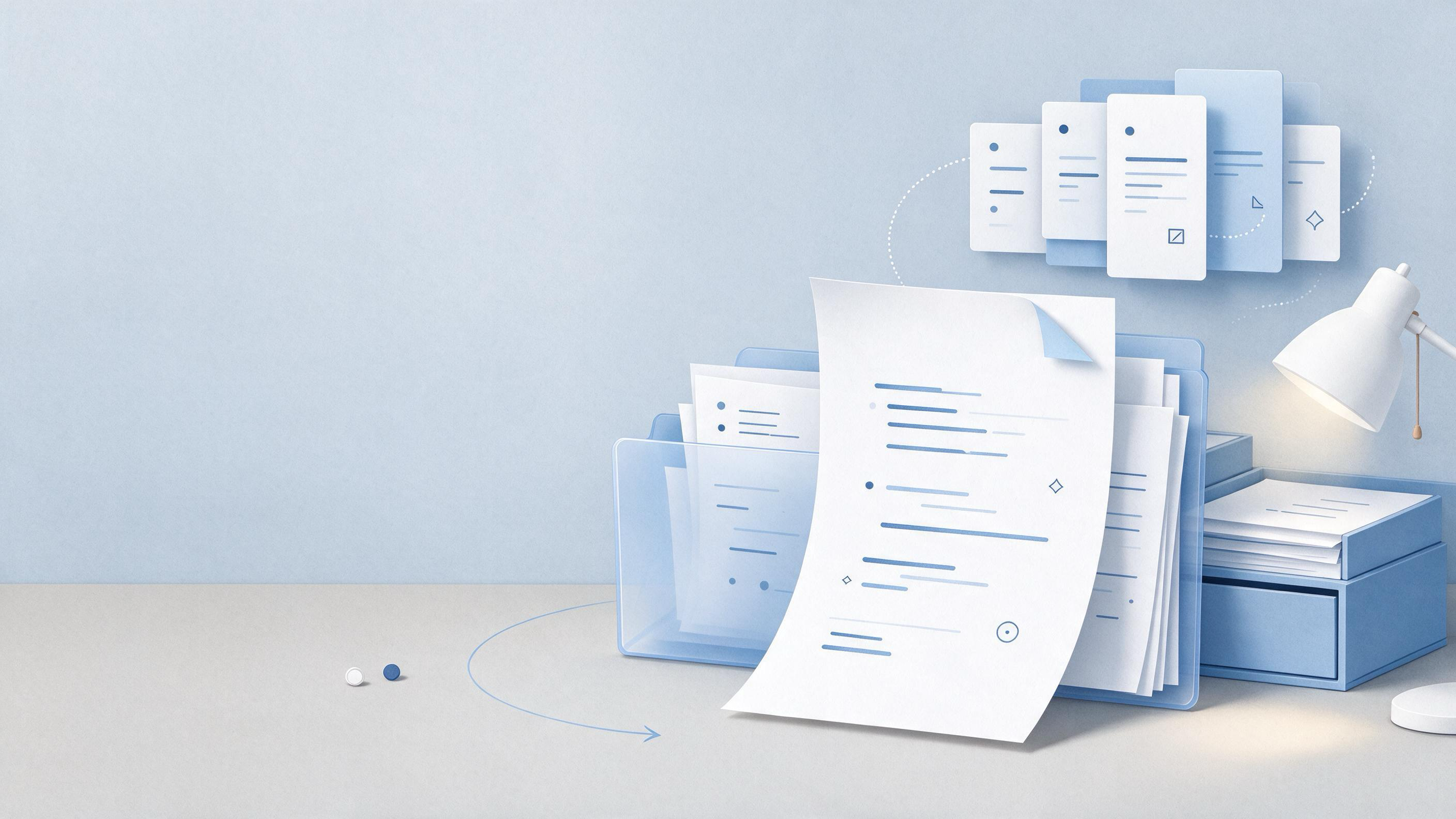
At the end of a long project, six files named Final, Final_v2, Final_FINAL, and Really_Final are a sorting problem, but they are also a record-keeping failure. The exact content of one manuscript has become unrecoverable by filename alone, and the chain of decisions that produced it is no longer auditable. This article shows how to repair that state, choose one authoritative version, and reset the folder so the next submission or review round does not recreate it.
What is actually wrong in the folder?
The observed symptom is duplicate final versions. The underlying problem is usually one of three things: versions were numbered by mood rather than date, multiple people saved to the same location, or comments and files from a review round were mixed into the manuscript folder. The fix is not to guess which file is correct. It is to restore the trail that should have been visible from the start.
A folder is a small expression of a larger principle. Research data and supporting documents are easier to find and reuse when files have meaningful names, documented versions, and suitable formats, together with supporting documentation. When six files share the same name, none of those conditions holds.
Which file is the actual final manuscript?
Start with an inventory, not with an opinion. Open each of the six files and record three facts: the last modified timestamp, the author who saved it, and the first meaningful difference you can see. The most recent timestamp often names the true final, but chronology alone is not enough; a colleague may have opened an old copy and saved it accidentally while forwarding comments.
Use the document's own track-changes and comment history where available. If one file contains acceptance of all reviewer edits and another contains only a subset, the accepted version is the better candidate. Record that comparison in a short changelog: filename, timestamp, author, and one line explaining what makes that file distinct. The purpose is not to argue in the changelog but to make the decision later reproducible.
How do you restore an auditable method trail?
Once you identify the authoritative file, move every other file into an archive/ subfolder rather than deleting them. Add a short README that names the selected manuscript, gives its date and version, and lists the archived candidates with a one-line reason each was superseded. This preserves provenance while leaving a clean working directory.
The same thinking applies to the evidence behind the manuscript. The FAIR principles describe research objects as findable, accessible, interoperable, and reusable, with persistent identifiers, rich metadata, provenance, and clear usage conditions. A manuscript is a research object like any other: the final PDF should carry enough surrounding information that a new reader, or your future self, can see how it was reached.
Where do peer-review materials belong?
Reviewer responses, rebuttal letters, and marked-up copies are records of the submission process, not versions of the manuscript. Separate them into a reviews/ folder keyed by round: review_round1/, review_round2/. Inside each, store the reviewer comments, the decision letter, and the point-by-point response. The manuscript that accompanies a round belongs next to those materials, not in a flat pile of files named Final.
This separation also changes how a team reads the folder. A coauthor looking for the current manuscript sees exactly one candidate. A colleague auditing the project can follow the review history without opening six files. The repair is complete when the folder answers two questions without explanation: which file is the manuscript, and where is the history.
What should the correction look like when it is finished?
A corrected submission folder has a stable name for the manuscript that includes a date and version, such as manuscript_2025-01-17_v2.docx. It has no competing files named Final. It has an archive/ folder containing the old versions and a short log, and it has a reviews/ folder containing round-specific records.
The result is ready when three checks pass. First, every member of the team can point to the same file without asking. Second, the last change to the manuscript is described in the log, not implied by a filename. Third, a person who joins the project can reconstruct why the current version won without access to anyone's memory.
How do you prevent six Finals in the next project?
Versioning works best when it is a convention, not a mood. Agree on a simple scheme such as YYYY-MM-DD plus a sequential version, and put it in the shared folder's README at project start. Zotero collections can also support this outside the folder itself: the same item can be organized in multiple project groupings without duplicating it, while tags can record topics, methods, or workflow status. The benefit is that the project's references remain one canonical set even as the manuscript moves through rounds.
For the manuscript text, the convention is simpler to state than to enforce across a team. One person should own the role of merging edits and saving the next numbered version. If work must happen in parallel, each contributor adds a short suffix such as v3_alice and submits to the owner, who then produces v4. The owner also updates the log. This keeps the folder clean while preserving individual work in the archive.
How can WisPaper Search and My Library help you trace evidence?
The same discipline applies to the references and sources that feed the manuscript. When a revision requires a new citation or a changed method justification, a scholar search can find academic papers through WisPaper search. Once relevant works are found, they can be saved or uploaded and organized in My Library, so the project's evidence base has one home rather than scattered browser tabs.
This is especially useful at the revision stage. A reviewer asks for a source on a specific claim, and instead of reconstructing the search from memory, the team has a library where the papers that shaped the argument are already collected. Keeping that library current is part of the same folder hygiene that stops six files named Final from appearing.
How do you check that the citations in your final manuscript are real?
A corrected folder can still contain a corrupted reference list. When the final manuscript is assembled, the bibliography deserves the same forensic check as the filename. TrueCite checks BibTeX against real academic databases to flag hallucinated references, which makes it useful before the final bibliography is locked.
Run the check before submitting or resubmitting. If a citation has been altered during editing, or a placeholder was never replaced, the flagged entry can be corrected while the source document is still open. The correction becomes part of the same changelog and becomes repeatable if the check is run again after the next revision.
What does a year-end reset look like?
A submission folder is also a natural point for a reset between projects. Archive the working files, preserve the review history, and create a new project space for the next manuscript. In WisPaper, Research Projects is the area where a new project can be created, which separates the next work from the evidence trail just closed.
The reset does not mean abandoning the old materials. It means marking them as complete and moving the active work into a clean container. The same principles that repaired six files named Final, naming, separation, and a log, now apply to the project boundary. The next folder starts with one manuscript file and a documented plan.
FAQs
Keep Reading
Your Supplementary File Contains an Outdated Table: A Submission-Ready Repair Protocol
A reviewer returns your manuscript with one line that lands harder than a full rejection: *"Your supplementary file contains an outdated table."* The immediate problem is clear—a table in the supplementary materials no l
Your Reference Library Contains Years of Unsorted Imports
The concrete failure is familiar: you open your reference library to prepare a rapid evidence brief, meet a wall of unlabeled PDFs, duplicate records, and imports with no usable metadata, and realize you cannot say which
Your Abstract Still Describes an Earlier Version of the Results
The warning appears after the third round of supervisor feedback. The abstract promises a direct effect, but the final regression table now shows a null result and an unexpected interaction. The title still lists the var