
1000 Songs: Bridging the Gap in Music Emotion Recognition with Open Data
000 songs for emotional analysis of music
The paper introduces the "1000 Songs" dataset, a large-scale collection of Creative Commons music from the Free Music Archive (FMA) annotated for emotional analysis using both static and dynamic (second-by-second) Valence-Arousal (V-A) scales. It establishes a benchmark for Music Emotion Recognition (MER) and provides a baseline system using Multivariate Linear Regression on standard acoustic features.
TL;DR
The "1000 Songs" project addresses the "copyright deadlock" in music research by providing a 1,000-track dataset of Creative Commons music (from FMA) fully annotated for emotion. Using a specialized crowdsourcing pipeline, the researchers captured both static and time-varying (dynamic) Valence and Arousal scores, creating a robust benchmark that demonstrates Arousal is far easier to automate than the nuanced perception of Valence.
Context: Why Music IR is Hard
In the world of Music Information Retrieval (MIR), emotion is the "holy grail." We index music by mood, yet training machines to recognize mood requires massive amounts of audio data. Historically, researchers faced a dilemma: use copyrighted pop music (which they can't share, making results unrepeatable) or use small, private datasets (which lack scale). Furthermore, emotion is subjective—one person's "relaxing" is another's "boring."
The "Crowd" Filter: Methodology
To solve the data bottleneck, the authors turned to Amazon Mechanical Turk but recognized that "noisy" labels are the bane of affective computing.
1. The Quality Control Pipeline
Instead of allowing any worker to participate, they implemented a two-step screening:
- The Qualification Test: Workers had to describe music accurately and identify whether Arousal/Valence was increasing or decreasing in controlled clips. Only 12.8% of initial applicants eventually made it to the main task.
- The Interface: A custom HTML5 slider allowed for real-time annotation as the song played, capturing the "flow" of emotion rather than just a single summary tag.
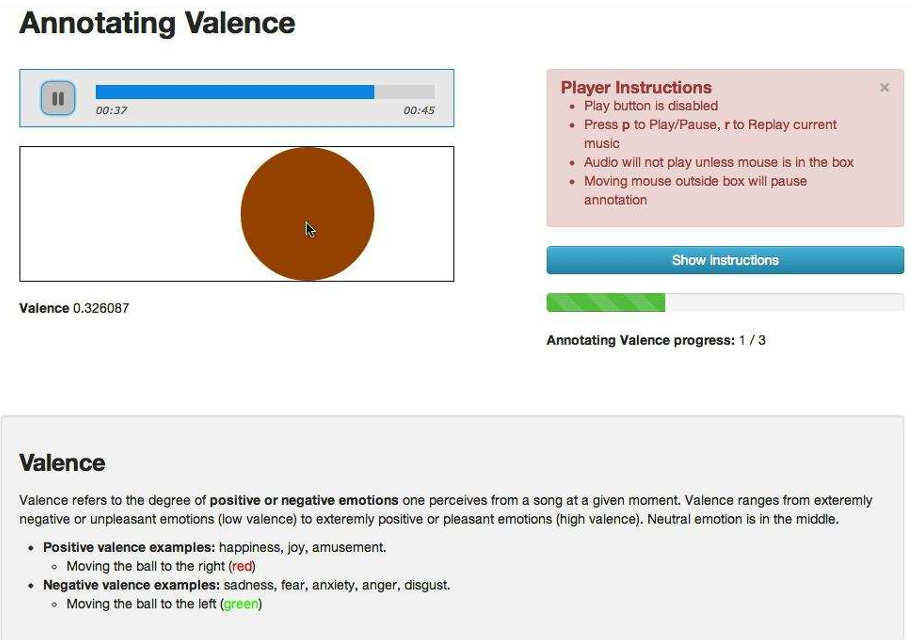 Figure 1: The dynamic interface used to capture per-second emotional shifts.
The Results: The Persistent "Valence Gap"
The authors established a baseline using Multivariate Linear Regression (MLR) on features like MFCCs, Spectral Contrast, and Chromagrams. The findings confirmed a long-standing frustration in the MER community:
- Arousal is "Physical": Features like loudness and spectral centroid correlate strongly with Arousal (). If a song is loud and fast, it’s high-energy. Machines "get" this.
- Valence is "Psychological": Predicting whether a song is happy or sad (Valence) remains near chance levels (). This suggests that current acoustic features fail to capture the harmonic and cultural nuances that define "pleasantness."
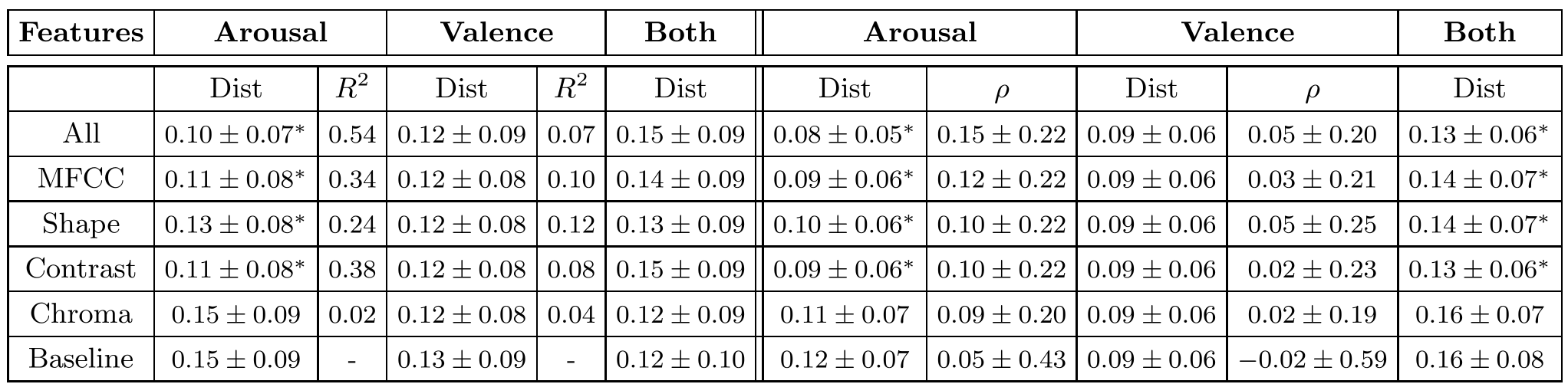 Table 1: Baseline performance showing the drastic difference between Arousal and Valence prediction accuracy.
Deep Insights: The "Energetic" Bias
One fascinating finding was the effect of the annotator's own state. Through the use of "nonsense words" to measure mood—a psychological technique called IPANAT—the researchers found that workers who felt more "energetic" tended to rate music as having higher arousal and valence. This highlights the Inductive Bias inherent in human-labeled datasets: the label is not just a property of the music, but a product of the listener-music interaction.
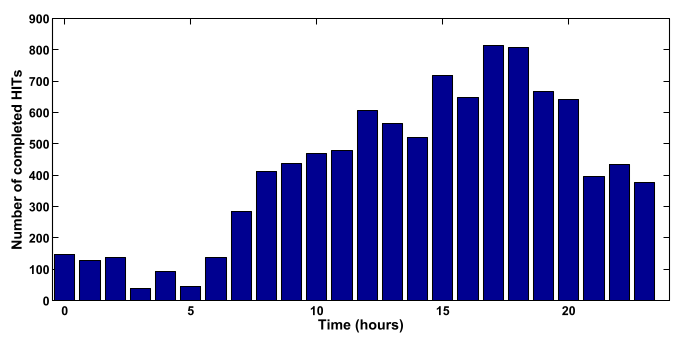 Figure 2: The correlation between the worker's self-reported "energetic" state and their emotional ratings of the music.
Conclusion & Future Impact
The "1000 Songs" dataset remains a foundational contribution to the MediaEval benchmarking campaigns. Its value lies not just in its size, but in its openness. By choosing Creative Commons audio, the authors allowed the community to stop arguing over feature extraction and start comparing model architectures directly.
Takeaway for the Industry: For AI music recommendation systems (like those in Spotify or Apple Music), Arousal is a solved problem for sorting by "intensity." However, achieving high-fidelity "mood" matching (Valence) still requires moving beyond traditional spectral features into deep, context-aware embeddings.
Limitations: The baseline used linear models. Modern transformers and CNNs would likely fare better, yet they would still struggle with the intrinsic subjectivity revealed by the low inter-annotator agreement scores noted in the paper.