
Petimo: Redefining Child Safety through Tangible Social Networking
108_Petimo children's companion for safe social networking.
Petimo is an interactive robotic toy and dual-platform system (Physical Robot + Petimo World 3D) designed to enable safe social networking for children aged 7-9. It introduces a "Physical Proximity" verification gate for friend requests to eliminate online predatory risks.
TL;DR
Petimo is a pioneering cyber-physical system designed at the National University of Singapore. It addresses the growing danger of online social networks for children by requiring physical interaction to grant digital access. By combining a cute robotic "avatar" with a virtual 3D world, it ensures that a child's social circle is limited to people they have met in the real world.
Background & Motivation: The Danger of the Digital Playground
As social networking becomes a cornerstone of modern childhood, the risks—ranging from cyber-bullying to digital predation—have scaled exponentially. Previous solutions relied heavily on parental monitoring software, which can be bypassed or feel intrusive. The authors identified a core gap: the lack of a physical "handshake" in the digital world. For children aged 7-9, the boundary between the "real" and "virtual" is porous; Petimo exploits this by making social connection a tangible, safe, and fun ritual.
Methodology: Bridging the Virtual and the Physical
The Petimo system operates on a dual-layer architecture:
- The Physical Robot: A tactile interface that acts as the child's guardian and pet. It uses haptic sensors to detect "squeezes" and outputs visual/audible joy when a friend sends a digital gift.
- The Physical Handshake: To add a friend, two children must bring their Petimo robots into close proximity. This creates a "safe zone" verified by physical presence, effectively locking out strangers.
- Petimo World: A 3D virtual environment where social hierarchies are visualized spatially. Children can interact through personalized avatars and send emoticons that trigger real-world responses in their friend's robot.
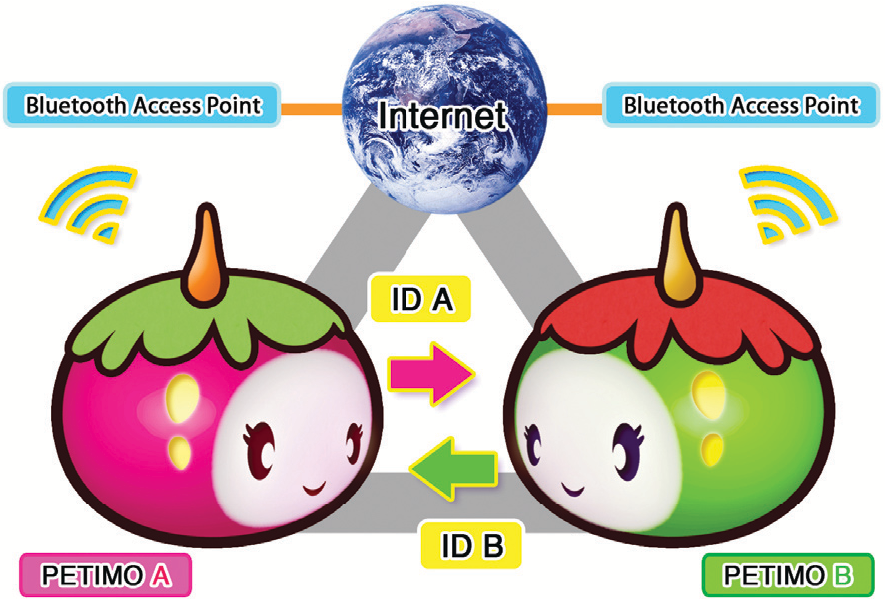 Figure 1: The Petimo robot serves as a physical mediator for virtual social interactions.
Why This Works: Haptic Social Bonds
Unlike a smartphone screen, Petimo provides multimodal feedback. When a child receives a "gift" in the Petimo World, the robot doesn't just show a notification; it beams with a joyful face and emits a trilled sound. This "Haptic Emoticon" system strengthens the emotional connection between peers.
Key Technical Features:
- Proximity-based Authentication: Eliminates the threat of "anonymous" friends.
- 3D Spatial Visualization: Helps children grasp the abstract concept of "social distance" by seeing their friends arranged in a 3D world based on closeness.
- Tactile Interaction: Supports developmental needs for touch and physical play.
 Figure 2: Children engaging with the Petimo robot to navigate the social 3D world.
Critical Insight & Future Outlook
The genius of Petimo lies in its Inductive Bias toward safety: by making the digital world secondary to the physical world, security becomes a default rather than an afterthought. While the 2009 hardware might look nostalgic today, the core concept of "Proof of Proximity" is more relevant than ever in the age of Deepfakes and AI-driven social engineering.
Future iterations of this tech could potentially use Bluetooth LE or NFC for more sophisticated proximity detection, or even integrate with modern Metaverses to ensure that "friendship" remains a high-trust, physical-first relationship.
Conclusion
Petimo successfully proves that the best way to protect children in cyberspace is to ground their digital identity in their physical reality. It is a masterclass in designing for a specific, vulnerable demographic by transforming security protocols into a playful, robotic companion.