
ISS: Bridging Social Media Intelligence and Urban Intervention
10866_Generic architecture of a social media-driven intervention support system for smart cities.
The paper introduces a "Generic Architecture of a Social Media-driven Intervention Support System (ISS)" for smart cities. It leverages a four-stage data pipeline to identify and target specific user groups on social media to facilitate public awareness campaigns, exemplified through an implementation targeting gender-based violence (GBV).
TL;DR
Researchers have developed a Generic Architecture for an Intervention Support System (ISS) designed to help smart city organizations move beyond simple data collection. By integrating social-psychological theories with distributed computing, the system identifies target audiences for public service campaigns—such as those addressing gender-based violence—by modeling latent biases and predicted social actions.
Background & Positioning
In the evolution of Smart Cities, social media has moved from a communication toy to a critical data frontier. While previous works focused on predicting trends (like flu outbreaks or box-office hits), this paper focuses on intervention. It positions itself as a bridge between complex behavioral modeling and practical organizational workflows for NGOs and government agencies.
The Problem: Noise vs. Nuance
The primary bottleneck in modern urban analytics isn't a lack of data; it's the "Sensemaking Gap." Prior works often struggled with:
- Linguistic Noise: Sarcasm, slang, and grammar-free posts.
- Scale: The sheer volume of "Big Social Data" overwhelms traditional analysis tools.
- Static Analysis: Most tools look at what was said, rather than why a user might act on it (e.g., why they retweet a specific stereotype).
The authors argue that to be effective, a system must understand the behavioral psychology behind the screen.
Methodology: Socio-Psychological Modeling
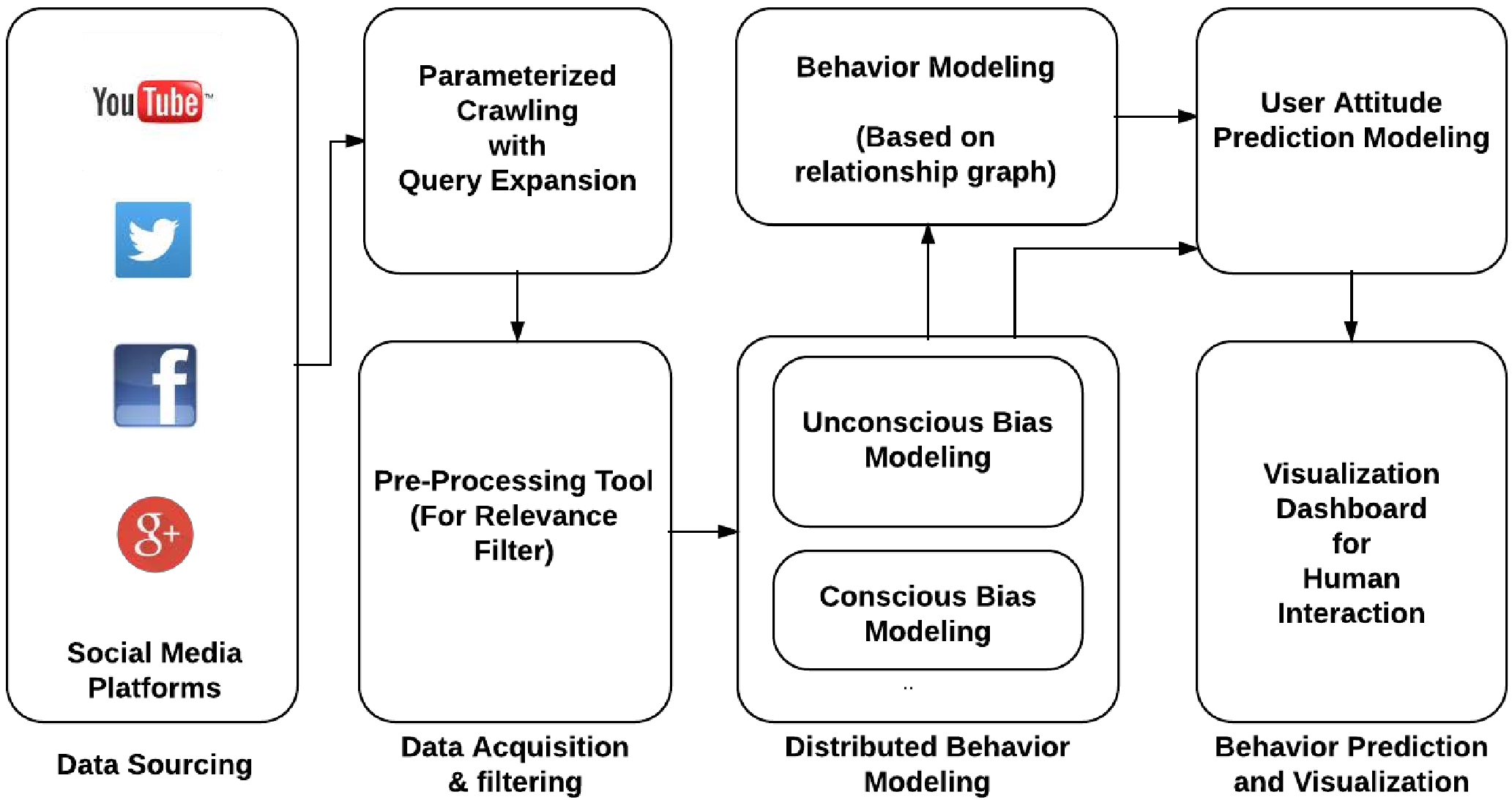
The ISS architecture is defined by a clean, four-stage pipeline:
- Data Sourcing: Utilizing Streaming APIs from platforms like Twitter.
- Acquisition & Filtering: Narrowing down to specific events or localized bounding boxes.
- Distributed Behavior Modeling: This is the "brain" of the system. It calculates:
- Unconscious Bias (): Measuring the divergence in how users interact with different demographic groups (e.g., male vs. female mention patterns).
- Conscious Bias (): Calculating aggression through target-specific sentiment analysis using specialized lexicons.
- Prediction & Presentation: Using these behavioral traits as features to predict future actions (like retweets) and presenting them via an interactive dashboard.
The Physics of Attitude
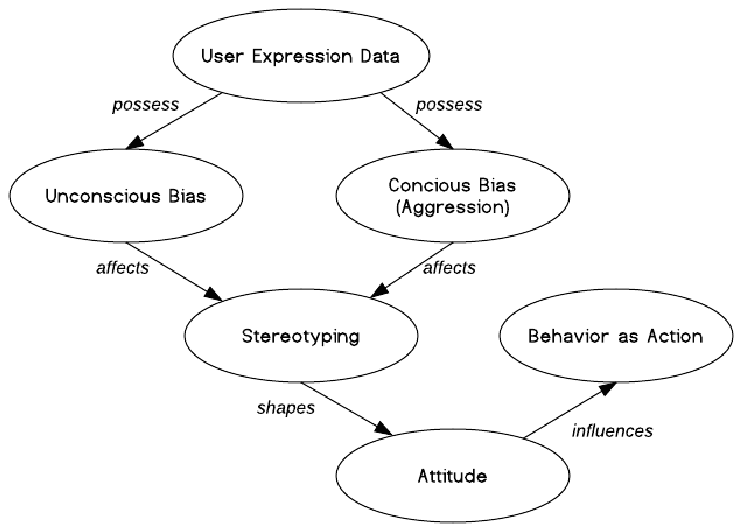
The authors don't just use black-box ML. They utilize a Relationship Graph Model based on the theory of the Implicit Association Test (IAT). By mapping the distance between a user's intent, their sentiments, and their final actions, the system can infer a "Stereotypical Attitude" even when the user isn't being overtly aggressive.
Case Study: Fighting Gender-Based Violence (GBV)
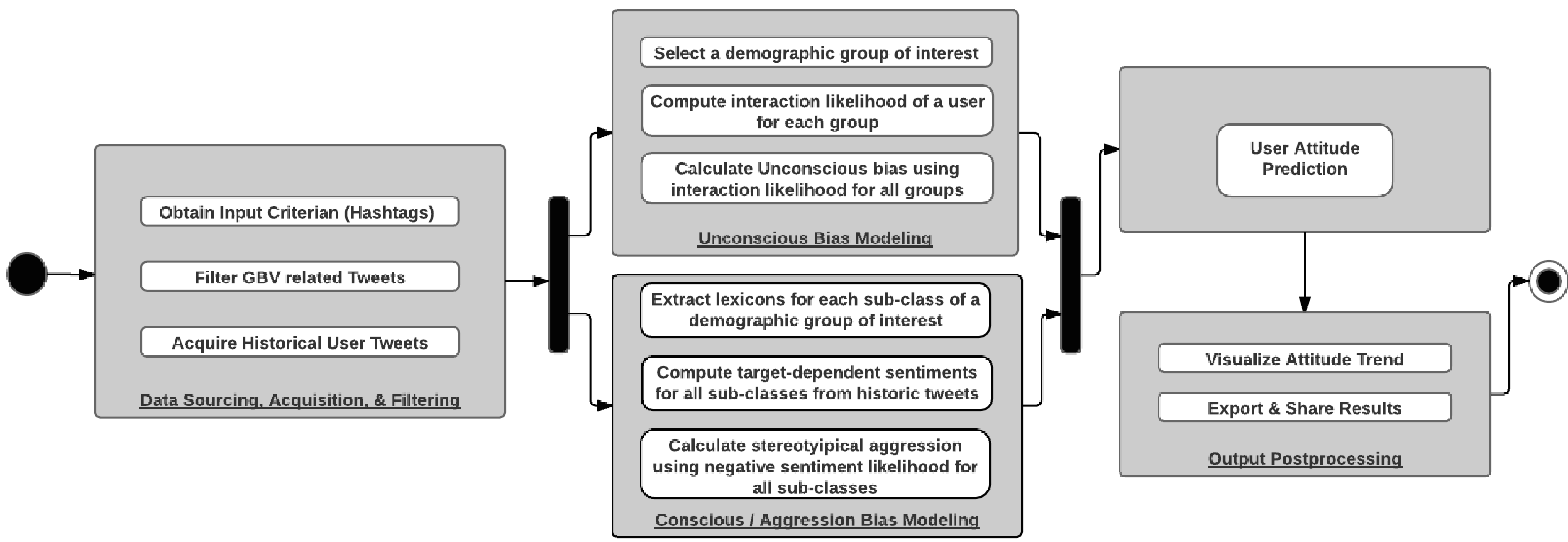
To prove the architecture works, the authors implemented it for a campaign against GBV.
- The Input: Raw tweets containing keywords like "harassment" or "sexual assault."
- The Model: It identifies users who exhibit strong gender biases or aggressive tendencies toward specific social lexicons.
- The Goal: Recommendations for NGOs to "curb the crisis" by targeting awareness campaigns specifically toward high-influence, high-bias user clusters.
Critical Analysis & Future Horizon
Takeaways
The real value of this work lies in its modularity. By swapping out the lexicon or the interaction metrics, the ISS can be repurposed from fighting GBV to monitoring political radicalization or public health skepticism. It provides a formal framework for "Computational Social Science" to enter the operational theater.
Limitations
- Scalability: While built for distributed frameworks, the real-time processing of historical profile data (backfilling) for thousands of users is resource-heavy.
- Platform Specificity: Behavior on Twitter (retweets) is very different from behavior on Instagram (likes) or TikTok (shares). The model currently focuses heavily on text-based interaction.
Conclusion
As smart cities become more "connected," the ability to intervene in digital social crises becomes as important as managing physical traffic or waste. This ISS architecture provides the blueprint for a more proactive, psychologically-aware urban governance.