
Synergistic Face Clustering: Beyond Pixels to Social Networks in Cinema
113_Clustering Faces in Movies Using an Automatically Constructed Social Network.
This paper proposes an iterative framework that integrates face clustering with the automatic construction of social networks in movies. By leveraging character interaction cues—such as coappearance and shot alternation—the method refines facial similarity metrics to bridge the gap between low-level visual features and high-level social structures.
TL;DR
Recognizing faces in movies is notoriously difficult due to "intrapersonal variation"—the same actor looks different in a dark bar than on a sunny beach. This paper breaks the reliance on pure appearance by building an automatic social network from character interactions. By understanding "who talks to whom," the system achieves a massive 26.7% boost in clustering quality (NMI) by using social behavior as a corrective lens for visual similarity.
Problem & Motivation: The Appearance Trap
In a feature-length film, a character's face is a moving target. Lighting changes, makeup evolves, and expressions shift. Current SOTA methods like the Associate-Predict model try to solve this by associating faces with a generic memory of poses and lighting. However, even these struggle when two different characters are filmed in the same lighting (high inter-personal similarity) or when a main character appears in vastly different settings (high intra-personal variation).
The authors' insight is simple yet profound: Characters in a movie are not random individuals; they exist within a structured social fabric. If two face clusters exhibit the same pattern of interaction with other "anchor" characters, they are likely the same person, even if they look different visually.
Methodology: Bridging the Gap
The framework operates in a loop: Initial clustering provides a noisy social graph, which is then used to refine the clustering, which in turn cleans the social graph.
1. Constructing the Social Network
Instead of just looking at who is in the same frame (coappearance), the authors use film-editing cues. They track shot alternations—if Character A and Character B appear in alternating shots, they are interacting. This captures relationships even when the characters aren't on screen together (e.g., a phone call).
2. The Anchor Set & Social Proximity
To handle noise, the system selects an Anchor Set—typically the main characters who have the most distinct interaction patterns. Each face cluster is assigned a "social feature vector" based on its connection to these anchors.
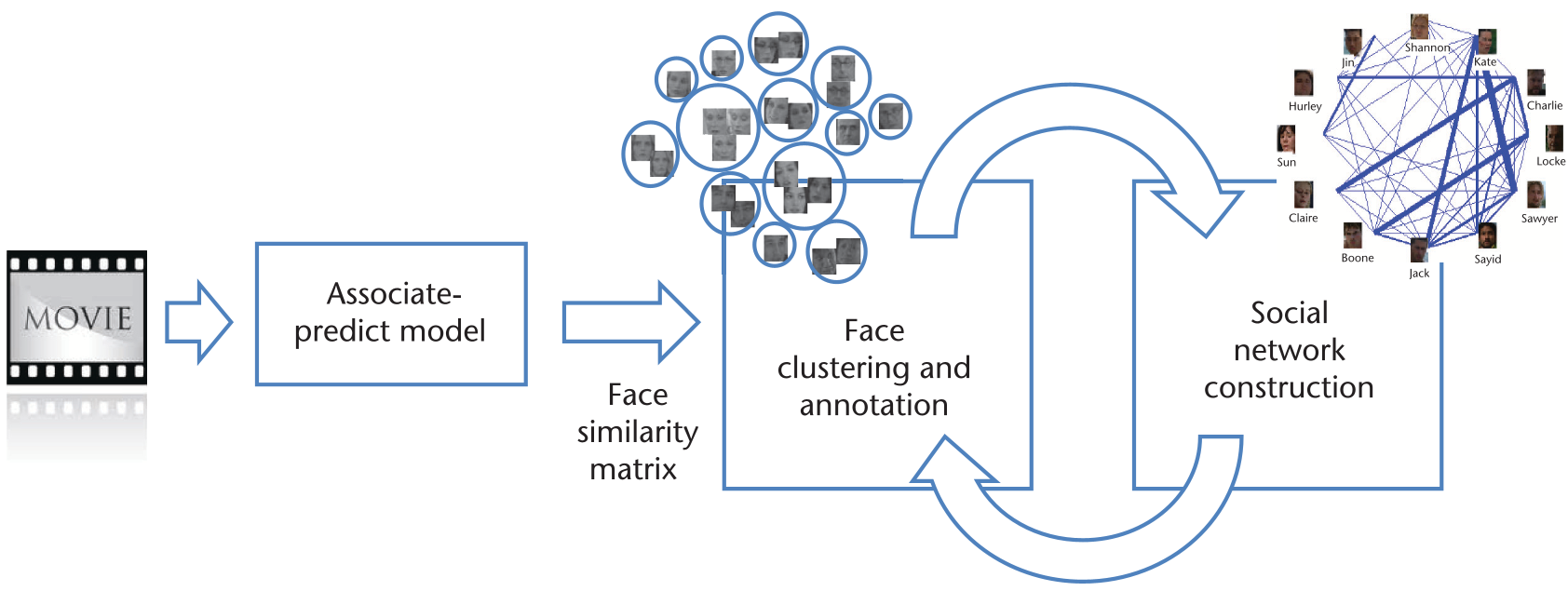 Figure 1: The iterative loop between face clustering and social network construction.
3. Mathematics of Social Logic
The similarity between two clusters and is defined by two factors:
- Related Info: Do they talk to the same people? (Cosine similarity of social vectors).
- Unrelated Info (The "0-0 Match"): Do they both ignore the same people? This "negative" cue is surprisingly discriminative in the limited social world of a movie.
Experiments & Results: Quantitative Breakthroughs
The team tested their approach on five films and two sitcoms, processing over 320,000 face images.
- The Devil Wears Prada Case Study: When comparing the appearance-based baseline to the social-enhanced version, the NMI (Normalized Mutual Information) jumped significantly across various cluster preferences.
- Iterative Evolution: The social graph actually "evolves." As the clustering gets cleaner, the social graph starts to mirror the ground truth, as shown in the visual comparison below.
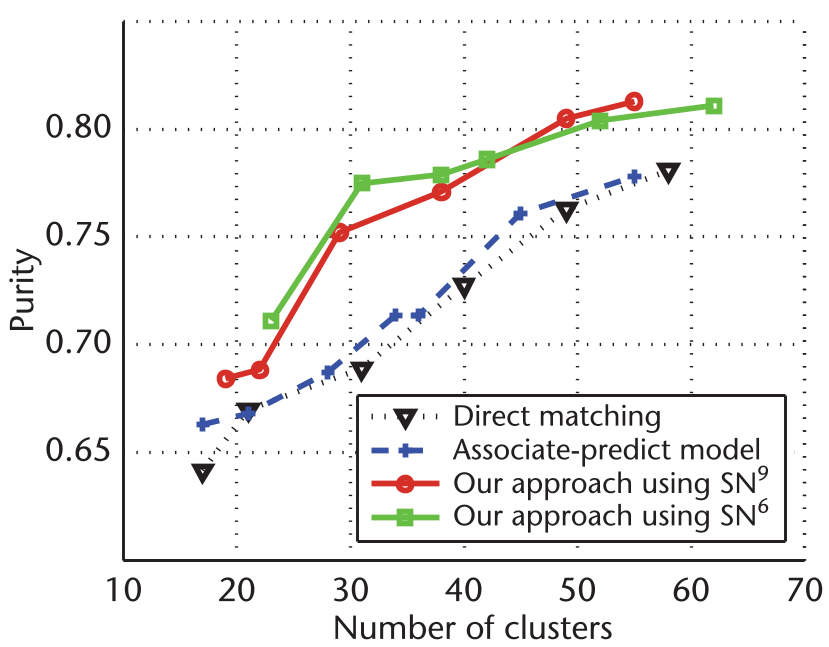 Figure 2: Performance gains in Purity (a) and NMI (b) using social cues.
Critical Analysis & Future Outlook
The beauty of this method lies in its computational efficiency. The social network construction is , and the similarity calculation is fast enough to process a two-hour film in seconds.
Takeaway: This work marks a shift from "Generic Vision" to "Contextual Vision." It proves that in domain-specific tasks (like movie analysis), the metadata—the relationships and story structure—is just as important as the pixels themselves.
Limitations: The system still relies on a decent initial appearance-based cluster. If the first pass is too noisy, the "anchor set" might be invalid. Future work could incorporate Audio features (speaker recognition) or Script analysis to further ground the identity of these social nodes.
Conclusion
By treating a movie as a social network rather than a sequence of images, the authors have provided a robust path toward fully automated media management, where "searching for an actor" becomes as reliable as searching for a keyword.