
SOLVER: Bridging the Gap Between Online Social Circles and Vehicular Ad-Hoc Networks
12261_SOLVER A Framework for the Integration of Online Social Networks with Vehicular Social Networks.
This paper introduces SOLVER (Social OnLine and social VEhicular netwoRks), a hybrid architectural framework that integrates centralized Online Social Networks (OSNs) with distributed Vehicular Social Networks (VSNs). By leveraging OSN social ties as a "virtual bridge," SOLVER effectively mitigates VSN connectivity holes and reduces OSN server load through opportunistic P2P data redirection.
TL;DR
SOLVER is a pioneering hybrid framework that merges the persistent, centralized world of Online Social Networks (OSNs) with the dynamic, opportunistic world of Vehicular Social Networks (VSNs). By allowing data to hop between OSN servers and V2V (Vehicle-to-Vehicle) links, it solves the "connectivity hole" problem in cars while reducing server strain for social platforms like Facebook or Twitter.
Background & Motivation: Two Worlds, Two Problems
In the current networking landscape, we have two dominant but disconnected paradigms:
- OSNs (e.g., Facebook, LinkedIn): Highly stable, centralized (Client-Server), but prone to server congestion.
- VSNs: Highly mobile, distributed (P2P), but plagued by frequent disconnections due to vehicle speed and sparse traffic.
The authors of SOLVER argue that these two should not exist in silos. If two drivers are "friends" on an OSN and are currently driving near each other, why should their data travel all the way to a central server and back? Why not use their existing social trust to facilitate a direct, local V2V exchange?
Methodology: The Hybrid Architecture
The core of SOLVER is its ability to perform seamless handovers between the centralized cloud and the local ad-hoc network.
1. The Multi-Layer Architecture
SOLVER is structured into four functional components:
- Mobile Platform: Handles the actual handover logic on the vehicle's OBU (On-Board Unit).
- Cloud Platform: The "brain" that matches OSN profiles with VSN positions.
- Web Application: Interface for users to interact with cached vehicular content.
- Security & Trust Platform: Uses OSN-based "honesty factors" to validate VSN interactions.
2. Communication Paradigms
The framework defines three ways data can move:
- Intra-VSN: Caching local vehicular data into the OSN cloud so it survives even after the vehicles drive away.
- Inter-VSN: Using OSN social tags (e.g., "Classmates," "Football Fans") to bridge two separate vehicular clusters that aren't in direct radio range.
- OSN Extension: "Offloading" OSN traffic to local V2V links to save backhaul bandwidth.
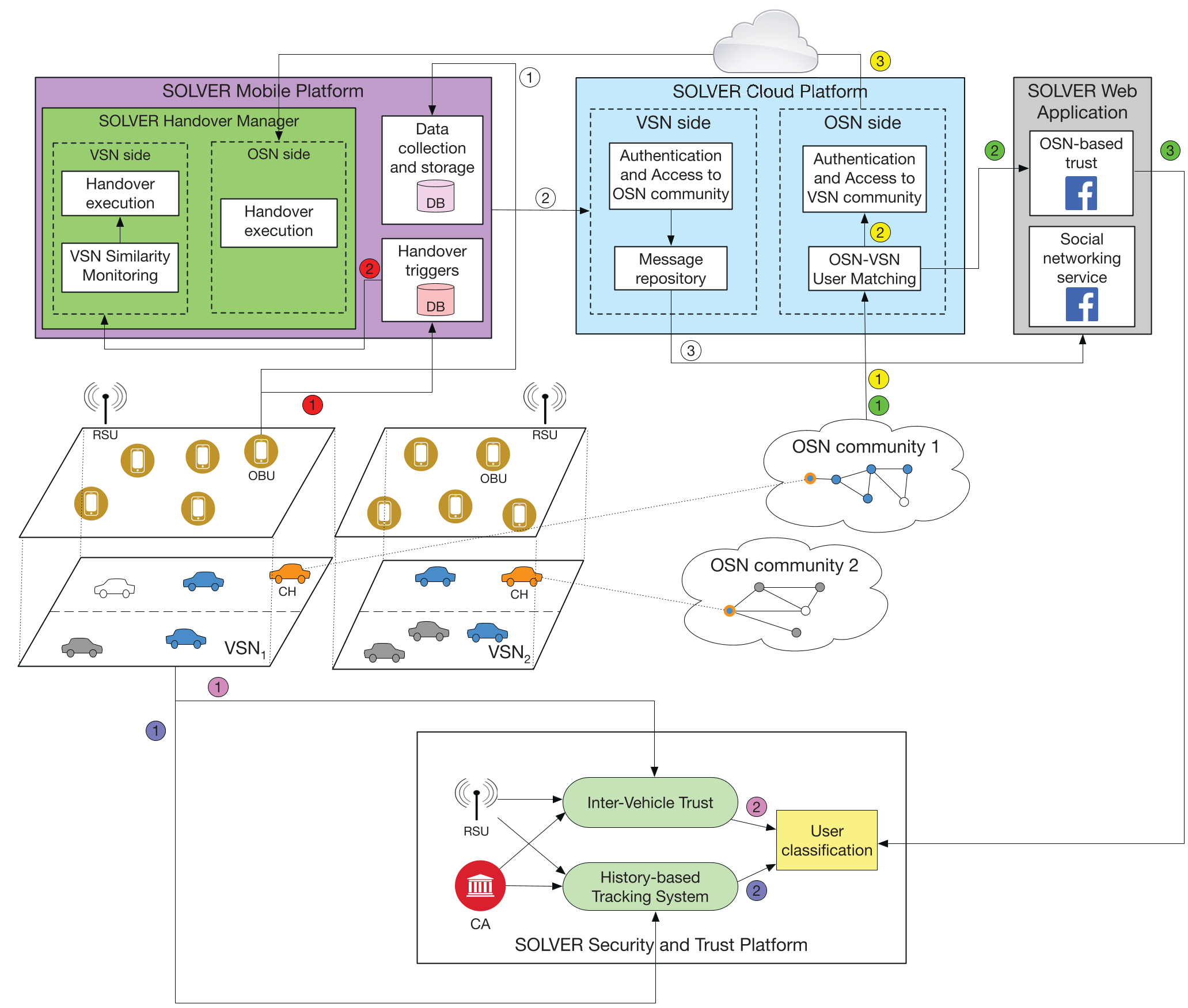 Figure 1: The SOLVER coordination mechanism showing the data flow between VSN clusters (red/yellow circles) and the centralized OSN cloud.
Experiments and Performance Gains
The authors validated SOLVER using technical simulations focused on two metrics: Transmission Delay and Connectivity Probability.
Transmission Efficiency
The "OSN Extension into VSN" scenario shows a clear win-win. When OSN users utilize local V2V links (P2P mode), the transmission delay becomes significantly lower than the standard Client-Server (CS) mode, especially as the density of "socially-connected" vehicles increases.
Breaking Connectivity Deadlocks
Vehicular networks often suffer from "null connectivity"—moments where a vehicle has no neighbors to talk to. SOLVER compensates for this by providing a handover to the OSN via cellular/RSU links.
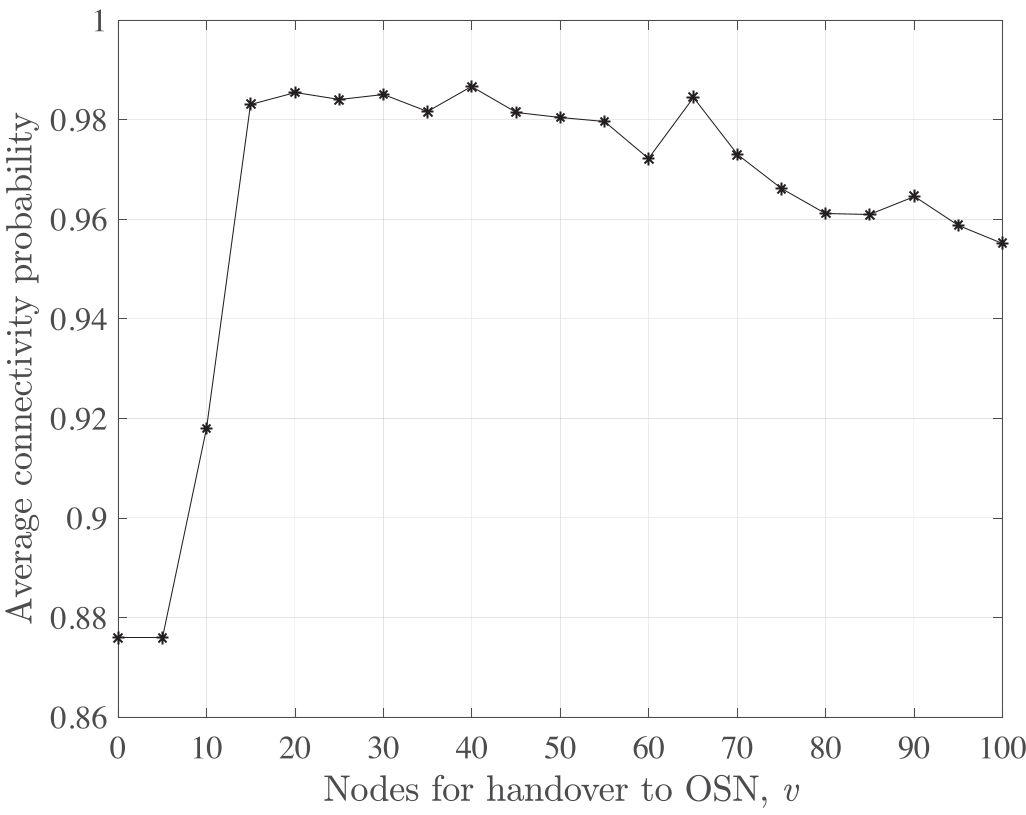 Figure 2: Impact of SOLVER on connectivity probability. The blue markers represent the significant increase in stable links when OSN-based handovers are enabled.
Critical Insight & Future Outlook
The true value of SOLVER isn't just in the "handover" but in the Security and Trust layer. Traditionally, VSNs struggle with "Sybil attacks" or malicious nodes. By tying a vehicle's identity to a long-standing OSN profile, SOLVER introduces a "Social Honesty Factor" that makes the P2P network much more resilient.
Limitations: The paper assumes high OSN penetration among drivers. In a real-world scenario, privacy concerns regarding sharing real-time GPS data with a social network remain a significant hurdle for adoption.
Conclusion: SOLVER effectively proves that the Internet of Vehicles (IoV) should be viewed as a social layer, not just a physical transport layer. This paves the way for "Infotainment" services that are more local, more trusted, and significantly faster.