
Wernicke: Decoding Quality Through the "Digital Body Language" of Crowdsourced Workers
1238_Crowdsourcing Human Annotation on Web Page Structure Infrastructure Design and Behavior-Based Quality Control.
This paper introduces Wernicke, a browser-extension-based crowdsourcing system designed to annotate complex semantic web structures. It utilizes a novel behavior-based quality control mechanism that predicts annotation precision and recall by analyzing fine-grained worker interactions, such as mouse movements, scrolling, and pausing.
TL;DR
Researchers from the University of Pittsburgh and Google have developed Wernicke, a system that predicts the quality of web page structural annotations by watching how workers interact with the page. By analyzing "digital body language"—such as mouse oscillations and pausing patterns—the system can predict the accuracy of a label even if it has never seen the worker before.
The "History" Problem in Crowdsourcing
In the world of data labeling, we usually trust workers based on their résumé—their historical performance. However, this creates three major bottlenecks:
- Cold Start: How do you trust a worker on their first day?
- Inconsistency: A great worker might be tired, distracted, or confused by a specific complex task.
- Rigidity: Performance history doesn't tell you if a specific web page is just naturally harder to parse than others.
The authors of this paper argue that we should stop looking exclusively at the "who" and start looking at the "how."
Methodology: Beyond Clicks
The core innovation of Wernicke lies in its granular tracking of Behavioral Features. The authors went beyond simple timers to track:
- Contextual Efforts: Did the worker hover over the text before labeling it?
- Compound Behaviors: "Oscillation"—the act of moving the mouse in and out or scrolling up and down—often signals indecision or high cognitive load.
- Bag-of-Fragments (BoF): Since web structures are messy, Wernicke breaks every annotation into "fragments" to allow for mathematical comparison across different workers.
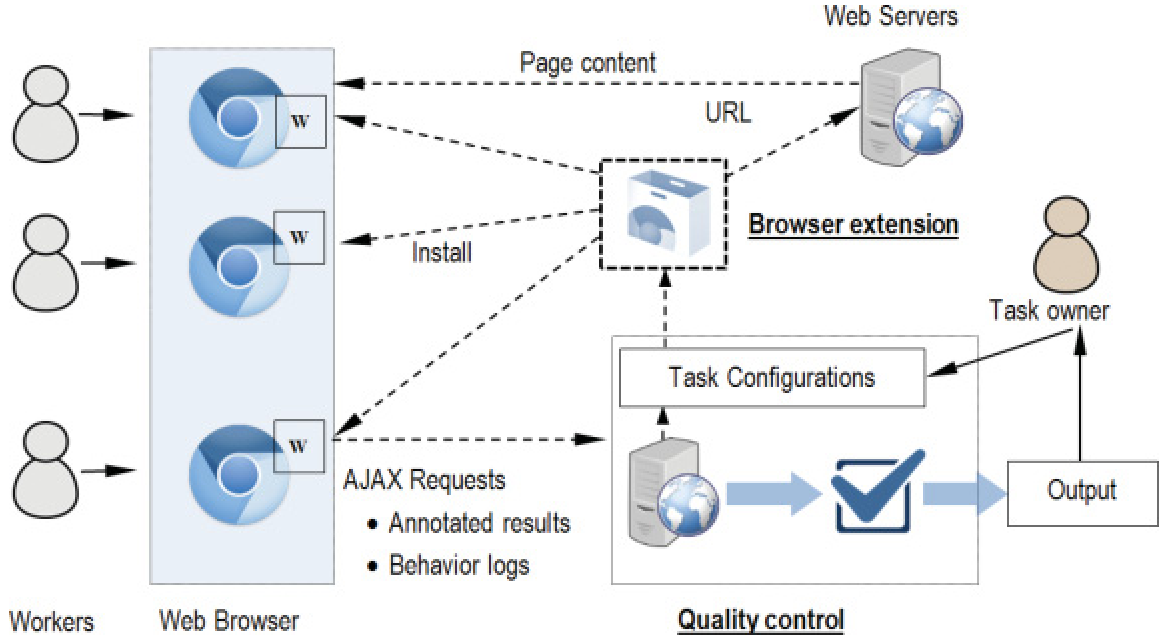 The infrastructure of Wernicke, bridging the browser extension (data collection) and the quality control module (prediction).
The Intuition of "Pausing" and "Oscillating"
The research found that Before-Annotation Time (the time spent "studying" the page before clicking) is an extremely strong positive predictor for recall. Conversely, frequent Oscillations might suggest a worker is struggling to find the boundaries of a semantic block, which serves as a signal for potential precision errors.
Experimental Validation
The authors tested Wernicke on a challenging domain: Q&A Web Page Structure. Annotating where a "comment" ends and an "author" tag begins is much harder than simple image tagging.
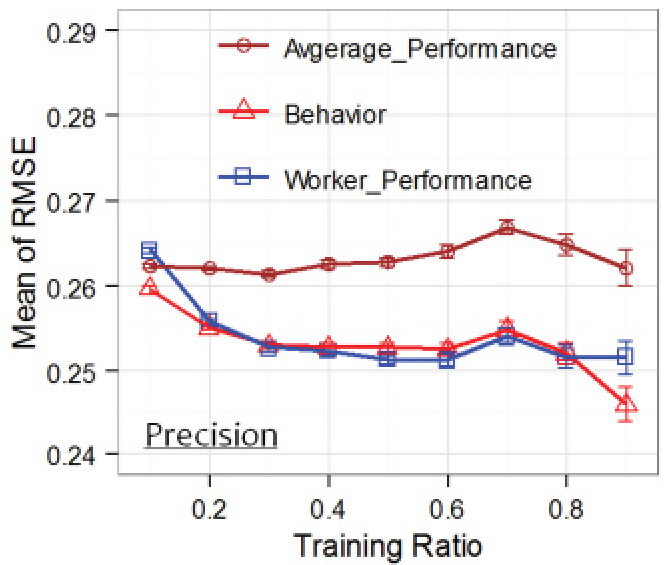 The Behavior-based method (Red) consistently shows lower Error (MAE) in recall prediction compared to traditional performance-based baselines (Blue/Brown).
Key Findings:
- Superior Generalization: Behavior-based models trained on one website (e.g., StackOverflow) worked remarkably well when applied to a completely different site.
- Recall Mastery: Behaviors are excellent at predicting if a worker missed something (Recall), while individual history remains slightly better at predicting if what they did mark was exactly correct (Precision).
- The Hybrid Win: The best results came from a "Combined Model" that used both behavior and history, proving these two signals are complementary, not redundant.
Critical Analysis & Takeaways
The brilliance of Wernicke is that it turns a "noisy" signal—user interaction—into a "ground truth" predictor.
- Value for Industry: For companies running large-scale RLHF or data labeling pipelines, implementing behavior logging can act as a real-time "lie detector" or "fatigue sensor," allowing for dynamic task reassignment.
- Limitations: The study notes that behavior-based metrics are more powerful for Recall than Precision. This suggests that while we can tell if someone is trying hard, we still need cross-verification to ensure they are correct.
Future Outlook
As we move into more complex human-AI alignment tasks, the "Wernicke approach" of analyzing the process of work rather than just the result of work will likely become the standard for high-stakes data curation.
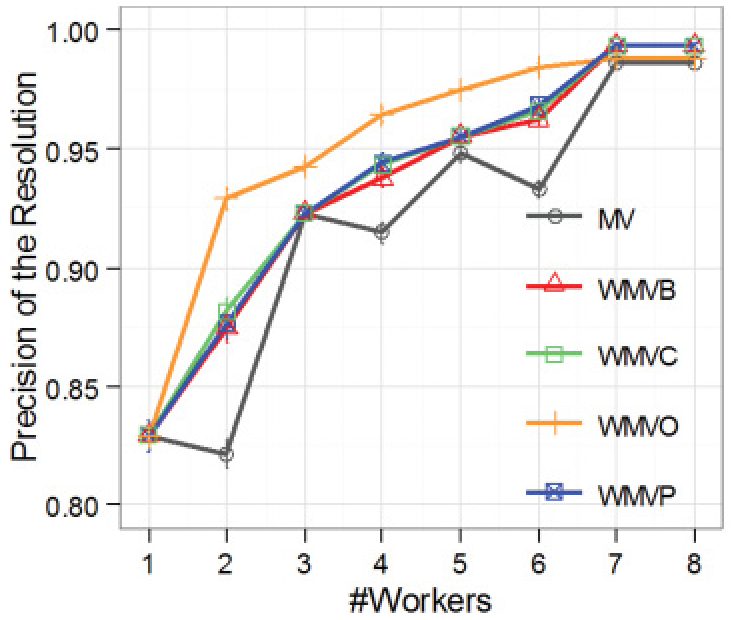 Comparison of Weighted Majority Voting (WMV) methods showing that behavior-informed weights (WMVC) help resolve conflicts even with few redundant workers.