
The Fragile Shield: A Deep Dive into the Hidden Failures of Ad-Blocking Crowdsourcing
1278_Errors, Misunderstandings, and Attacks Analyzing the Crowdsourcing Process of Ad-blocking Systems.
Deep measurement study analyzing the nine-year evolution of the EasyList filter-list and its crowdsourcing ecosystem. The authors identify systemic errors in ad-blocking (FP and FN) and categorize 15 distinct adversarial evasion methods used by ad publishers.
TL;DR
Ad-blocking is not just a software task; it is a massive, human-driven "arms race" powered by crowdsourcing. This study uncovers the startling inefficiency of this process: 50% of legitimate content blocks (False Positives) last over a month, and ad publishers are using 15 different evasion tactics—from WebSocket tunnels to CSS background hacks—to bypass your filters.
Background: The Power and Pitfalls of EasyList
Most modern ad-blockers (Adblock Plus, uBlock Origin, Brave) don't decide what to block on their own. They rely on EasyList, a master manifest of rules maintained by a tiny group of editors. While this crowdsourced model has scaled to 170M+ devices, it operates on a "break-fix" cycle that is increasingly vulnerable to sophisticated adversaries and human error.
1. The Anatomy of an Error: Why "Good" Sites Break
The study categorizes errors into two types that haunt every internet user:
- False Positives (FP): Legitimate site features (like navigation menus) disappear.
- False Negatives (FN): Annoying ads leak through the "shield."
The Blame Game
Who is responsible for the "broken" web?
- Ad-blocker's Failure (65%): Editors often push "generic" signatures (e.g., blocking any URL containing
/ads-) that accidentally catch legitimate resource paths. - Designer's Failure (35%): Website developers unknowingly use CSS ID or Class names (like
header-ads) for legitimate parts of their layout that are already blacklisted.
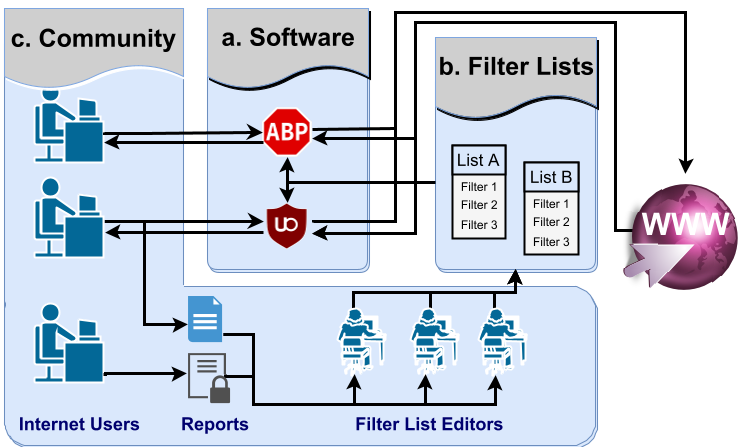 Figure 1: The flow of information from users to editors to the filter lists.
2. Methodology: Resurrecting the Past
To understand how errors evolve, the authors used a "Time Machine" approach. By combining the Internet Archive (Wayback Machine) with historical EasyList commits, they replayed thousands of site versions to see exactly which rule caused a specific menu to vanish in 2014.
Their findings on "Error Duration" are a wake-up call: even when a site owner reports a breakage, the median delay to fix it is 2 days, but the time the error existed before being reported is often exceeding 30 days.
3. The Adversarial Arms Race: 15 Ways to Cheat
The most technical contribution of this work is the taxonomy of how publishers bypass blockers. The authors highlight 8 previously unstudied attacks, including:
- WebSocket Tunnelling: Ad servers push content through persistent sockets that aren't caught by traditional URL request filters.
- CSS Background Image Hack: Loading ads as background properties to hide them from standard DOM-hiding rules.
- Domain Hopping: Ad networks like PopAds generate thousands of short-lived domains. The study found that even after a domain is blacklisted, its traffic only significantly drops in 61% of cases—the rest simply pivot to new URLs faster than humans can report them.
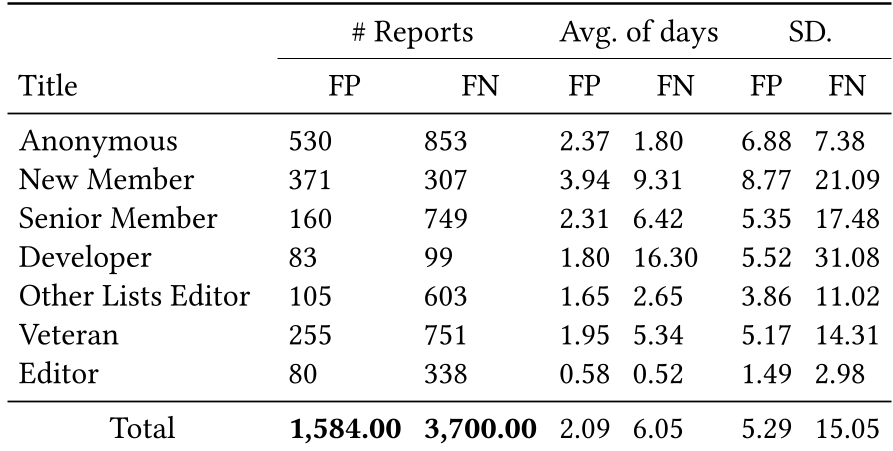 Table 1: Statistical breakdown of how different user categories (Editors vs. Anonymous) contribute to the ecosystem.
4. Critical Insight: The "Anonymous" Paradox
Interestingly, while "Veteran" members provide the most accurate reports, Anonymous users provide the highest volume of error detections. However, because these reports often lack detail (e.g., "this site is broken"), over 62% of FN reports are eventually ignored or rejected by editors. This "signal-to-noise" problem is the primary bottleneck for ad-blocking scalability.
5. Summary & Future Outlook
The current state of ad-blocking is a reactive manual process struggling against proactive automated adversaries.
Key Takeaways:
- Rule Cleanup is Neglected: Editors are great at adding rules but terrible at removing obsolete ones, leading to "filter bloat" and increased FP risk.
- ML is the Future: The delay in human reporting (30+ days) is a window of opportunity for attackers. We need "ShadowBlock" style ML models that detect ad-like behavior in real-time rather than relying on static blacklists.
- For Developers: If you want your site to remain functional, audit your CSS classes against EasyList before deployment.
As tracking and advertising become more "embedded" (inline scripts and first-party content), the era of simple URL-based blocking is ending. The next generation of blockers must understand the intent of code, not just the filename.