
GremoBot: Can an AI Moderator Save Your Team from Toxic Group Chats?
14326_GremoBot Exploring Emotion Regulation in Group Chat.
GremoBot is an AI-powered chatbot designed to monitor and regulate group emotions in text-based collaborative environments like Slack. Utilizing emotional regulation theories (Attentional Deployment and Cognitive Change), it intervenes during negative emotional shifts or long silence gaps to maintain team morale and performance.
TL;DR
Researchers from the Hong Kong University of Science and Technology introduced GremoBot, a chatbot designed to regulate group emotions in Slack. By analyzing text sentiment in real-time and intervening with psychological strategies, the bot aims to keep digital teams positive and active. While effective in "Debate" scenarios, the bot highlights a fine line between being a helpful mediator and a digital nuisance.
Context: The Hidden Crisis of Digital Collaboration
In the era of remote work, Slack and Teams have replaced the office watercooler. However, these platforms suffer from a "signal void"—no body language, no tone of voice, and no facial expressions. When a self-managing team hits a rough patch, negative emotions can spiral without a leader to intervene. GremoBot enters this space not as a task manager, but as an emotional thermostat.
Methodology: How GremoBot Thinks
GremoBot operates on a loop of Monitor, Evaluate, and Modify.
- Monitoring: It uses the Microsoft Text Analytics and IBM Tone Analyzer APIs to assign a "Sentiment Score" to every message and emoji.
- Evaluation: It looks for two red flags:
- Long Pauses: Indicating a lack of progress or engagement.
- Negative Status: A dip in sentiment scores or an accumulation of "anger" or "sadness" tones.
- Intervention: It utilizes two primary psychological strategies:
- Attentional Deployment: Shifting focus back to tractable goals.
- Cognitive Change: Helping members reframe negative situations in a positive light (e.g., "This disagreement is just a sign that we have many diverse ideas!").
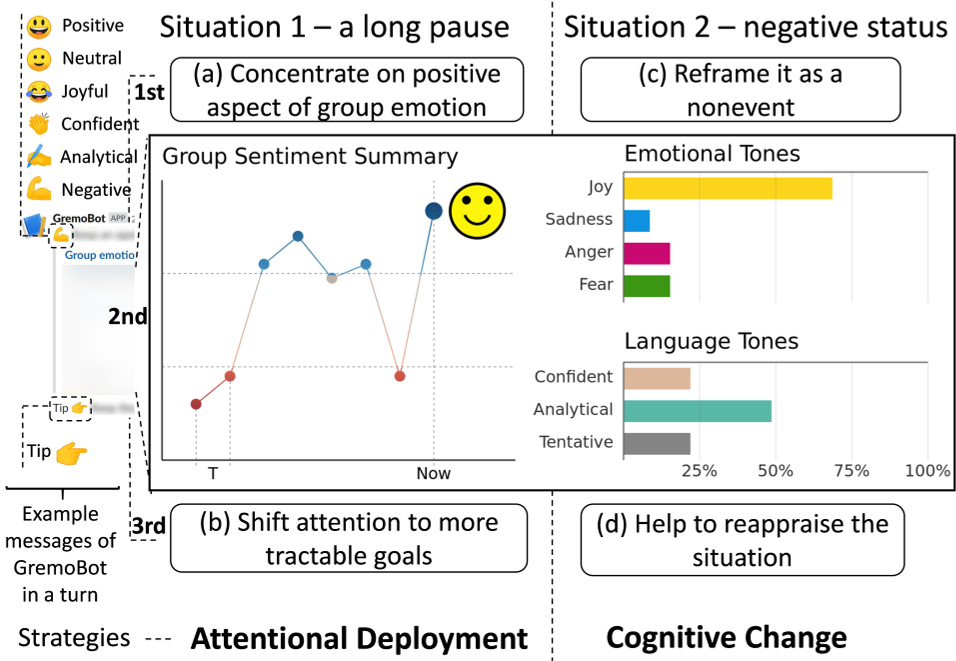 Figure 1: GremoBot's intervention messages featuring emotional visualization and strategy-based text.
Experimental Insights: Does It Actually Help?
The researchers tested GremoBot across three task types: Decision-Making (DM), Creativity (Cr), and Debate (Db).
Key Findings
- The Utility Paradox: Users found GremoBot most useful in Debates because it acted as a mirror, making them aware of potential toxicity. However, in Decision-Making (logic-heavy tasks), the bot was rated as significantly more annoying because it "broke the flow" of deep thinking.
- Visual Dominance: Participants responded more to the visualizations (line charts of group mood) than the actual text tips. Seeing a "dip" in the line chart acted as a social "impulse" for members to type more positively to "fix" the graph.
- Accuracy Issues: A major hurdle was sentiment accuracy. Sarcasm or culture-specific nuances often led the bot to misread the room, which can damage its credibility.
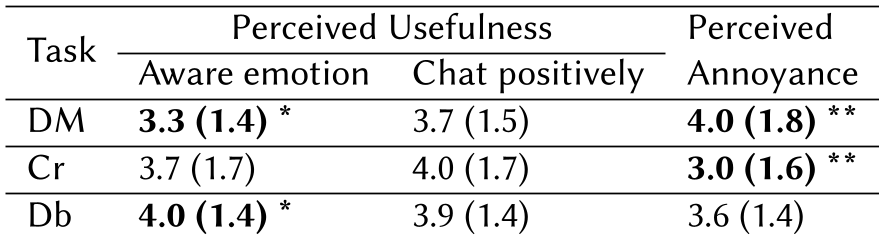 Figure 2: Statistical breakdown of perceived usefulness vs. annoyance across different task contexts.
Critical Analysis & Future Outlook
GremoBot proves that group emotion is a designable surface. However, the study reveals several "Inductive Biases" in human-AI social interaction:
- The "Human-in-the-Loop" Problem: For a bot to be a moderator, it must be perceived as "fair." If the sentiment API fails to catch a joke, the bot's intervention feels robotic and frustrating.
- Intervention Timing: "Intelligent" timing is harder than "intelligent" sentiment analysis. A bot that interrupts a heated but productive brainstorm is more a hindrance than a help.
The Takeaway
Future AI collaborators shouldn't just manage our calendars; they need to manage our vibes. But to do so effectively, they must move beyond static API calls toward Adaptive Timing and Context-Aware Reasoning.
Final Verdict: A promising step for CSCW (Computer Supported Cooperative Work), but don't fire your human HR manager just yet.