
USDE: Breaking the Efficiency Trap in Unbiased Social Media Sampling
1448_Unbiased Sampling of Social Media Networks for Well-connected Subgraphs.
This paper introduces Unbiased Sampling with Dummy Edges (USDE), a novel random-walk algorithm designed to sample social media networks. It achieves unbiased node sampling while maintaining high connectivity and sampling efficiency by artificially injecting "dummy edges" to bypass excessive rejections in disassortative graphs.
TL;DR
Researchers have developed Unbiased Sampling using Dummy Edges (USDE), a random-walk algorithm that solves the "celebrity trap" in social network crawling. By injecting temporary, artificial edges during the walk, the algorithm avoids the massive redundant samplings (rejections) typical of current SOTA methods like MHRW, achieving up to 5x higher efficiency while maintaining perfectly unbiased and well-connected samples.
Background: The Sampling Dilemma
Studying information diffusion on platforms like Twitter or Sina Weibo requires subgraphs that are both unbiased (every user has an equal chance of being picked) and well-connected (preserving the network topology).
- Uniform Random Sampling provides unbias but results in "island" nodes with no context.
- Standard Random Walks are biased toward high-degree "celebrity" nodes.
- Metropolis-Hastings Random Walk (MHRW) fixes the bias through rejection sampling, but in real-world networks with high disassortativity (celebs followed by millions of low-degree users), the crawler gets "stuck" re-sampling the same low-degree nodes thousands of times.
The USDE Insight: Transition instead of Rejection
The core intuition of USDE is simple yet profound: If you are going to reject a move and stay on the same node, why not use that probability budget to jump to a "useful" nearby node instead?
USDE introduces Dummy Edges. Instead of a walker repeatedly "sampling itself" at a low-degree node, it traverses a dummy edge to an unvisited neighbor of a previously seen node. These edges are temporary scaffolds for the crawler and are not included in the final data.
Methodology & Architecture
The algorithm maintains a queue of potential "target" nodes that have high expected rejection rates. When a walker lands on a node with a high self-sampling probability (above threshold ), it pops a target from and creates a dummy edge.
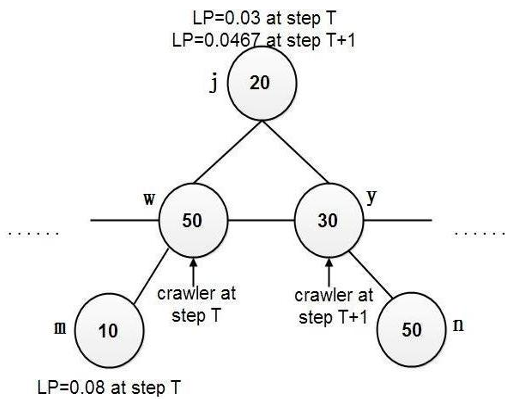 Figure 1: The algorithm estimates the lower bound of self-sampling probabilities () for neighbors during the walk to decide where dummy edges are most needed.
The moving probability is carefully balanced (as seen in Equation 1 of the paper) to ensure that the walk remains a Markov Chain with a uniform stationary distribution, satisfying the requirements for unbiased nodal sampling.
Experimental Results: Faster and More Accurate
The authors tested USDE against MHRW on real-world snapshots of Twitter and Sina Weibo.
1. Superior Efficiency
In Twitter, MHRW requires sampling each node 6–8 times on average to maintain unbias. USDE slashes this to ~2 times. This translates directly to fewer API calls and faster dataset collection.
2. Rapid Feature Discovery
Because USDE doesn't get stuck in "rejection loops," it discovers new network attributes (like user locations) much faster than traditional walks.
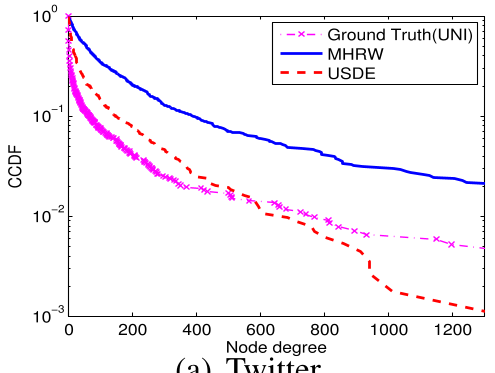 Figure 2: USDE identifies nearly 4x more unique locations in Twitter than MHRW within the same number of iterations.
3. Distribution Accuracy
When comparing the distribution of followers (degree distribution), USDE samples nearly mirrored the ground truth (UNI), whereas MHRW samples remained skewed due to the excessive repetitions that occur when walkers fail to move.
Conclusion & Insights
USDE represents a significant step forward for empirical social media research. By treating the "rejection probability" not as a wasted cost but as a "movement budget," it overcomes the structural hurdles of disassortative graphs.
Takeaway for Practitioners: When crawling graphs where node degrees vary by orders of magnitude (power-law distributions), look beyond standard rejection-based MHRW. Mechanisms that leverage local neighborhood information to "teleport" the walker, while mathematically preserving unbias, are essential for modern web-scale data mining.