
Manipulation among the Arbiters: How Wikipedia Administrators Mold Public Opinion
1526_Manipulation among the Arbiters of Collective Intelligence How Wikipedia Administrators Mold Public Opinion.
This research investigates deliberate manipulation within Wikipedia's governance structure, specifically focusing on how administrators utilize their status to shape public opinion on controversial topics. The authors introduce the "Clustered Controversy Score" (CC-Score) to quantify suspiciously focused editing and demonstrate that a subset of administrators significantly sharpens their topical focus on contentious issues immediately following promotion.
TL;DR
Is Wikipedia truly neutral, or is it a "Googlocracy" governed by a few biased elites? This paper uncovers a disturbing trend: a significant number of editors change their behavior to focus intensely on specific controversial topics once they gain administrative powers. By developing a new metric—the CC-Score—the researchers prove that we can predict which "potential manipulators" are infiltrating the ranks, but only if we listen to "expert" voters instead of the raw majority.
The "Neutrality" Myth and the Elite Capture Problem
We treat Wikipedia as the "first stop" for objective truth. However, the enforcement of its "Neutral Point of View" (NPOV) policy rests in the hands of a few thousand administrators. The core problem is Infiltration: groups like political advocacy organizations have historically attempted to plant members as administrators to "mold" sensitive debates (e.g., the Israel-Palestine conflict).
Prior research focused on petty vandalism, but this paper targets the "Arbiters of Collective Intelligence"—the elites who are too smart to be caught by simple anti-vandalism bots.
Methodology: Quantifying "Suspicious" Focus
The researchers moved beyond simple activity metrics to create the Clustered Controversy Score (CC-Score). It answers: Is this person editing controversial pages across the board (normal for an admin), or are they laser-focused on one specific, sensitive "cluster" (suspicious)?
The CC-Score Pipeline:
- Controversy Mapping: Using regression to identify pages that are likely to be contentious (e.g., Abortion, Homeopathy).
- Topical Clustering: Using Latent Dirichlet Allocation (LDA) to model articles as distributions of 1,000 topics.
- Graph Logic: Measuring the "Impact" of a user based on the connection strength between the controversial neighbors in their edit history.

Key Finding 1: The "Administrator Pivot"
The study compared successful admins to those who failed their "Request for Adminship" (RfA). While candidates look identical before the election, successful ones show a "fat tail" of behavior change. A significant subset immediately pivots to narrow, controversial topics once they have the keys to the kingdom.
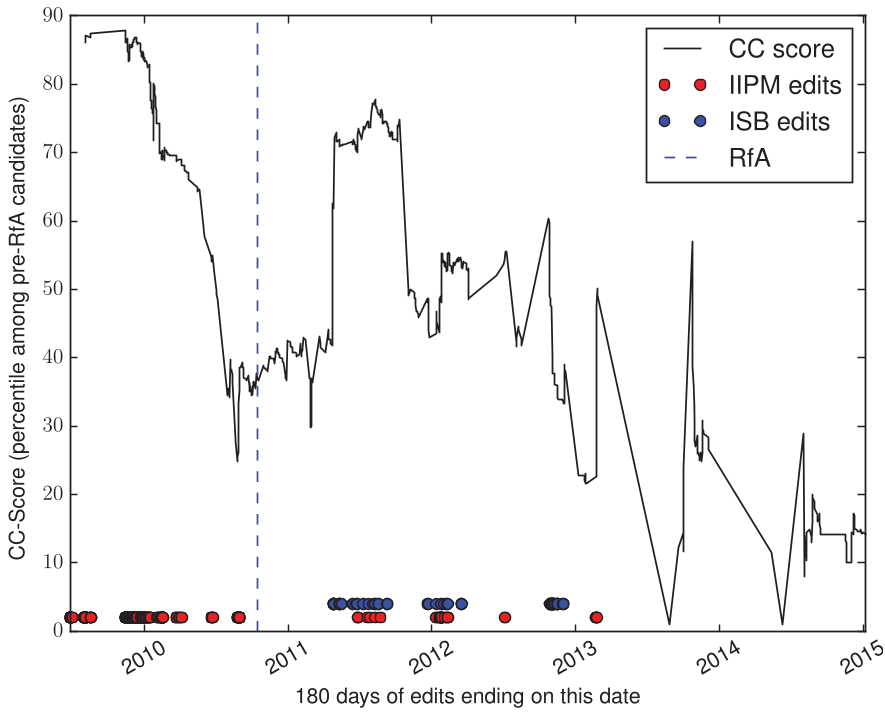
Note: Group 1 (Successful Admins) shows a clear shift toward higher CC-Scores compared to unsuccessful candidates and the general population.
Key Finding 2: The Failure of Democracy (and the Solution)
Can we catch these people before they are promoted? The authors tested three models:
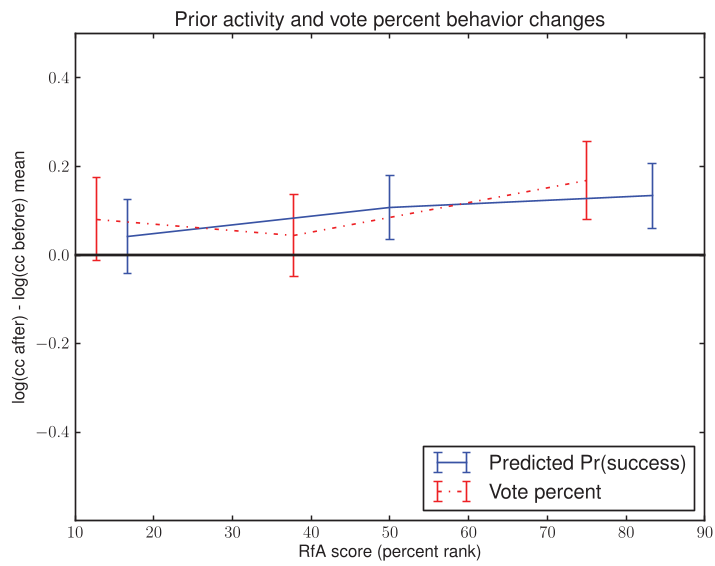
- Simple Vote Count: Fails. Manipulators often have higher support percentages because they "game" the system.
- Prior Activity Model: Fails. Being an "ideal" editor on paper doesn't predict post-promotion bias.
- Weighted-Voter Score: Succeeds. By using an eigenvector-based approach to weight the opinions of "high-quality" voters (those who consistently align with long-term bureaucrat decisions), the model flags suspicious candidates that the raw majority missed.
Critical Insights & Conclusion
This paper is a wakeup call for any system relying on "Collective Intelligence."
- Strategic Infiltration is Real: The data supports the theory that some users hide their true colors to achieve status, then pivot to "POV-pushing."
- Human Expertise Matters: The "wisdom of the crowd" exists, but it’s concentrated. When we flatten votes into a simple percentage, we lose the signal from expert users who can spot a "bad actor" through qualitative intuition.
Limitations: The study is post-hoc and observational. While the CC-Score identifies suspicious behavior, it cannot mathematically distinguish between a "passionate good-faith advocate" and a "paid infiltrator." However, for a platform as influential as Wikipedia, even unconscious bias from those at the top is a vulnerability that requires systematic monitoring.