
The Interval 2-Tuple Model: Balancing Complexity and Precision in Computing with Words
17003_Linguistic Computational Model Based on 2-Tuples and Intervals.
The paper introduces an interval-based version of the 2-tuple fuzzy linguistic representation model for Computing with Words (CW). It establishes a novel framework comprising an interval numerical scale, interval-based computation, and a generalized inverse operation to bridge linguistic terms with interval type-2 fuzzy sets (IT2 FSs).
TL;DR
Researchers have developed a new linguistic computational framework that uses intervals of 2-tuples to bridge the gap between simple linguistic labels and complex Interval Type-2 Fuzzy Sets (IT2 FSs). By utilizing an interval numerical scale, this model retains the nuanced uncertainty of human language while drastically reducing the computational cost associated with traditional Type-2 fuzzy logic.
Background: Why Words are Hard for Machines
In the field of Computing with Words (CW), the challenge has always been "Perception." Words like "Small" or "Good" mean different things to different people (Perceptual Uncertainty).
- Type-1 Fuzzy Sets are too rigid; they represent a word as a single fixed membership function.
- Interval Type-2 Fuzzy Sets (IT2 FSs) are more realistic as they provide a "Footprint of Uncertainty" (FOU), but they are computationally expensive to process in large-scale decision-making.
- 2-Tuple Models (Herrera & Martínez) were efficient but struggled with non-symmetrical, non-uniform linguistic distributions.
This paper introduces a hybrid approach: an Interval Version of the 2-Tuple Model that treats the "index" of a word not as a point, but as a range.
Methodology: The Three-Step Framework
The authors propose a logic flow that transforms subjective words into actionable data without losing the "fuzziness" of the original meaning.
1. Interval Numerical Scale (INS)
Instead of mapping a word to a single number, it is mapped to an interval . This interval is derived from the centroid of the corresponding IT2 FS.
2. Computation via Interval Arithmetic
Aggregation (like Weighted Averages) is performed directly on these intervals. This uses straightforward interval math rather than the complex Algorithms required for full IT2 FS processing.
3. Generalized Inverse Operation
The final interval result is mapped back into the "Linguistic Space." If the result doesn't perfectly match a single word, it is represented as an interval of 2-tuples, such as .
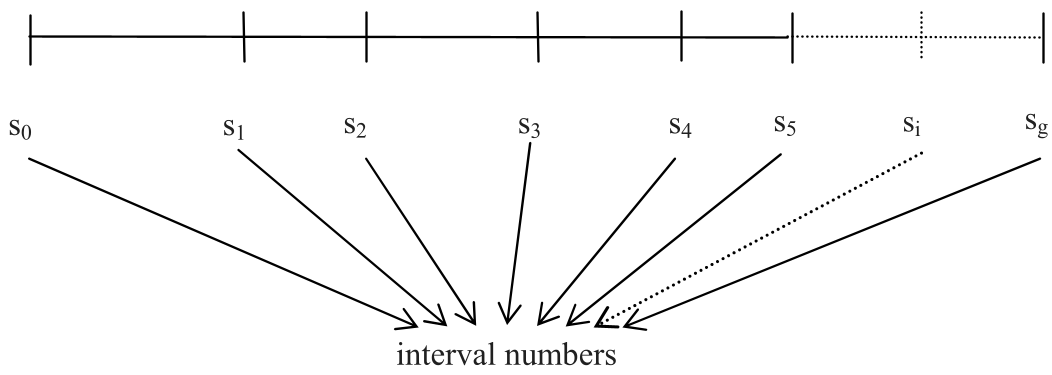 Figure 1: The transformation process from linguistic term sets to interval numerical indices.
Experiments and SOTA Comparison
To prove the model's validity, the authors ran 1,000 simulations comparing their interval 2-tuple model against a "Gold Standard" (the heavy IT2 FS model).
Key Metrics:
- Consistency (): Do the results align? The tests showed the results were consistent in nearly 100% of cases for .
- Precision (wid): The width of the resulting linguistic intervals remained narrow ( to ), indicating high-resolution decision-making.
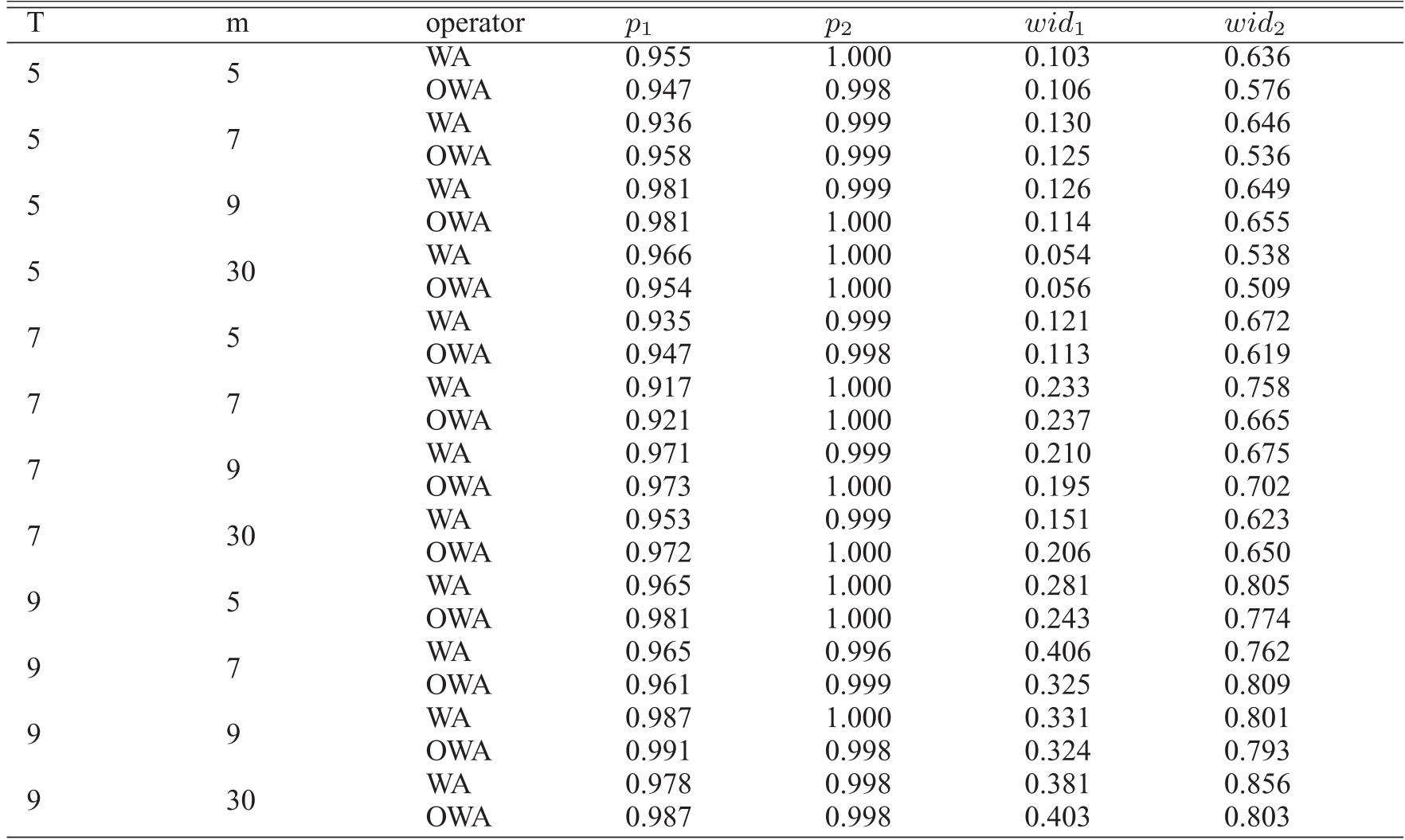 Table 1: Simulation results under different parameters (T = terms, m = items to aggregate), showing high consistency.
Critical Insights: Why This Matters
The breakthrough here isn't just "intervals"; it's the Scale. By generalizing the numerical scale approach of the Wang and Hao model, the authors have created a way to calibrate linguistic models using existing "Footprint of Uncertainty" data (like the 32-word FOU dataset by Liu and Mendel).
Limitations: The model assumes an Ordered interval numerical scale. While most linguistic sets are ordered (e.g., Poor < Fair < Good), non-linear or multi-dimensional linguistic descriptors might require further extensions.
Conclusion
The Interval 2-Tuple Model is a "Best of Both Worlds" solution. It provides a formal connection between symbolic 2-tuples and IT2 FSs. For practitioners in Group Decision Making (GDM) or Sensory Evaluation, this means they can now use the sophisticated uncertainty modeling of Type-2 Fuzzy Sets with the speed and clarity of 2-tuple linguistic labels.