
Inf-VAE: Bridging Social Homophily and Temporal Influence for Superior Diffusion Prediction
17529_Inf-VAE A Variational Autoencoder Framework to Integrate Homophily and Influence in Diffusion Prediction.
Inf-VAE is a novel Variational Autoencoder framework designed for diffusion prediction that jointly models social homophily and temporal influence. It achieves state-of-the-art performance, notably reaching a 22% improvement in MAP@10 across datasets like Digg, Weibo, and Stack-Exchange.
Executive Summary
TL;DR: Inf-VAE is a VAE-based framework that moves beyond local cascade sequences by integrating the global social graph to predict information spread. By combining GNN-learned social latent variables with temporal position encodings via a co-attentive fusion layer, it solves the "inactivity" problem for users with sparse historical data, achieving a 22% average improvement in MAP@10.
Context: In the landscape of diffusion modeling, this work represents a shift from purely sequential/recurrent modeling (like LSTMs) toward structure-aware generative modeling. It places itself as a SOTA solution for real-world social networks where data is often missing or sparse.
Problem & Motivation: The "Observed" Trap
Traditional diffusion models (e.g., Topo-LSTM, CYAN-RNN) treat information spread as a sequence of events. They project cascades onto local neighborhoods to create Directed Acyclic Graphs (DAGs).
The Flaw: If a user is active but hasn't participated in many observed cascades, the model sees them as a "cold" node. However, in reality, social ties (like following a political leader or a hobbyist group) suggest shared interests (Homophily) even if no re-tweet has occurred yet. Existing models fail to capture these "hidden" structural correlations, leading to poor performance for the silent majority of social media users.
Methodology: The Core of Inf-VAE
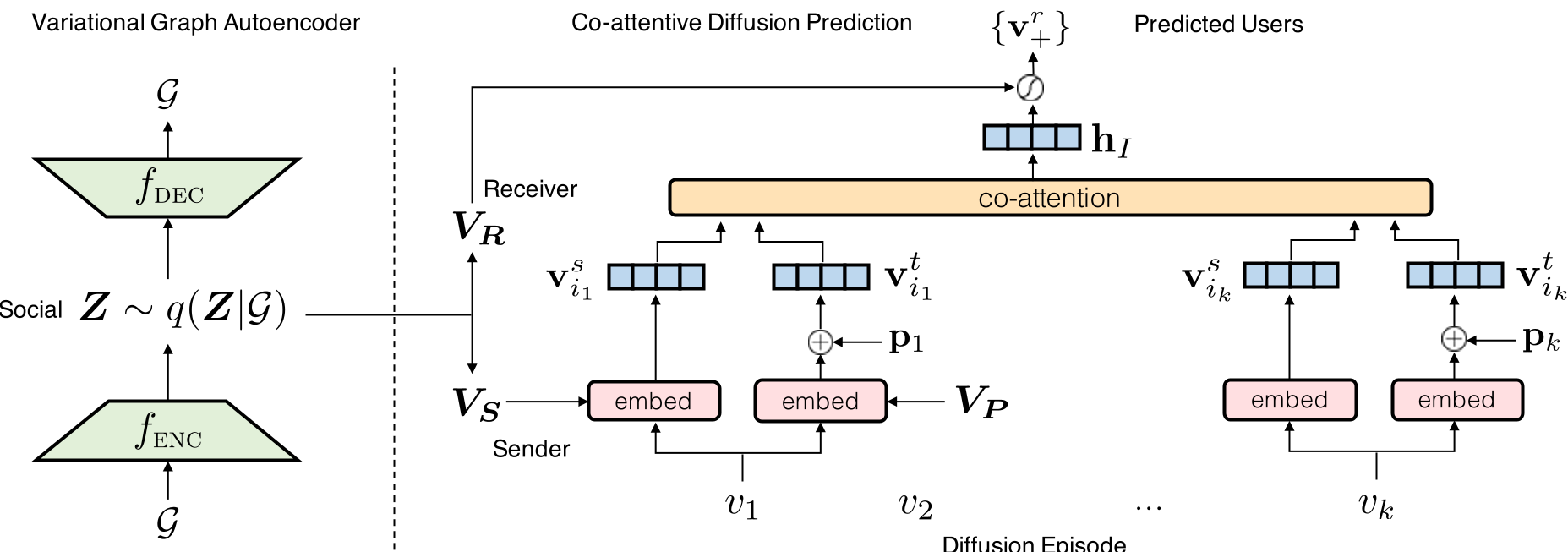
The architecture of Inf-VAE is built on a dual-latent variable strategy.
1. Modeling Social Homophily (The VAE Component)
The model assigns every user a latent social variable .
- Encoder: Uses GNNs (GCN or MLP) to compress the global social structure into .
- Role Differentiation: To account for asymmetric behavior, is used to derive two specific variables: a Sender vector () and a Receiver vector ().
2. Temporal Influence & Co-Attentive Fusion
The "influence" part of the model doesn't just look at who was active, but when.
- Position Encodings: Similar to Transformers, relative activation order is encoded into temporal embeddings ().
- Co-attention: This is the "secret sauce." Instead of a simple RNN, a bi-linear fusion network () attends over the sender variables and temporal variables simultaneously. It asks: "Given this user's traits and their position in the sequence, how much weight should they carry in the overall influence?
Experiments & Results
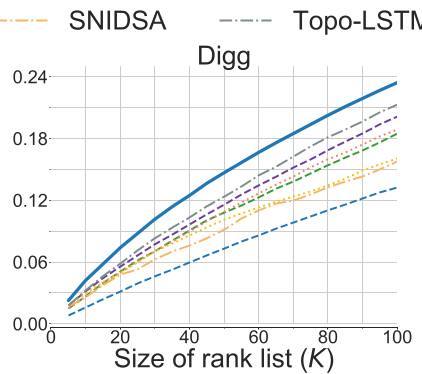
The authors tested Inf-VAE on diverse datasets: Digg, Weibo, and various Stack-Exchange communities.
Performance Gains
Inf-VAE consistently crushed the competition. On the Christianity dataset, it achieved a MAP@10 of 0.2594, compared to the best baseline (CYAN-RNN) at 0.1971.
The "Inactivity" Breakthrough
The most striking result is found in Figure 3 of the paper. For users in the bottom quartile of activity (Q1), Inf-VAE provides massive relative gains. While RNNs struggle when the sequence is short, Inf-VAE's social prior (learned from the global graph) "fills in the blanks" for these inactive users.
Efficiency and Scalability
Unlike RNNs that require sequential Backpropagation Through Time (BPTT), the co-attention mechanism in Inf-VAE is parallelizable. It is 10x faster than Topo-LSTM and scales linearly as the cascade length increases.
Critical Analysis & Conclusion
Takeaway: Inf-VAE proves that global context matters. Diffusion isn't just a sequence of dominoes falling; it is a manifestation of an underlying social fabric that exists even when silent.
Limitations:
- The model currently uses relative order; integrating exact timestamps (Neural Point Processes) could further refine the "contagion" effect.
- While scalable, very large graphs (millions of nodes) would require neighborhood sampling techniques like GraphSAGE.
Future Outlook: This framework paves the way for "Behavioral Graph Pre-training," where social graphs and activity cascades are co-evolved to predict everything from viral marketing success to the spread of misinformation.