
D-Dupe: Bridging Intuition and Algorithms for Network Entity Resolution
18322_D-Dupe: An Interactive Tool for Entity Resolution
D-Dupe is an interactive visualization tool designed for Entity Resolution (ER) in social networks, specifically social collaboration graphs. It combines machine learning algorithms for duplicate detection with a domain-aware UI to help users merge or disambiguate nodes in an iterative process.
TL;DR
D-Dupe is an interactive framework that addresses the "Identity Crisis" in social networks. By visualizing local subgraphs and leveraging machine learning, it allows users to find and merge duplicate entities (like "J. Smith" and "John Smith") that would otherwise skew network metrics like node centrality and degree distribution.
Background & Motivation
In social network analysis, we often take for granted that one node equals one unique person. In reality, data harvested from the web is messy—full of abbreviations, misspellings, and alias variations.
The authors argue that Entity Resolution (ER) in graphs shouldn't rely solely on string similarity. The "Insight" here is Structural Propagation: if two suspiciously similar names share a significant number of neighbors (e.g., common co-authors), they are likely the same person. D-Dupe was built to make this environmental context visible to the human eye.
Methodology: The Human-in-the-Loop Loop
D-Dupe transitions ER from a "black box" algorithmic task to a transparent, iterative workflow.
1. The Context Collaboration Graph (CCG)
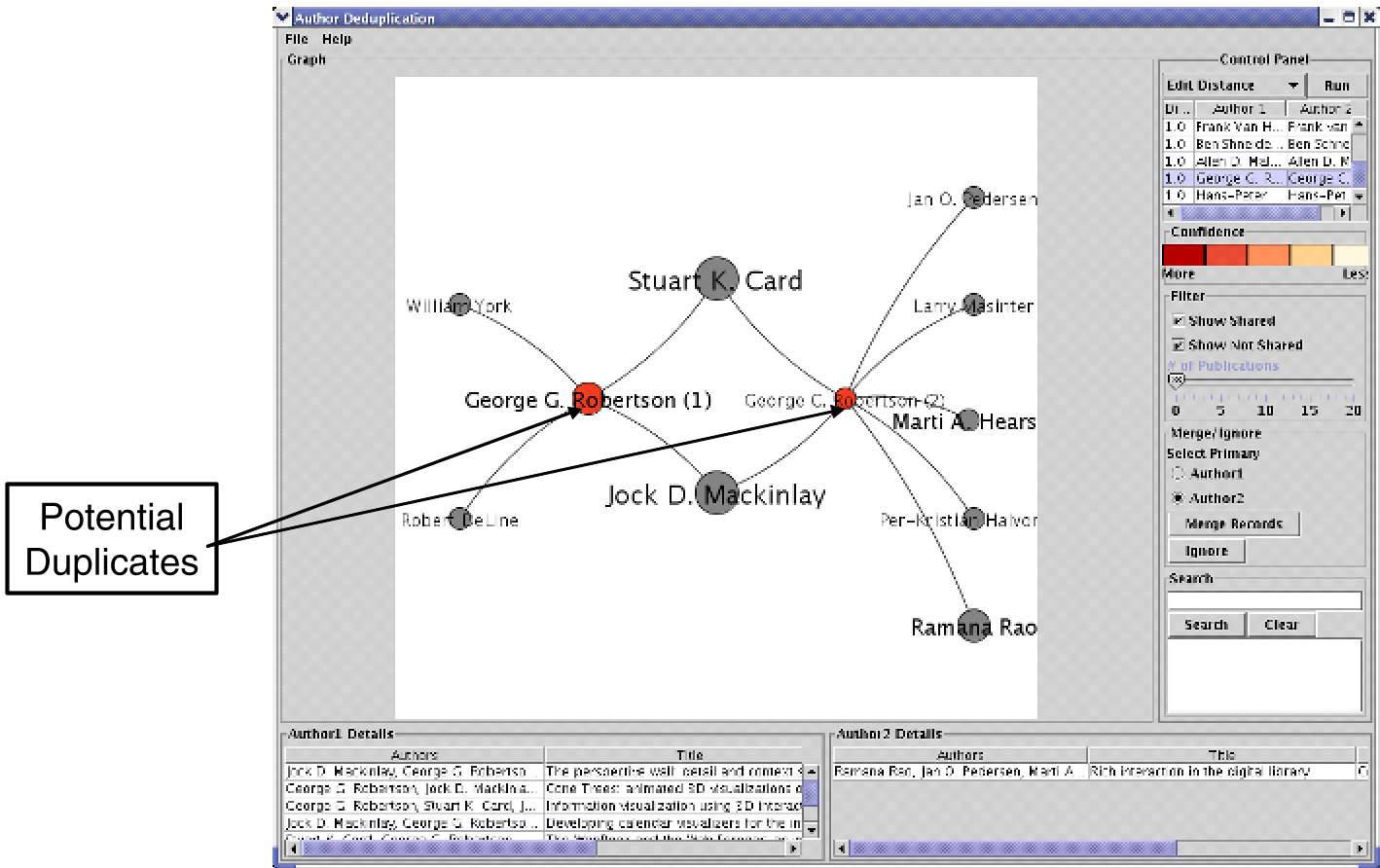
Unlike standard hairball visualizations, the CCG is task-specific. It isolates a pair of potential duplicates and their immediate neighborhood.
- Visual Logic: The tool highlights edges only between potential duplicates and their neighbors, stripping away noise.
- Color Encoding: A heatmap-like approach uses shades of red to indicate the ML model's confidence in a duplicate pair.
2. Integrated ML Control Panel
D-Dupe is algorithm-agnostic. Users can select different ML models to populate a "candidate list." When a user decides to merge a pair, the network updates in real-time. This is crucial because resolving one duplicate can trigger the discovery of others (the "ripple effect" of data cleaning).
3. Details on Demand
Since network structure isn't always enough, the bottom panel provides raw data (e.g., publication titles, dates). This allows for a final sanity check before structural changes are committed.
Experiments & Critical Impact
The paper demonstrates the importance of ER through bibliographic analysis. Without D-Dupe, an author with three different name variations appears as three "small" nodes. After resolution, these merge into one "super-node," correctly reflecting their influence in the field.
Key Advantages:
- Reduced Cognitive Load: By filtering the graph to only relevant neighbors, users aren't overwhelmed by the global network.
- Structural Evidence: Proving that "J. Smith" is "John Smith" is significantly easier when you see they both collaborate with "Mary Ann."
Critical Analysis & Conclusion
D-Dupe is a foundational work in Visual Analytics for Data Wrangling. While modern methods might use Deep Walk or GNNs to compute similarity, the core UI philosophy—linking algorithmic suggestions with local neighborhood visualization—remains a gold standard for high-stakes data cleaning.
Limitations: As networks scale to millions of nodes, the "candidate table" approach may suffer from the "n-squared" comparison problem. Future iterations would benefit from better blocking techniques to prune the search space before user intervention.
Takeaway: Effective AI tools are those that don't just provide an output, but provide the evidence (in this case, structural context) for that output.