
IVD: How Facebook Prevents Authorization Bugs at Trillion-Entity Scale
185_IVD- Automatic Learning and Enforcement of Authori
This paper introduces Invariant Detector (IVD), a defense-in-depth system deployed at Facebook that automatically learns and enforces authorization rules in Online Social Networks (OSNs). By mining normal data manipulation patterns to distill likely invariants at the database layer, IVD successfully detects and blocks high-impact authorization bugs in real-time.
TL;DR
Facebook's Invariant Detector (IVD) is a "police officer" that watches the traffic between the application and the database. By learning what "normal" behavior looks like (e.g., "Only the owner can merge these two pages"), it creates rules—Invariants—that automatically block hackers trying to exploit missing or incorrect security checks in the code.
The Problem: The Complexity of Saying "No"
In a social network with billions of users and trillions of connections, authorization isn't just a simple checkbox. It’s a messy web of relations: Am I an admin of this group? Is this group a child of this business? Does this business have the 'merge' permission?
Even with elite engineering and strict privacy frameworks, bugs are inevitable because:
- Code Evolution: New features are added daily, and developers might forget a check in one of several API endpoints (Web, Mobile, REST).
- No General Solution: Unlike SQL Injection, there is no "one-size-fits-all" filter for authorization logic.
- Scale: Static analysis tools struggle with the sheer size and dynamic nature of OSN codebases.
Methodology: Turning Behavior into Law
IVD’s core philosophy is: If the code usually behaves this way, it’s probably a rule.
1. The Architecture
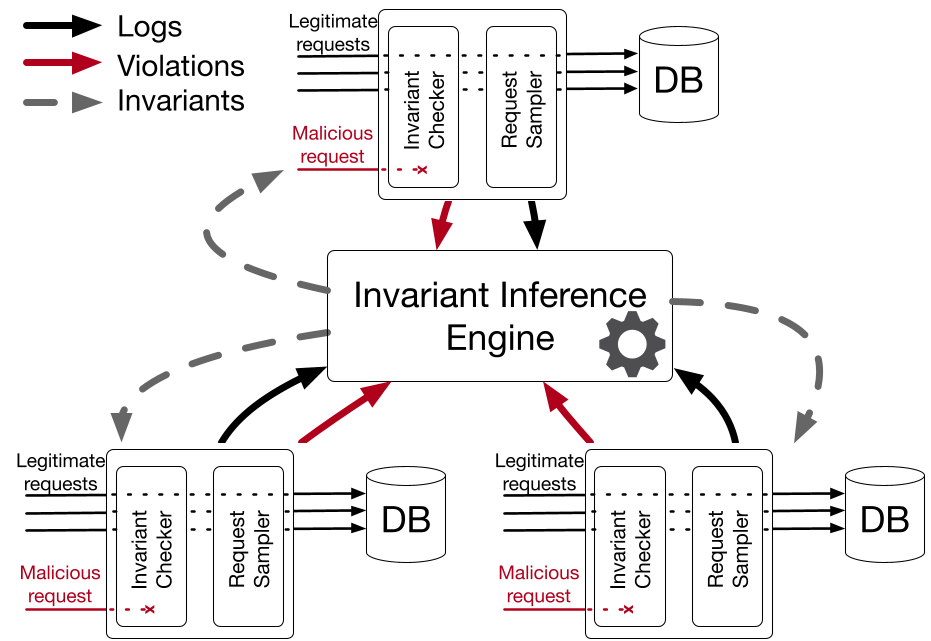
IVD sits at the boundary between the web servers and the graph database. It consists of three main components:
- Request Sampler: Lightly logs "local properties" (data in the request) and "global properties" (who is logged in).
- Inference Engine: An offline Hive/Hadoop pipeline that looks for patterns, such as "Property A always equals Property B when this API is called."
- Invariant Checker: A real-time enforcer that checks every database write against ratified rules.
2. High-Precision Invariants
To prevent "crying wolf" (false positives), IVD uses a Two-Stage Deployment:
- Evaluation Phase: A new rule is "watched" for 5 days. If it's ever broken by legitimate code, it's discarded.
- Ratification: If it holds for thousands of requests across a diverse set of users, it becomes a "Law." Any future violation is blocked as a potential hack.
Real-World Impact: Catching the "Page Merge" Exploit
The paper highlights a critical catch. A researcher found they could craft a request to merge an victim's business page into their own, even without permission. While the application code missed the check, IVD did not. It had already learned the invariant: logged-in user must be an owner of both pages. When the researcher tried the exploit, IVD blocked the write operation before the database was touched.
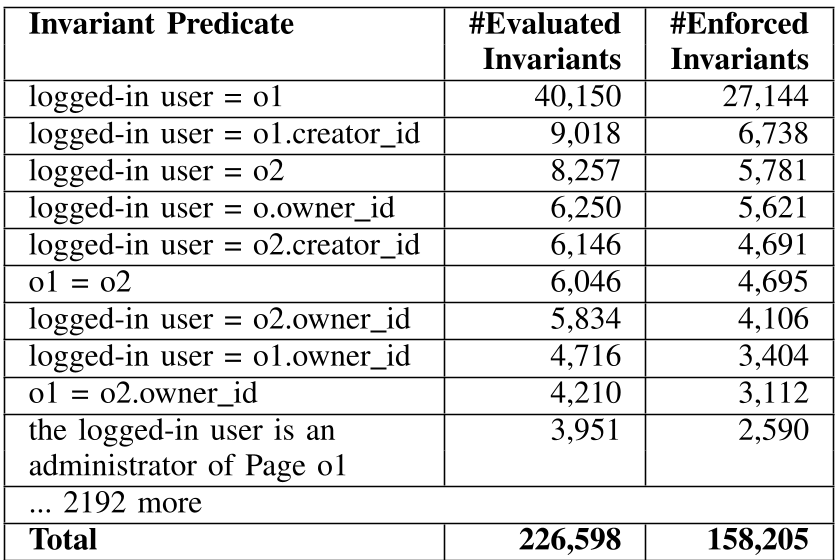 Table 1: Commonly inferred predicates, showing high ratification rates for ownership and creator checks.
Performance: Security at Zero Cost
Checking rules for 10 million writes per second sounds expensive. However, IVD is highly optimized:
- In-Memory: Invariants are stored in the web server's RAM.
- CPU Impact: Only 0.014% of Facebook's total app CPU time.
- Latency: Adds a median of only 0.1ms per database write—virtually invisible to the user.
Critical Analysis & Conclusion
IVD is a brilliant example of Defense-in-Depth. It doesn't replace secure coding; it acts as a safety net.
Limitations:
- Write-Only: Currently, it doesn't cover "Reads," meaning it can't prevent someone from seeing data they shouldn't (though the authors propose ways to fix this).
- Expressiveness: It struggles with "OR" logic (disjunctions), only focusing on "AND" conditions (conjunctions).
Future Outlook: The success of IVD at Facebook's scale suggests that large-scale systems should move toward automated invariant mining. As systems become too large for any human to fully understand, we must rely on the data itself to define the boundaries of safety.