
IP Traceback: Unmasking the Origins of DDoS Attacks
18575_IP Traceback A New Denial-of-Service Deterrent
This paper provides a comprehensive taxonomic review of IP traceback methodologies—Link Testing, Logging, ICMP-based messaging, and Packet Marking. It evaluates these techniques as essential deterrents against Denial-of-Service (DoS) and Distributed Denial-of-Service (DDoS) attacks by identifying the true origin of spoofed IP packets.
TL;DR
Denial-of-Service (DoS) attacks remain a primary threat to Internet stability because the IP protocol allows for easy source-address spoofing. This paper by Hassan Aljifri explores the technical landscape of IP Traceback—mechanisms designed to identify the true source of malicious traffic despite forged headers. By evaluating Link Testing, Logging, ICMP-messaging, and Packet Marking, the article distinguishes between methods that require active attacks and those that allow for post-mortem analysis.
The Core Challenge: A Stateless Internet
The Internet was built on trust. The IP header includes a "Source Address" field, but routers typically look only at the destination to forward packets. Attackers exploit this by "spoofing" their IP, making it appear as though the attack is coming from a legitimate or non-existent entity. While ingress filtering (blocking spoofed packets at the ISP level) is a partial solution, it is rarely fully enforced due to administrative costs and potential performance overhead.
Methodology: Four Paths to the Source
The paper categorizes the evolution of traceback into four distinct technical pillars:
1. Link Testing (The Reactive Response)
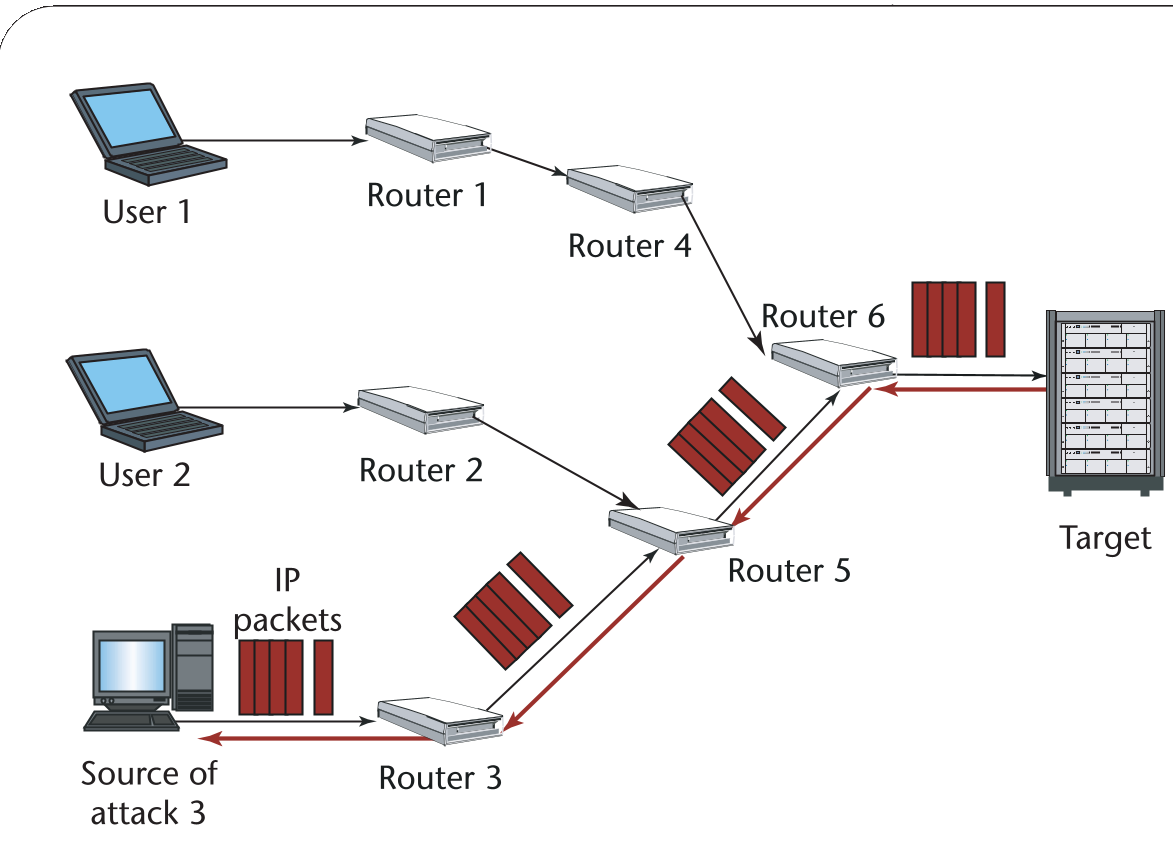
This is an interactive, hop-by-hop process. Starting from the router closest to the victim, administrators test upstream links to find where the "bad" traffic is coming from.
- Input Debugging: Requires manual coordination between ISPs.
- Controlled Flooding: The victim triggers a flood toward upstream routers; if the attack traffic drops, that link is identified as part of the path. Note: This technique is controversial as it is itself a form of DoS.
2. Logging (The Digital Paper Trail)
Routers log packet information as it passes through. While highly accurate, the storage requirements for 10Gbps+ links are astronomical.
- SPIE (Source Path Isolation Engine): Uses hash digests and Bloom filters to reduce storage needs, allowing for single-packet traceback.
3. ICMP-based Traceback (The Notification System)
Also known as iTrace, routers occasionally (e.g., 1 out of every 20,000 packets) generate an out-of-band ICMP message containing path information. The victim collects these messages to reconstruct the attack graph.
- Limitation: In DDoS attacks where each "zombie" sends low-volume traffic, the sampling rate might be too low to catch distant sources.
4. Packet Marking (The In-Band Solution)
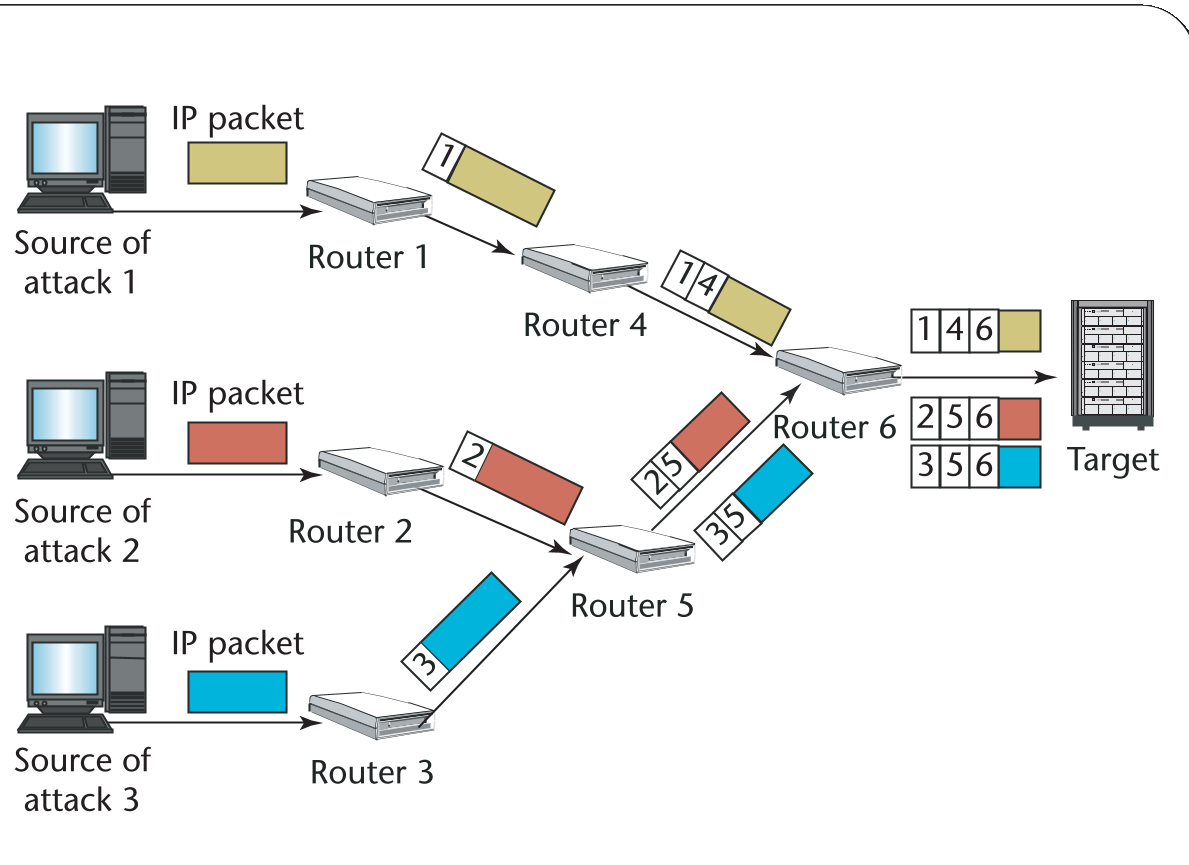
This is the most popular proactive research area. Routers "mark" the IP header of packets with their identification.
- Probabilistic Packet Marking (PPM): Routers mark packets with a low probability to avoid CPU strain.
- Snitch: A specific methodology proposed to use space cleared by header compression (RFC 2507) to store traceback data without increasing packet size.
Comparative Performance
The paper provides a critical look at the trade-offs of these technologies, summarized in its evaluation tables.
| Feature | Link Testing | Logging | ICMP-Based | Packet Marking |
|---|---|---|---|---|
| Deployment | Reactive | Proactive | Proactive | Proactive |
| ISP Cooperation | Essential | Minimal | Not Required | Not Required |
| Post-Attack Analysis | No | Yes | Yes | Yes |
| DDoS Suitability | Low | High | Medium | High |
Deep Insight: Why No "Silver Bullet"?
The paper concludes that the primary barrier to IP Traceback is not mathematical or algorithmic, but economic and political.
- Incentive Misalignment: ISPs bear the cost of implementing these features (CPU cycles, storage, management), while the benefit (security) goes to the victim.
- Fragmented Infrastructure: Unless a significant portion of the Internet adopts a unified marking or logging standard, an attacker can simply route traffic through "non-traceable" autonomous systems.
- Protocol Constraints: Many methods (like Packet Marking) struggle with IPv6 or IPSec, which have stricter header integrity requirements.
Final Thoughts
Hassan Aljifri’s work reminds us that technical excellence is only half the battle. As DDoS attacks grow in scale (from simple floods to sophisticated application-layer disruptions), moving toward a "deterrent-based" network where participants are held accountable via automated traceback is essential—but it requires a "common denominator" across industry giants that has yet to be finalized.