
MoodExplorer: Recognizing the Complexity of Human Emotions via Passive Smartphone Sensing
1869_MoodExplorer Towards Compound Emotion Detection via Smartphone Sensing.
This paper introduces MoodExplorer, a smartphone-based sensing system designed for "compound emotion" detection—identifying a set of multiple basic emotions experienced concurrently or sequentially. By leveraging a Factor Graph model on data from microphone, accelerometer, and APP usage, the system achieves a 76.0% exact match in recognizing complex emotional states.
TL;DR
Researchers have developed MoodExplorer, an Android-based system that moves beyond simple "happy or sad" classifications to detect compound emotions—mixtures of multiple emotional states. By analyzing passive sensor data (GPS, light, APP usage) through a Factor Graph model, the system achieves a 76.0% exact match accuracy, outperforming standard machine learning baselines by accounting for the natural correlations between different emotions.
Problem & Motivation: Beyond "One Emotion at a Time"
Most existing affective computing research operates under a restrictive assumption: that humans exist in a single pure emotional state during any given window. Social psychology tells a different story—we often feel "sadly disgusted" or "happily surprised."
While physiological sensors (ECG) or facial analysis via cameras can detect these nuances, they are either too expensive or too intrusive for daily life. The authors of MoodExplorer identified a gap: Can we use the "digital breadcrumbs" of smartphone usage—which are naturally correlated with our behaviors—to infer these complex emotional vectors?
Methodology: The Power of Factor Graphs
The core innovation of MoodExplorer lies in its choice of model. Instead of treating each emotion category as an independent variable, it uses a Factor Graph to model the ecosystem of human feeling.
1. Feature Extraction & Selection
The system extracts over 110 features across four categories:
- Environment: Noise levels (microphone), light intensity, and indoor location (WiFi SSIDs).
- Contact: Call duration and SMS frequency (social connectivity).
- APP Usage: Time spent on 18 categories of apps (e.g., shopping vs. social chat).
- Activity: Movement patterns via accelerometer and gyroscope.

2. Modeling Correlations
The Factor Graph utilizes two specific functions:
- Feature-Label Factor: Maps specific behaviors (like high social app usage) to specific emotions.
- Label-Label Factor: This is the "secret sauce." It recognizes that if a user is "Sad," they are statistically more likely to also be "Disgusted" or "Fearful," rather than "Happy." By building a Label Correlation Tree, the model constrains the prediction to biologically and psychologically plausible combinations.
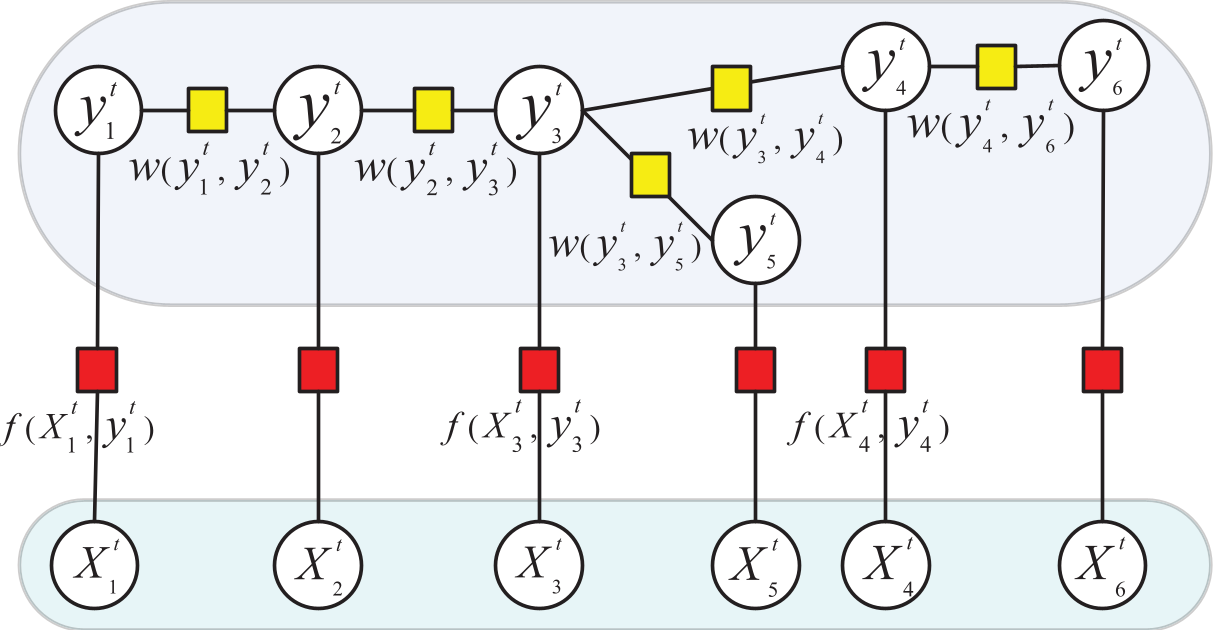
Experiments & Results
The study involved 30 university students providing self-reports (ground truth) over a month. The findings were striking: 60% of reports were compound emotions, justifying the need for this multi-dimensional approach.
Key Performance Metrics:
- Exact Match: 76.0% (Significant improvement over SVM's 71.4%).
- Precision: 80.2% (Compared to ~67% for traditional baselines).
- Insight: The model's performance was most stable when using the Top 6 personalized features, as adding too many features with a limited dataset led to over-fitting.
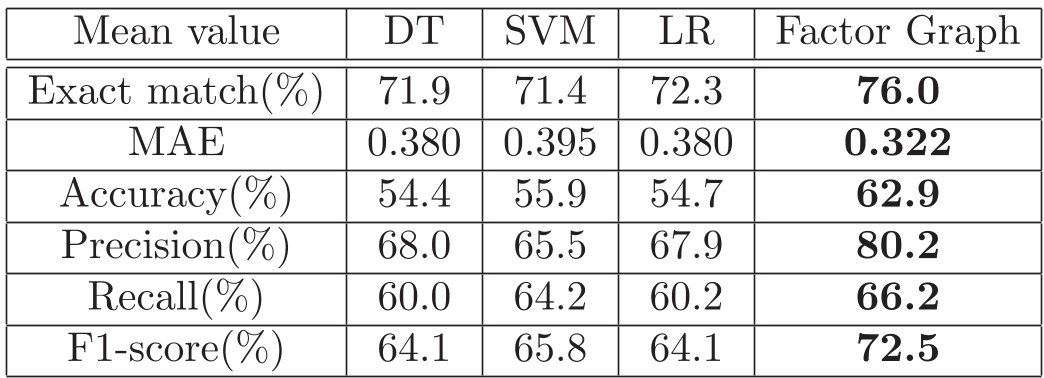
The correlation analysis also revealed that Social Contact (calls/SMS) and Indoor Location (WiFi) were the most influential predictors of mood, highlighting that who we talk to and where we are are the primary drivers of our emotional state.
Critical Analysis & Future Outlook
MoodExplorer successfully demonstrates that specialized graphical models can crack the code of complex emotions better than generic "black box" classifiers.
Limitations:
- Startup Cost: The model is person-specific and requires a week of training data to become accurate.
- Sampling Bias: The data was collected only from university students, potentially limiting its generalizability to different age groups or cultures.
Future Impact: This research paves the way for "Emotion-Aware" applications—smart music players that understand you're "happily surprised" rather than just "happy," or mental health apps that can passively detect the onset of depressive "compound" states (e.g., sadness combined with low social activity).
Takeaway
Emotions aren't experienced in a vacuum. By modeling the relationships between feelings, MoodExplorer offers a more human-centric approach to AI, turning our most personal device—the smartphone—into a sophisticated mirror of our inner lives.