
FAME: Rethinking Topical Expertise on Twitter through Crowdsourced Endorsements
19041_Finding topical experts in Twitter via query-dependent personalized PageRank.
The paper introduces FAME (Finds Authorities, Mavens, and Experts), an expert-finding algorithm for Twitter that utilizes crowd-sourced metadata from Twitter lists. By modeling endorsements as an edge-labeled directed graph, it employs a novel query-dependent personalized PageRank variant to identify topical authorities with a focus on relevance and serendipity.
TL;DR
Finding the real "experts" on Twitter is harder than it looks—follower counts are often vanity metrics, and self-written bios are biased. This paper presents FAME, an algorithm that leverages public Twitter Lists as a form of "crowdsourced endorsement." By applying a refined version of query-dependent PageRank to a small, high-quality subgraph (less than 0.05% of Twitter), FAME discovers experts that are not only relevant but also "serendipitous"—the hidden gems that official algorithms like Twitter’s "Who-To-Follow" (WTF) often overlook.
The Problem: The Noise of Influence
Most search systems for social media struggle because endorsements (like a "follow") are context-blind. Does a follow mean I respect your political views, or I just like your cat photos? Furthermore, existing SOTA methods like COGNOS or official systems often fall into two traps:
- Metric Manipulation: Users "keyword-stuff" their bios to appear in searches.
- The Popularity Bias: Systems tend to recommend the most famous accounts (the "obvious" choice), failing to find domain-specific mavens.
Methodology: The Endorsement Graph & PREP
The researchers' core insight is that Twitter Lists are a goldmine. When a user adds an account to a list titled "Machine Learning," they are providing a human-verified, labeled endorsement.
1. Building the Graph via Focused Crawling
Instead of trying to ingest all of Twitter, FAME uses a BACKWARD-FORWARD crawling strategy. It starts with a few seed users, finds the lists they belong to (Forward), finds other users in those lists (Backward), and iterates. This results in a dense graph of authorities and hubs.
2. The PREP Algorithm
Standard query-dependent PageRank (QD-PageRank) has a mathematical flaw: Stochastic Normalization. If a node has ONLY low-relevance outgoing edges, normalization forces those edges to appear highly relevant relative to that node's local neighborhood.
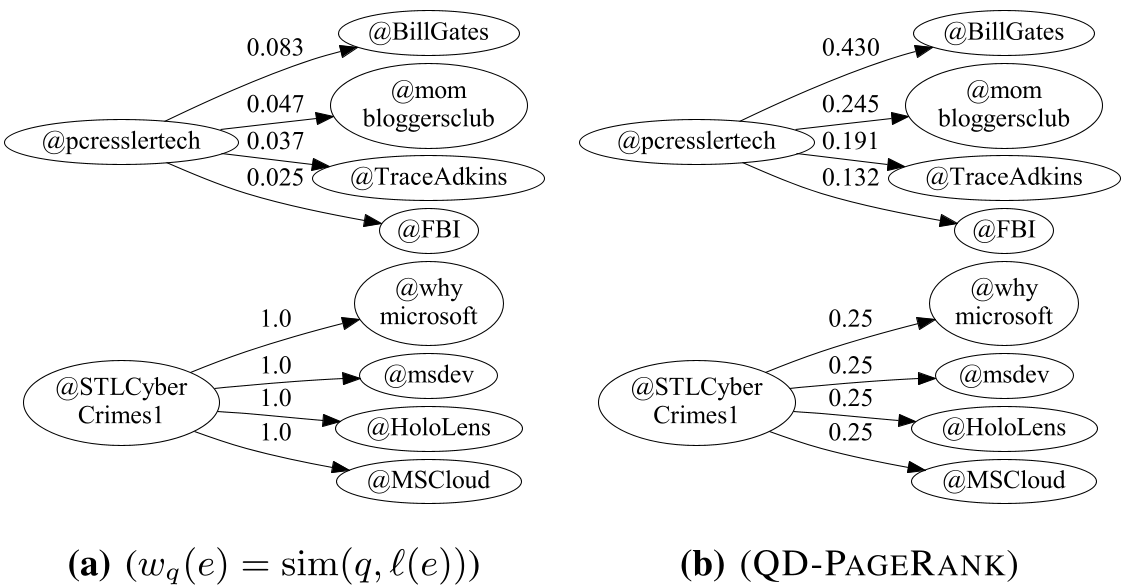
FAME introduces PREP (PageRank on Endorsement graPh), which uses a dynamic weighting scheme. If the total relevance of a node's outgoing edges is low, the walker is more likely to "teleport" to a known relevant node elsewhere in the graph rather than follow a weak local link.
Experimental Battle: FAME vs. WTF vs. COGNOS
The researchers conducted two major user studies—one with internal experts and one on CrowdFlower.
Key Findings:
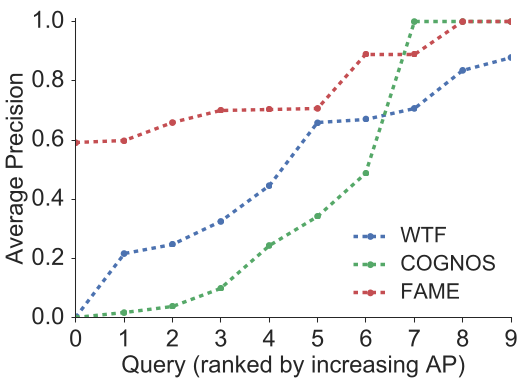
- Higher Relevance: FAME outperformed COGNOS in 70% of test cases.
- Serendipity Factor: While Twitter's "Who-To-Follow" (WTF) is very safe (recommending Bill Gates for "Microsoft"), FAME found relevant accounts that didn't even have the query in their bio (e.g., finding the Android team account for the query "programming").
- Efficiency: FAME achieved these results with a tiny fraction of the data (0.05% of users), proving that the quality of links matters more than the quantity.
Deep Insight: Why This Matters
The real value of FAME lies in its ability to balance Authorities (the giants everyone knows), Mavens (information brokers), and Experts (the niche practitioners). By moving away from self-reported data and focusing on how the "crowd" categorizes users into lists, FAME bypasses the "popularity contest" of traditional social search.
Limitations & Future Work
The current version of FAME relies on Label Space similarity (syntactic matching). While the authors experimented with Word2Vec and People Space (semantic matching), these were limited by sparsity and the limitations of pre-trained models in 2017. Today, replacing the similarity function with a modern LLM-based embedding would likely make FAME even more powerful.
Conclusion
FAME proves that you don't need a "Firehose" access to Twitter's data to build a world-class recommendation engine. By focusing on human-curated structures like Lists and fixing the mathematical biases in PageRank, we can find the experts that truly move the needle in specific domains.