
XI-Code: Breaking the Practicality Barrier of Lowest Density MDS Array Codes
19051_XI-Code A Family of Practical Lowest Density MDS Array Codes of Distance 4.
The paper introduces XI-Code, a novel family of lowest density Maximum-Distance Separable (MDS) array codes with a distance of 4. It is designed to correct triple column erasures or a single column error combined with one erasure, achieving optimal update complexity and near-optimal decoding efficiency for practical storage systems.
TL;DR
Researchers have developed XI-Code, a new family of MDS array codes that settle the long-standing conflict between structural rigidity and performance. By supporting code lengths of or (for any odd prime), XI-Code achieves a distance of 4 (correcting 3 failures), maintains the absolute minimum update complexity, and introduces iterative decoding algorithms that outperform the current industry standard, Generalized RDP.
Background: The Price of Triple-Fault Tolerance
In modern data centers, the "RAID-6 is enough" mantra is fading. Massive disk capacities and constant bit-error rates have made triple disk failures—or a mix of disk failures and sector errors—a statistical certainty. While codes like STAR and Generalized RDP can handle these scenarios, they suffer from Update Penalty. Every time you change one bit of data, you might have to update 5 or more parity symbols.
"Lowest Density" codes were proposed to solve this, promising only 3 updates for distance-4 codes. However, until now, these codes were academic curiosities with "strict constraints" (e.g., must be a prime where 2 is primitive in ), making them useless for a standard 12-drive or 16-drive storage array.
Methodology: Geometric Simplicity
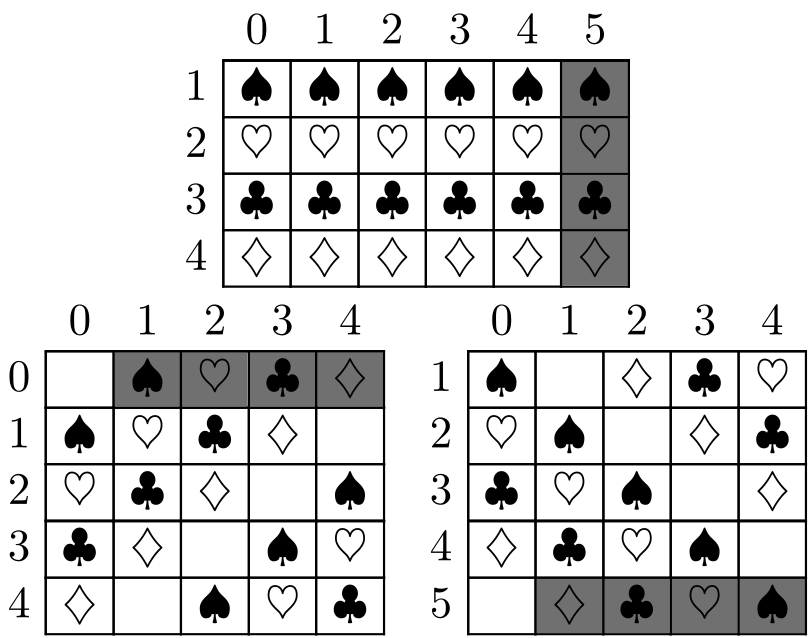
XI-Code achieves its efficiency through a structured grid of XOR operations. In a array:
- Row Parity: A simple XOR across the row.
- Diagonal Parity (Slope 1): XORs across diagonal lines.
- Anti-Diagonal Parity (Slope -1): XORs across anti-diagonal lines.
The "Magic" of XI-Code lies in its use of imaginary 0-bits. By strategically placing virtual zeros in the array, the authors ensure the code remains MDS (Maximum Distance Separable) while supporting much more flexible array lengths ( or ).
Performance: Efficiency Reimagined
The true breakthrough is in the Decoding Complexity. Traditional MDS codes often require solving systems of linear equations ( or ). XI-Code provides an iterative algorithm.
1. Optimal Update & Encoding
XI-Code hits the mathematical floor for updates (Complexity = 3) and encoding (Complexity = per parity bit). This makes it ideal for write-heavy workloads.
2. SOTA Comparison
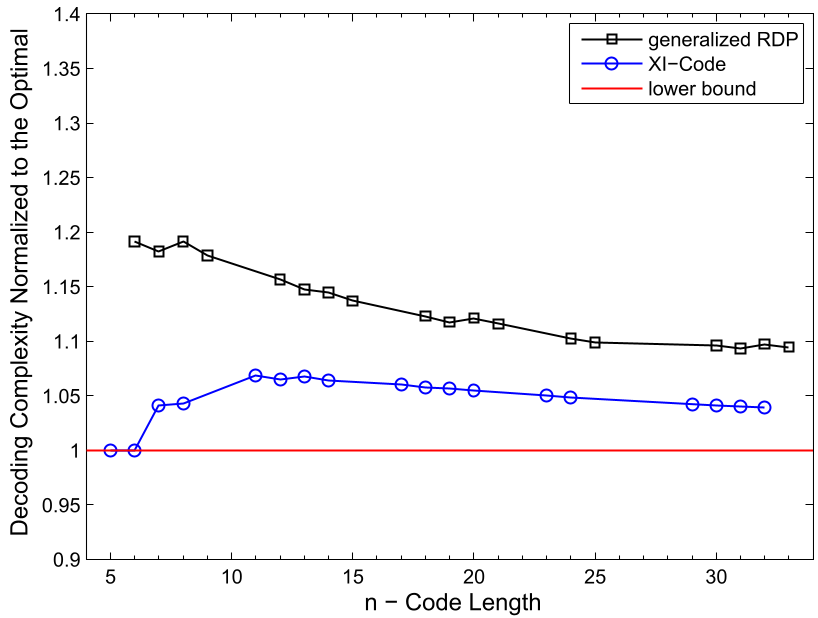
Compared to the state-of-the-art Generalized RDP (RTP), XI-Code demonstrates a lower normalized decoding complexity across almost all array sizes (5 to 33 nodes). For "Equidistant Erasures" (a common failure pattern), the complexity hits the theoretical lower bound.
Deep Insight: Why It Works
The ability to correct a single error combined with an erasure is a highlight. By mapping syndromes to cyclic shifts, the algorithm can "locate" the erroneous column without an exhaustive search. The paper proves that the relationship between diagonal and anti-diagonal syndromes unique identifies the error position via the index that minimizes the difference between shifted syndrome vectors.
Conclusion & Future Outlook
XI-Code is a significant step toward making high-fault-tolerant storage practical. It removes the "prime number headache" that plagued previous lowest-density designs and provides the XOR-friendly logic that storage engineers love.
Limitations: The code still relies on being an odd prime to guarantee the MDS property via the Diagonal/Anti-Diagonal intersection logic. Future Work: The hunt continues for "Lowest Density" codes that support any integer length and can scale to distance 5 and beyond.
Metadata Reference:
- Distance: 4 (Supports 3 Erasures)
- Field: GF(2) (XOR-based)
- Complexity: Asymptotically optimal as .