
Social Networks: Beyond the Digital Interface – A Structural Deep Dive
191_Guest Editors' Introduction- Social Networks and S
This paper provides a comprehensive overview of Social Network Analysis (SNA), tracing its origins from 1930s sociometry to modern digital implementations. It introduces the fundamental components of networks—nodes, ties, and flows—and discusses how computer-mediated communication has revolutionized the study and design of social technologies.
TL;DR
Social networking is far more than a "friend request." It is a rigorous scientific discipline—Social Network Analysis (SNA)—that maps how people are connected through common associates. This paper by Halverson and Churchill bridges the gap between 1930s psychology and the digital age, demonstrating how we can use network structures to solve isolation, improve organizational efficiency, and design better communication tools.
The Structural Intuition: Why Nodes and Ties Matter
The core "insight" of this work is that human interaction follows a determinable structure. Whether it is the famous "six degrees of separation" or the way a virus moves through a population, the value lies not in the individual (the node) but in the relationship (the tie) and the movement (the flow).
Prior to the Internet, studying these structures was a manual, painstaking task for anthropologists and sociologists. Today, "networked computers" serve as a massive instrumentation layer, allowing us to measure exactly how, when, and why people connect.
Methodology: The Anatomy of a Social Network
The paper defines the unit of analysis as social structures consisting of at least two entities and their links.
1. The Sociogram and Matrix
A network is visually represented as a sociogram (circles as nodes, lines as ties) and mathematically as a connectivity matrix.
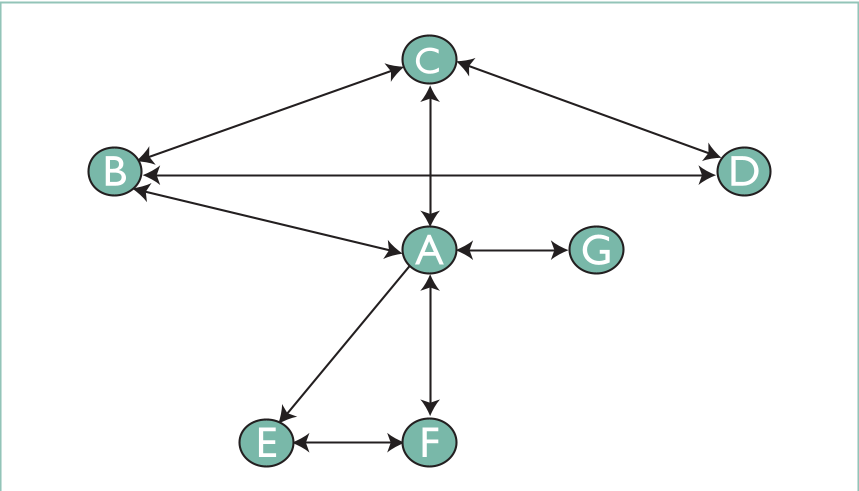
Figure 1: A basic sociogram showing unidirectional and bidirectional links. Note how node 'A' acts as a "boundary spanner" between two subgroups.
2. Flow Dynamics
Flows can be anything: information, money, gossip, or even emotional support. The paper categorizes nodes based on their network position:
- Boundary Spanners: Nodes that connect disparate groups (like Node A in the figure).
- Cliques: Cohesive subgroups where every node is linked to every other node.
- Flow Intensity: Whether the communication is copious/sparse or constant/intermittent.
Transforming Theory into Design
The authors present three groundbreaking case studies of how SNA drives design:
- Soylent & Roles: Visualizing email interactions to help users understand their personal "social ego" and identifying roles in public forums like Usenet.
- Social Biofeedback: A poignant application for the elderly. By using sensors to track phone calls and visits, researchers created "health feedback displays." When elderly patients saw their social interactions visualized, it provided empirical refutation of their feelings of isolation.
- P3 Systems (People, Palaces, and Places): Moving away from abstract digital space, this framework reintroduces geographic context into social networking, asking how physical location changes our desire for contact.
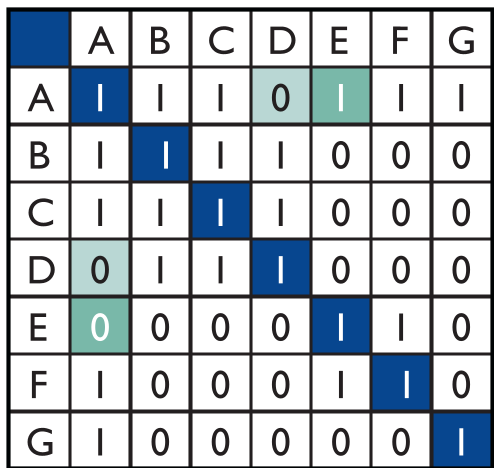
Figure 2: The mathematical representation (Matrix) of the network structure, allowing for rigorous computational analysis (SNA).
Critical Analysis & The Future
The paper successfully highlights that the "Internet" did not create social networking; it merely accelerated and made it visible. However, it also raises critical questions about inequity: As society becomes a "Networked Society" (as per Manuel Castells), those without access to these technical networks may face increasing social and economic exclusion.
Key Takeaways for Today’s Technologists:
- Informal vs. Formal: In businesses, the "formal chart" is often a lie. Reality lives in the informal knowledge flows identified by ONA (Organizational Network Analysis).
- Visualization is Persuasion: Visualizing a network is not just for analysis; it is a "socio-feedback" tool that can change human behavior and mental well-being.
- The Propinquity Paradox: While the Internet allows reaching across the globe, the most meaningful interactions still often require "place-centered" context.
Conclusion
Halverson and Churchill remind us that behind every "like" or "follow" is a century of behavioral science and graph theory. Designers who ignore the structural impact of their platforms miss the opportunity to foster truly cohesive and effective communities.