
Crowdsourcing Systems: Architecting the Collective Intelligence of the Web
192_Crowdsourcing systems on the World-Wide Web.
This seminal survey paper provides a comprehensive framework for "Crowdsourcing Systems on the World-Wide Web." It defines crowdsourcing as a general-purpose problem-solving method and categorizes diverse systems ranging from Wikipedia to Mechanical Turk into a unified taxonomy.
TL;DR
In this foundational survey, AnHai Doan and colleagues formalize the concept of Crowdsourcing (CS) as a vital problem-solving paradigm. By analyzing systems like Wikipedia, Linux, and Mechanical Turk, the authors delineate a world where the boundary between "users" and "builders" blurs, providing a blueprint for systems that harness the cognitive labor of millions to solve tasks that remain difficult for pure AI.
The Motivation: From Physical Crowds to Digital Legions
Before the 2010s, "crowdsourcing" was often seen as a collection of disjointed phenomena: open-source software development, social media tagging, or niche human-computation games. The authors identified a need to move past these silos. The core friction wasn't just how to get people to help, but how to design systems that can handle the noise, the potential for abuse, and the massive scale of data generated when "the crowd" gets to work.
Methodology: The Four Pillars of Crowdsourcing
The paper posits that any true CS system must address four existential challenges:
- Recruitment & Retention: How do you get people to show up? (via payment, volunteering, or "piggybacking" on existing habits).
- Contribution Type: What exactly can they do? (ranging from simple "slaves" for image labeling to "perspective providers" for reviews).
- Combination Mechanism: How do you merge 10,000 different inputs into one truth? (using weighted voting or manual dispute resolution).
- Evaluation: how do you find the "trolls"? (through blocking, automated testing, or "public shaming").
The Taxonomy of Collaboration
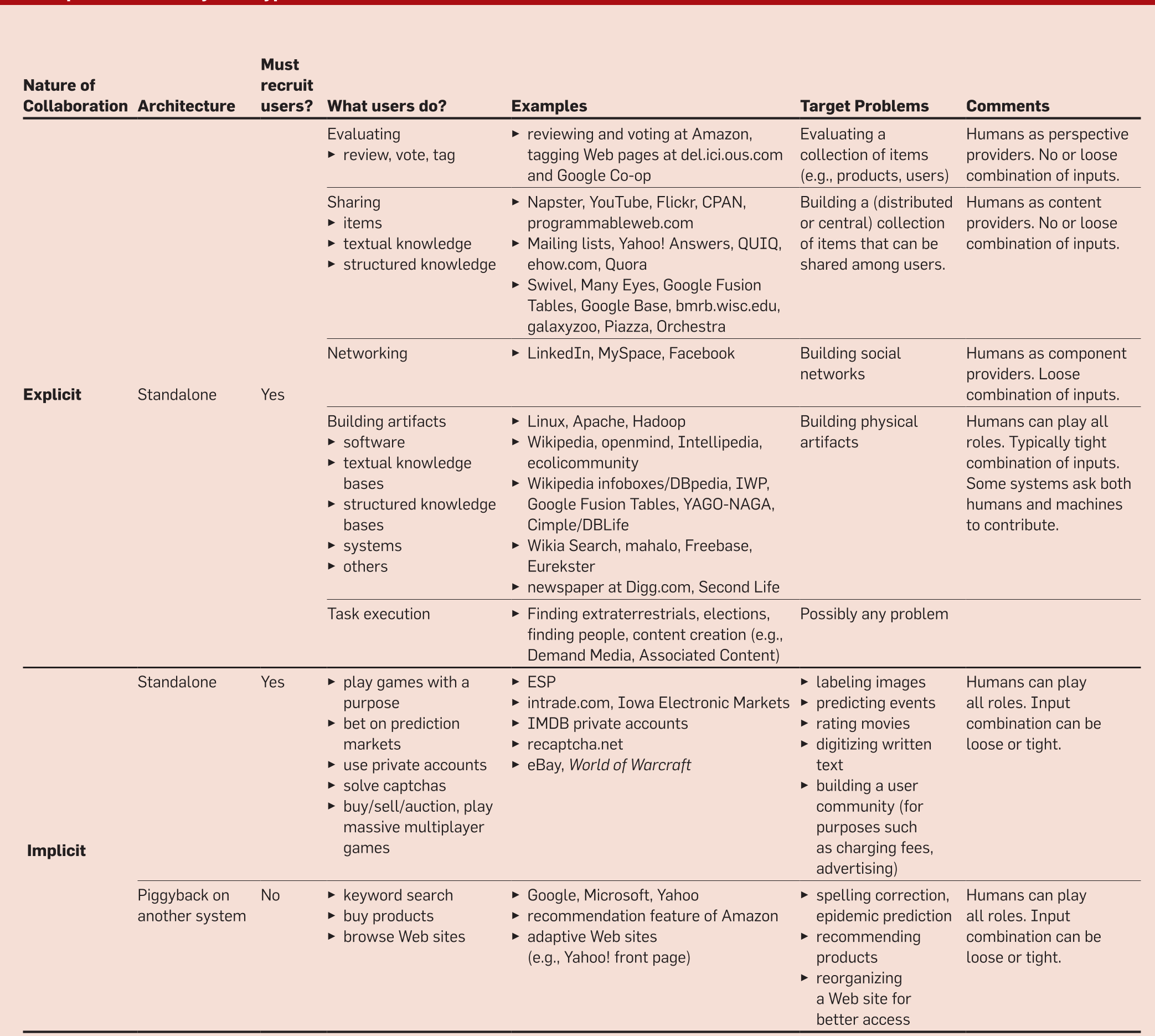
One of the most profound insights is the distinction between Explicit and Implicit systems:
- Explicit Systems: Users know they are collaborating (e.g., editing a Wikipedia page).
- Implicit Systems: Users solve a problem as a side effect of another activity (e.g., solving a ReCAPTCHA to prove humanity also helps OCR old books).
Human-Machine Synergy: Who Does What?
The authors emphasize that we shouldn't just dump tasks on humans. The goal is a complementary relationship:
- Machines excel at massive data processing and following rigid logic.
- Humans excel at "low-hanging fruit" for the brain (image recognition) and "high-impact" cognition (resolving controversial edits or providing domain-specific rules).
Experimental Context & Real-World Impact
The paper reviews various "in the wild" successes:
- Building Structured KBs: Projects like Cimple/DBLife show how a machine-human partnership can build complex databases far faster than engineers could alone.
- Massive Task Execution: The search for Jim Gray, where volunteers scanned thousands of satellite images, demonstrated the power of the crowd in crisis response.
 Example of extreme granular task distribution: Aaron Koblin’s "Ten Thousand Cents", where 10,000 workers each painted a tiny piece of a $100 bill.
Critical Analysis & Future Outlook
While the paper is optimistic, it doesn't shy away from the challenges of "undoing" damage. If a malicious user injects a faulty inference rule deep into a Knowledge Base, the "cascading" corruption is incredibly hard to reverse without losing valid work.
Takeaway for the Future: We are moving toward General Crowdsourcing Platforms. Instead of building a new "Wikipedia for [X]" from scratch, we will see frameworks that allow developers to deploy "crowd-powered" features with the same ease as calling a cloud API.
As we look toward an AI-driven future, this paper reminds us that the "Human API" remains one of the most powerful tools in a developer's arsenal for ensuring quality, diversity, and truth in our digital artifacts.