
TS-SRR: Revolutionizing Social Influence Quantification via Multi-Factor Temporal Ranking
2009 IEEE/WIC/ACM International Joint Conferences on Web Intelligence and Intelligent Agent Technologies
The paper introduces a Social Relationship Rank (SRR) framework designed to quantify user influence and connectivity within social networks. It proposes a multi-factor weighting model that incorporates similarity, access, and interaction history to calculate a "Time-Sensitive Social Relationship Rank" (TS-SRR), achieving significantly higher correlation with actual user influence (PWSR) compared to static metrics.
TL;DR
In the era of hyper-connected social media, "influence" is more than just a number of followers. This paper presents the Social Relationship Rank (SRR) and its evolved version, TS-SRR, which uses a weighted multi-factor approach (incorporating shared demographics, interaction frequency, and temporal decay) to rank user importance. It outperforms traditional ranking methods by achieving up to a 0.89 correlation with real-world influence benchmarks.
Background & Motivation: Beyond the Follower Count
Previous attempts to quantify social influence often treated all connections as equal or relied on static graph topologies. However, a "friend" from ten years ago with whom you have no shared interests does not contribute to your current social influence in the same way as a current professional colleague. The authors identified that existing SOTA methods lacked:
- Multi-dimensional attributes: Failing to distinguish between shared education, location, or interests.
- Temporal relevance: Ignoring that social influence is dynamic and decays if not maintained.
Methodology: The Anatomy of SRR
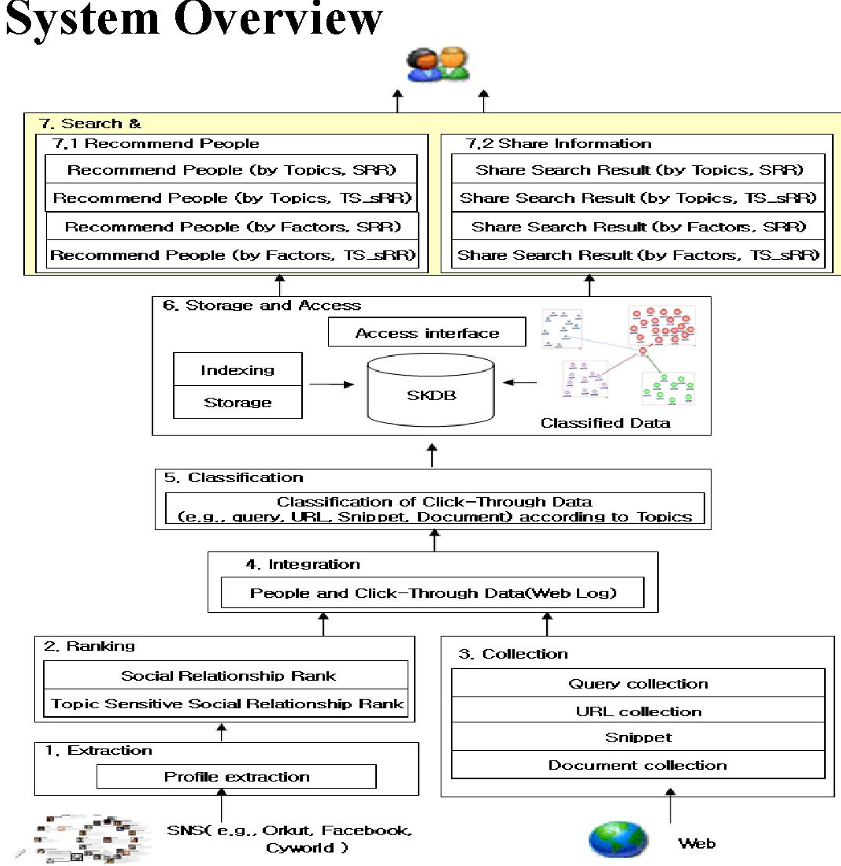
The core of the paper is a sophisticated weighting formula that aggregates different "Factor Attributes."
1. Multi-Factor Weighting
The SRR is calculated by balancing multiple vectors:
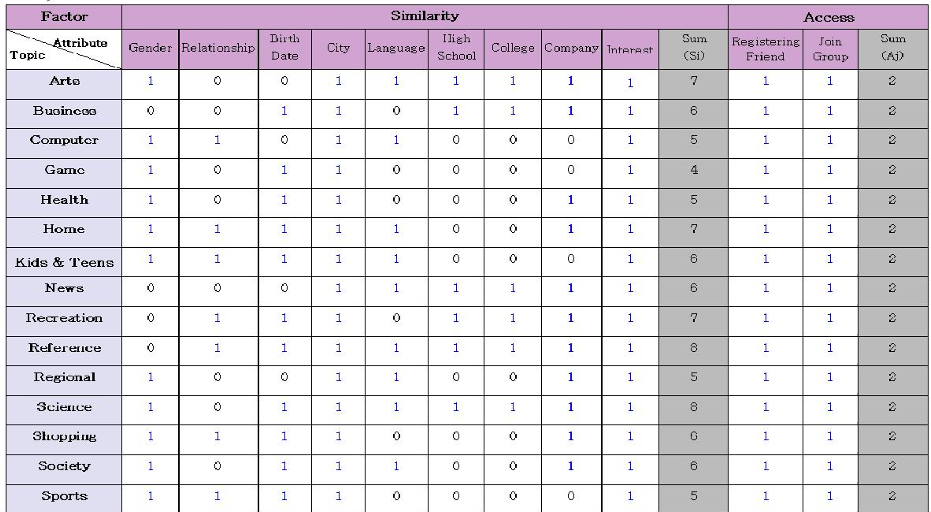
- Similarity (SI): Geometric and demographic overlaps (Gender, College, Company).
- Access (ACC): Behavioral interactions such as joining groups or registering friends.
- Intimacy (INTI) & Rewards (REW): Deeper engagement metrics.
2. The Time-Sensitivity Equation
The mathematical heartbeat of the paper is the TS-SRR formula, which introduces to ensure that recent interactions carry more weight than historical ones:
This ensures the model reflects the current state of the social graph rather than a stale historical snapshot.
Experiments: Proving the Value
The researchers tested their model across 15 different topic categories (Arts, Business, Science, etc.). The "Factor Attribute Topic" table shows how different attributes contribute to the final rank across these domains:
Key Result: Correlation Gains
The most compelling evidence for the method’s efficacy is the comparison between standard SRV and TS-SRV against the PWSR ground truth:
| Topics | Correlation (SRV) | Correlation (TS-SRV) |
|---|---|---|
| Arts | 0.802 | 0.895 |
| Business | 0.789 | 0.881 |
| Computers | 0.632 | 0.856 |
The inclusion of time-sensitivity significantly bridges the gap in "noisy" domains like Computer Science, where trends shift rapidly.
Critical Insight & Conclusion
The TS-SRR framework demonstrates that social influence is a "leaky bucket"—without continuous interaction and shared relevance, a node's rank should naturally diminish. By quantifying the "Balance Factors" (), the authors provide a flexible framework that can be tuned for different types of networks (e.g., professional networks might weigh "Company" higher, while hobbyist groups might weigh "Interests" higher).
Limitations: The paper assumes that all "similarity" factors are binary (0 or 1), which may oversimplify complex human relationships. Future work could benefit from integrating NLP to analyze the quality of interactions rather than just the count.
Bottom Line: For developers building recommendation engines or social discovery tools, the message is clear: Time and Context are the two pillars of relevance.