
Virus Propagation in Facebook: Why Social Networks are More Vulnerable than Email
2010 International Conference on Advances in Social Networks Analysis and Mining
This paper introduces two novel virus propagation models tailored for the Facebook ecosystem: the Application Platform Model and the Message Sending Model. Leveraging Barabási-Albert (BA) scale-free network topology, the study demonstrates that Facebook's high user engagement and trust-based application sharing significantly accelerate virus spreading compared to traditional email networks.
TL;DR
In this classic study, researchers W. Fan and K. H. Yeung dissect the mechanics of how digital "infections" spread within the Facebook ecosystem. By modeling both the Third-Party Application Platform and In-Platform Messaging, they reveal a sobering truth: the entertainment value and high engagement of social networks act as an accelerant for virus propagation, making them far more "infectious" than traditional email systems.
The Motivation: From Mailboxes to News Feeds
Before the rise of SNS (Social Network Services), virus modeling primarily focused on Email or IM. These systems were characterized by brief interactions—users log in, check mail, and leave. However, Facebook changed the game. Users stay online for hours, interact with third-party apps, and trust invitations from friends implicitly.
The authors identified a critical gap: existing models didn't account for preferential installation behavior in apps or the extended online duration of modern social users. They set out to prove that these two factors create a "Perfect Storm" for malware.
Methodology: Two Fronts of Attack
1. The Application Platform Model
Facebook allows third-party developers to create apps. The authors modeled this using a preferential characteristic, where the probability of a user installing an app is proportional to how many apps they already own () and the app's current popularity.
When an app is "malicious," it doesn't just wait to be found; it sends fake invitations to the victim's entire friend list. This creates a feedback loop:
- Social Trust: Users are more likely to install an app if a friend recommends it.
- Artificial Popularity: Malicious invites inflate the app's perceived value, triggering the preferential attachment mechanism.
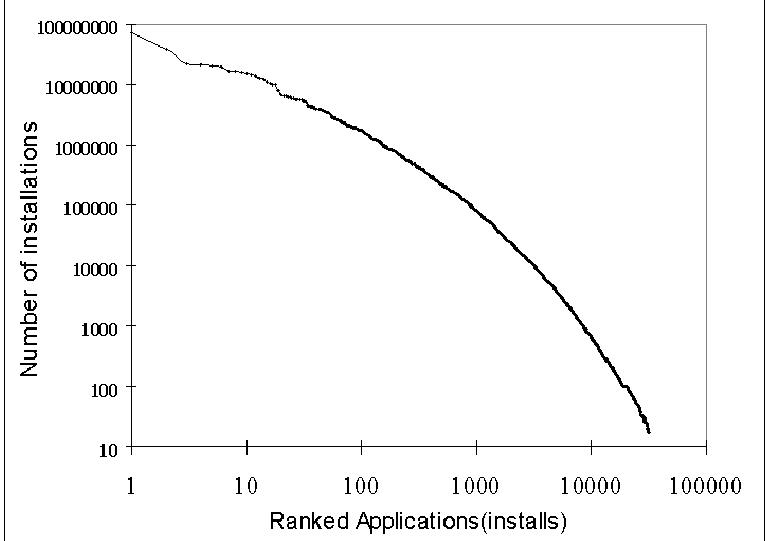 Fig 1: The power-law distribution of application installations serving as the baseline for the model.
2. The Message Sending Model (Email 2.0)
The second model mimics traditional email viruses but adds a crucial variable: Online Time (). In Facebook, if you receive a malicious link while you are already browsing, the time-to-infection is near zero. The authors modeled log-in intervals and online durations as Gaussian random variables to simulate real-world human behavior.
Core Insights from Experiments
The "Engagement" Penalty
The most striking result is found in the comparison between Facebook and Email. As shown in the simulation, the Facebook curve (solid line) rises much faster. This is directly attributed to Online Time. Because social network users stick around, they are "available" to be infected and to spread the virus much more frequently than an email user who only checks their inbox twice a day.
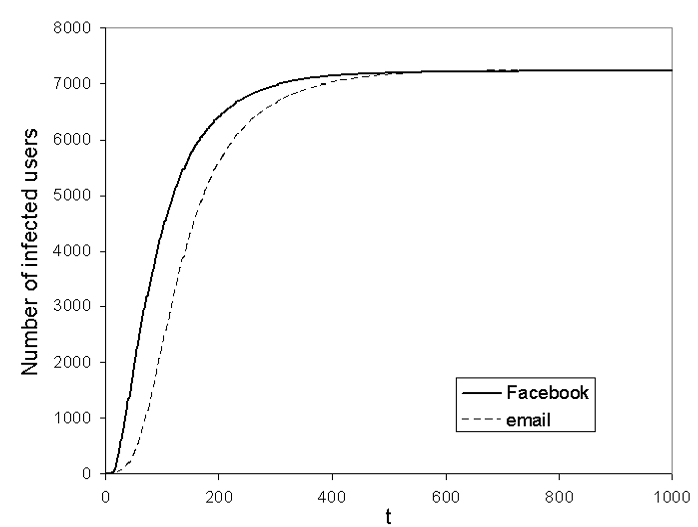 Fig 2: Facebook spreading (solid) vs. traditional Email spreading (dash). The high "stay time" on social platforms leads to a faster epidemic.
The "Super-Spreader" Effect
By utilizing the Barabási-Albert scale-free network, the study confirmed that nodes with higher degrees (more friends) are critical. In Fig 3 of the paper, increasing the average degree from to drastically reduced the time required for the virus to saturate the network.
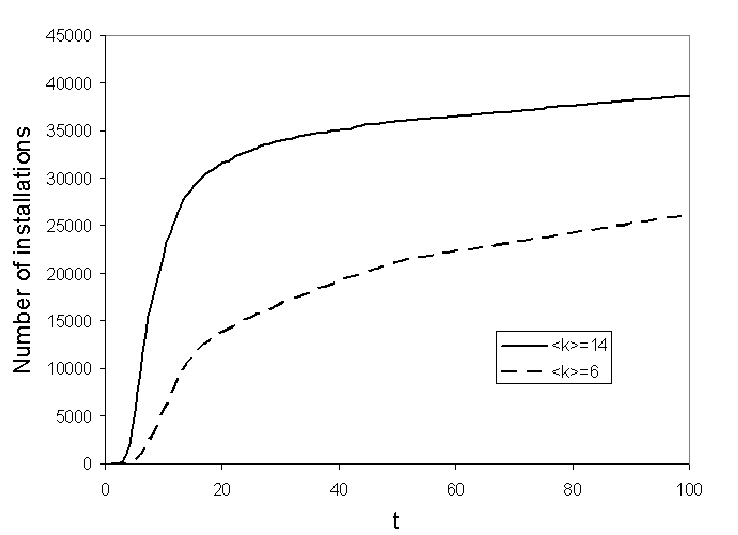 Fig 3: How the density of the social graph () accelerates the malicious application's growth.
Critical Analysis & Conclusion
The paper concludes that Facebook's strength—its interconnectedness and app ecosystem—is also its greatest security weakness.
Key Takeaways:
- Inductive Bias of Trust: Social networks bypass traditional "stranger danger" filters because malicious activity is masked as "friend activity."
- The Speed of Entertainment: The more time users spend on a platform for fun, the faster a virus can achieve total network penetration.
Limitations: While groundbreaking for its time (2009), the model assumes a somewhat static response from the platform itself (e.g., automated shadow-banning or modern AI-driven threat detection were not factored in). However, the mathematical intuition regarding Online Time remains a cornerstone for understanding modern digital epidemics, including the spread of "viral" misinformation today.