
Homing Socialbots: How Attackers "Home In" on Tech-Savvy Employees
2013 IEEE/ACM International Conference on Advances in Social Networks Analysis and Mining
The paper presents "Homing Socialbots," a method for infiltrating specific employees within targeted high-tech organizations on Facebook. By leveraging organizational network topologies and gaining mutual friends, the authors achieved a 50% to 70% success rate in having their Socialbots accepted by targeted users.
TL;DR
Even the most security-conscious IT professionals are not immune to social engineering. This paper demonstrates a successful "Homing" attack strategy that uses Socialbots to infiltrate specific employees in high-tech organizations. By strategically amassing mutual friends within the same company, researchers achieved up to a 70% success rate in compromising targeted users who should have known better.
Background: The Illusion of Security
We often assume that employees in technology-oriented organizations are hyper-aware of digital threats. However, this study proves that "social proof"—the psychological phenomenon where people rely on the actions of others to determine correct behavior—can be weaponized to bypass professional skepticism. The authors move beyond broad-scale bot spam to a surgical, topology-aware approach called "Homing."
The Insight: Exploiting Organizational Topology
The core problem with prior Socialbot work was its randomness. A stranger asking for a friend request is a red flag. However, a "new colleague" who shares 10 mutual friends from your actual office feels like a legitimate connection.
The authors' research intuition was simple: Infiltrate the periphery to conquer the center. By mapping out an organization's social graph, a bot can "warm up" its reputation by connecting with a target's colleagues before approaching the target themselves.
Methodology: The "Homing" Algorithm
The researchers followed a rigorous 4-step deployment process to ensure maximum psychological impact:
- Organizational Crawling: Using specialized tools to identify employees who publicly list their workplace.
- Credibility Building: Every Socialbot first gathered 50 random "junk" friends to avoid looking like a brand-new, suspicious account.
- The "Homing" Phase: The bot identifies 10 specific targets. It does not message them yet. Instead, it sends friend requests to the target's mutual friends within the same organization.
- The Final Strike: Once a sufficient number of mutual office-mates have accepted the bot, it sends the final request to the primary target.
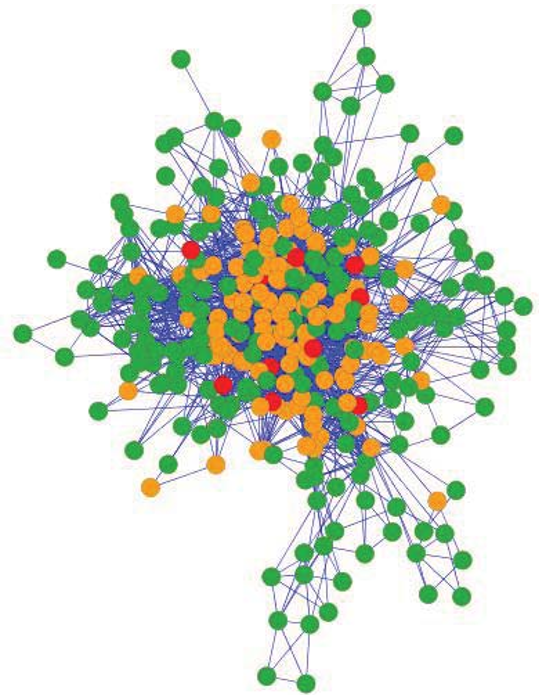 Figure: Red nodes represent the primary targets; orange nodes represent the colleagues targeted to build mutual-friend credibility.
Experimental Results: Breaking the Tech Shield
The results were alarming. Despite targeting high-tech companies where employees receive security training, the success rates were significantly higher than generic bot campaigns:
- Organization 1 (O1): 5 out of 10 targets (50%) accepted the friend request.
- Organization 2 (O2): 7 out of 10 targets (70%) accepted the friend request.
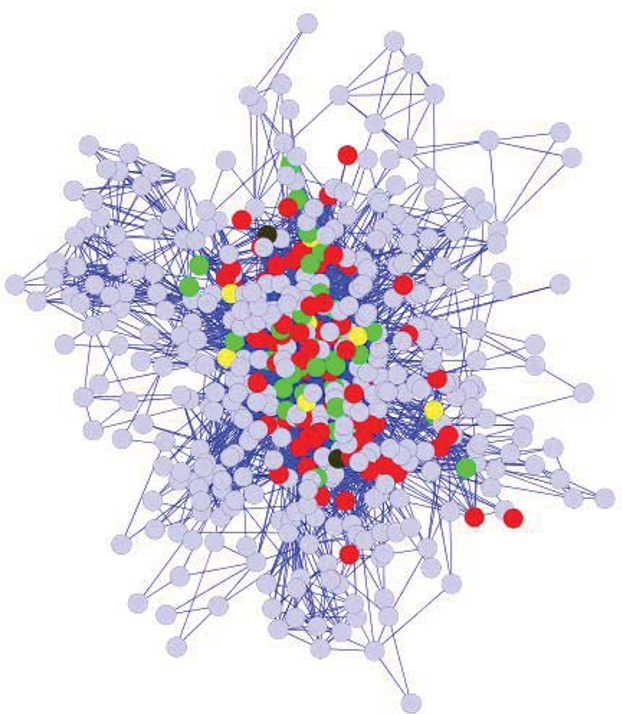 Figure: Green nodes represent successful colleague infiltrations; yellow triangles show the final "compromised" targets.
The "Trust Threshold"
The study identified a critical correlation: the more mutual friends a bot has, the more likely the target is to accept. For Organization 1, the tipping point was 6 mutual friends. For Organization 2, it was 7. Once a bot crosses this threshold, it effectively enters the "Circle of Trust."
Critical Analysis & Conclusion
The value of this work lies in its demonstration of the Socialbot-Topology synergy. While Facebook's Immune System (FIS) can sometimes detect high-volume spam, it struggles to identify low-volume, highly contextualized requests that mimic real-world organizational growth.
Limitations
- Failed Trials: One bot (S3) was banned because its target organization was located in a foreign country, and the bot's profile didn't match the local cultural/linguistic context, leading to high rejection rates. This suggests that "Homing" bots must be culturally tuned.
- Ethical Bounds: The authors were careful to use anonymous profile pictures and hide organization names, but the study highlights just how much data we leak through our "Public" workplace declarations.
Final Takeaway
The "Human Firewall" is weakest when it perceives a shared social identity. For organizations, the lesson is clear: security training must move beyond "don't click links" to "be skeptical of colleagues you haven't met in person," especially on Online Social Networks (OSNs).