
Beyond Activity Counts: Decoding Social Roles via Sociology Attributes
2013 IEEE/ACM International Conference on Advances in Social Networks Analysis and Mining
The paper introduces a "Role Discovery" framework for social networks, specifically targeting Sina Microblog, by clustering users based on intrinsic sociology attributes. Using a modified K-means clustering guided by the Bayesian Information Criterion (BIC), it successfully identifies three distinct user archetypes: "V-level Opinion Leaders," "Active Info-Seekers," and "Common Observers."
TL;DR
This research moves beyond superficial metrics like "number of posts" to identify user roles on Sina Microblog. By integrating sociological theories—such as Structural Holes and Social Capital—into a recursive clustering algorithm optimized by the Bayesian Information Criterion (BIC), the authors reveal the distinct behavioral DNA of influencers, active participants, and silent observers.
Background & Motivation: The Limits of Graph Theory
In 2013, early Social Network Analysis (SNA) was obsessed with structure (who follows whom) or simple volume (how many tweets). However, these metrics miss the intent and sociological impact of a user. An influencer isn't just someone with many followers; they are someone who bridges "structural holes" between disparate groups. The authors argue that to truly master public opinion tracking or E-commerce marketing, we must cluster users based on the functional roles they play in the social fabric.
Methodology: Bridging Sociology and Machine Learning
The core innovation lies in the Sociology Attribute Definition. The authors mined 11 key metrics grouped into six sociological categories:
- Structural Holes: Users who act as bridges between communities.
- Social Capital: The value derived from reciprocal interactions.
- Social Balance: The stability of a user’s immediate social circle.
The Recursive BIC-Clustering Algorithm
Determining the number of user roles () is usually a guessing game. The authors proposed a unique workflow:
- Start with .
- Recursively partition clusters using K-means.
- Use the Bayesian Information Criterion (BIC) to validate if a split actually improves the model.
- Stop once the BIC no longer increases, ensuring a data-driven choice for .
 (Image: The conceptual framework for Role Discovery in social networks)
Experimental Insights: The Three Pillars of Microblogging
Applying this to a dataset of ~50,000 Sina Microblog users revealed three distinct "DNA profiles":
- The Opinion Leaders (2.1%): These are the "Star" or "V-certified" users. They have massive reach and high "structural hole" scores but oddly low "social capital." Intuition: They broadcast original content but rarely engage in the "grunt work" of replying to others.
- The Information Seekers (10.2%): Extremely active users who forward and comment frequently. They have high "social capital" because they use the platform as a utility for gaining and sharing information.
- The Silent Observers (87.7%): The "Long Tail." They have high "social balance" because their interactions are confined to tight-knit, real-life friend circles. They mostly browse without contributing.
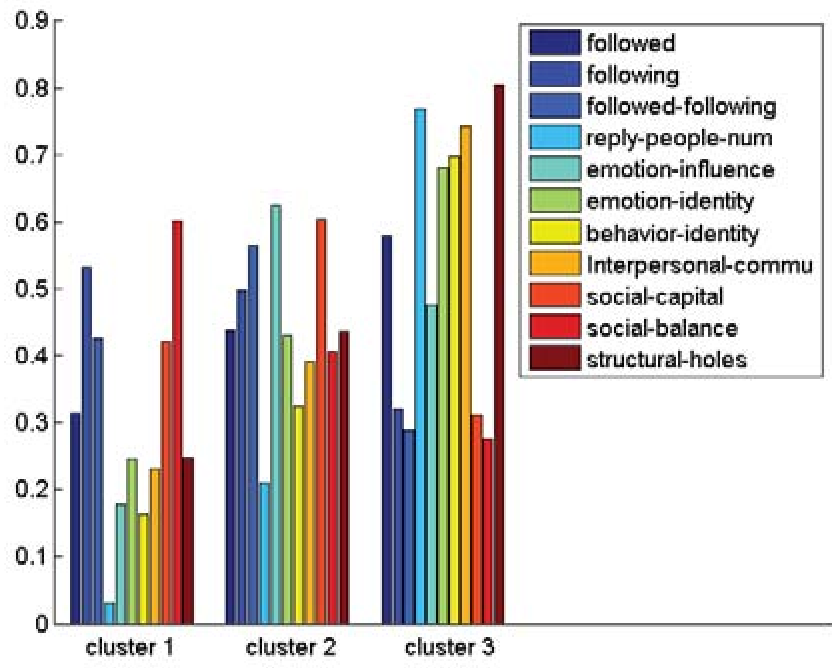 Figure 1: The metrics distribution showcasing how different sociology attributes peak for different clusters.
Critical Analysis & Future Outlook
While the paper successfully moves SNA toward "social physics," it has its limitations:
- Scale: The algorithm was tested on 50k users, but modern platforms have hundreds of millions. The authors rightly point to Spark/MapReduce as the next step for scalability.
- Static Data: The roles are treated as static, whereas a "Common User" might briefly become an "Opinion Leader" during a viral event.
Takeaway: Effective social marketing isn't about targeting everyone; it's about identifying the 2% who bridge structural holes and the 10% who provide the social capital necessary for information to spread.
Conclusion
This work serves as a foundational bridge between classical sociology and modern data mining. By quantifying abstract concepts like "social balance," the authors provided a blueprint for more empathetic and effective social network algorithms.