
Similarity-CNM: Boosting Community Detection via Virtual Social Networks
2013 IEEE/ACM International Conference on Advances in Social Networks Analysis and Mining
This paper introduces Similarity-CNM, an enhanced community detection approach that incorporates a node similarity pre-processing step before applying the Clauset-Newman-Moore (CNM) algorithm. By constructing a Similarity Virtual Network using the Jaccard measure, the method significantly improves community partition quality and computational efficiency across both synthetic and real-world social networks.
TL;DR
Community detection is vital for targeted marketing and social analysis, but traditional greedy algorithms like CNM often struggle with accuracy and efficiency. This paper introduces a pre-processing strategy that creates a Similarity Virtual Network based on Jaccard similarity. By connecting similar nodes before the clustering begins, the Similarity-CNM algorithm achieves up to a 67% increase in modularity and significantly faster convergence on large datasets like Flickr.
The "Greedy" Trap: Why Standard CNM Fails
The Clauset-Newman-Moore (CNM) algorithm is a staple in network science due to its complexity. However, its greedy, bottom-up nature is a double-edged sword. It prioritizes low-degree nodes early on, leading to a "snowball effect" where larger communities absorb neighbors indiscriminately. This often results in:
- Low Modularity (): Failure to find the globally optimal partition.
- Resolution Limit: The inability to detect small, tightly-knit communities in large graphs.
- Efficiency Bottlenecks: Spending excessive cycles merging nodes that lack strong structural affinity.
Methodology: The Power of Virtual Links
The core insight of the authors is that we can "guide" the clustering process by enhancing the network's topology before detection starts.
1. Similarity Calculation
Instead of relying solely on physical edges, the authors use the Jaccard Measure to compute the affinity between any two nodes and : Where is the number of common neighbors. This captures the structural context better than simple edge existence.
2. Virtual Network Generation
A Virtual Similarity Network is constructed where an edge exists if the similarity exceeds a predefined threshold. This doesn't change the real social network but provides a "refined" map for the algorithm.
3. Agglomerative Clustering
The CNM algorithm is then run on this virtual graph. Because the virtual graph already groups similar nodes, the algorithm starts from a much more coherent state.
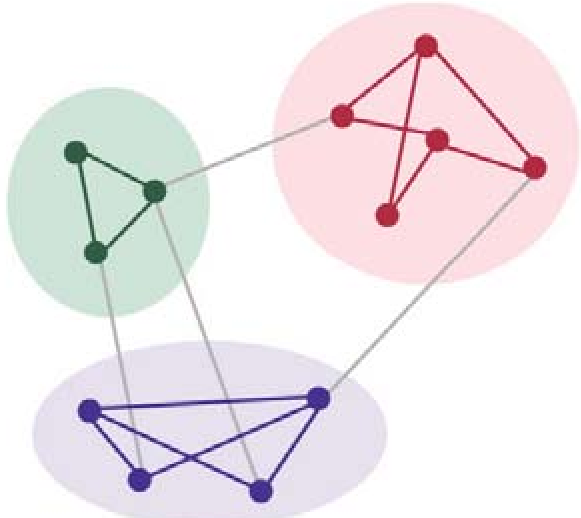 Figure 1: Illustration of a typical community structure with high internal density and sparse external links.
Experimental Validation
The authors tested their approach on the LFR Benchmark (synthetic) and real-world data (Flickr, American Football).
Quantitative Gains
- Modularity Boost: On the Flickr dataset (10,000 node subset), Similarity-CNM reached a modularity of 0.925, compared to just 0.247 for the original CNM—a staggering improvement.
- Step Reduction: The pre-processing allowed the algorithm to reach its peak modularity in 1,036 fewer steps for the Flickr network, proving that structural similarity acts as a shortcut to optimal clustering.
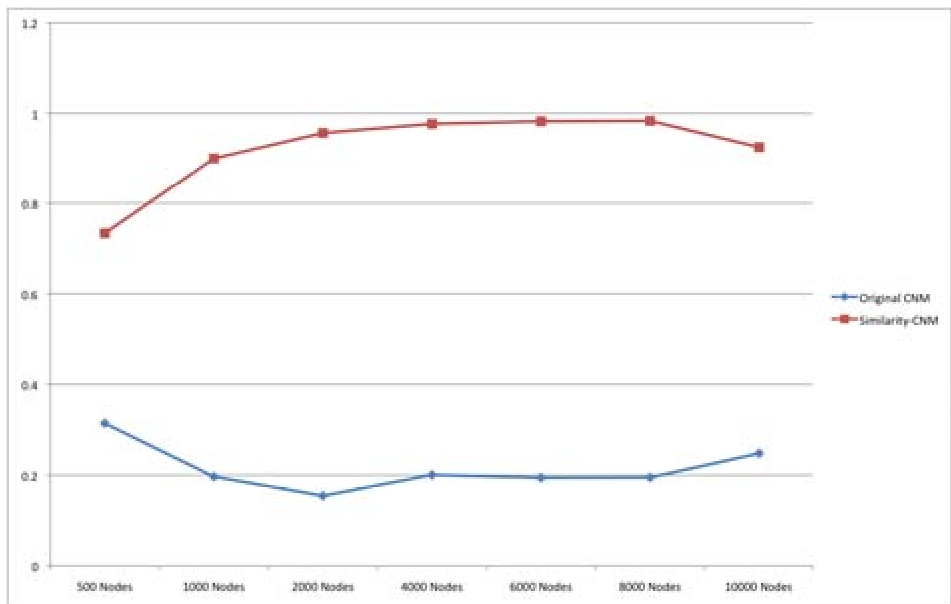 Figure 2: Maximum Modularity Comparison—Similarity-CNM (Blue) consistently outperforms Original CNM (Red) as network size increases.
Critical Insight: Why Does It Work?
By establishing virtual links, the authors effectively increase the "internal weight" of potential communities. In the original CNM, an edge is just an edge. In Similarity-CNM, the virtual edges represent triadic closure and shared context. This forces the greedy merge process to respect local densities, effectively bypassing the resolution limit that typically plagues modularity-based methods.
Conclusion and Future Work
The Similarity-CNM approach demonstrates that semantic enrichment through structural pre-processing is a low-cost, high-reward strategy for graph mining. While the current work focuses on unweighted directed networks, the logical next step is extending this to weighted heterogeneous graphs, where node attributes (age, location, interests) can be fused with structural similarity to create even more robust virtual networks.
For practitioners in social media analytics and targeted advertising, this method offers a path toward more accurate user segmentation without the massive computational overhead of deep graph neural networks.