
Socialization and Trust: The Asymmetric Loop in Virtual Worlds
2013 IEEE/ACM International Conference on Advances in Social Networks Analysis and Mining 653
This paper explores the mutual reinforcement between socialization and trust formation in the MMORPG EverQuest II. Using housing access as a proxy for trust, the study identifies a "socialization threshold" required for trust to emerge and employs supervised machine learning to predict relationship links across multi-relational networks.
TL;DR
Does being more social lead to higher trust, or does trust lead to more socialization? By analyzing millions of interactions in EverQuest II, researchers found that while a massive spike in social activity (grouping, trading, mentoring) is necessary to build trust, the formation of a trust bond actually leads to a decrease in interaction. Trust is the result of socialization, but it is not its fuel.
Contextualizing Trust in the Digital Wild
In the realm of online social networks, "trust" is often a hollow metric—think of a "like" on a review or a follower count. This paper moves beyond these low-stakes indicators by using in-game housing access as a proxy for trust. In EverQuest II, allowing someone into your house carries real risk: they can move or steal your hard-earned items. This creates a "scientifically mapped" proxy for real-world trust where something tangible is at stake.
The "Socialization Threshold" Hypotheses
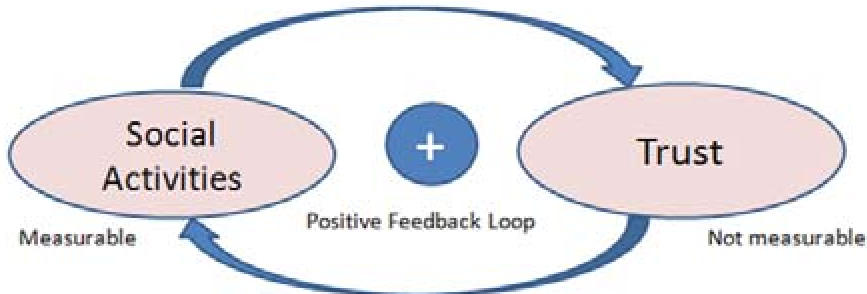
The researchers set out to test a common intuition: that socialization and trust form a virtuous cycle of mutual reinforcement. To do this, they used time-series clustering to align 20 weeks of activity around the exact moment a "trust link" (house access) was created.
The results revealed a surprising "threshold" effect. Before trust is granted, there is a sharp, almost frantic increase in interaction levels. However, once the "Gate" of trust is passed, the interaction frequency often drops.
Methodology: From Raw Logs to Semantic Insights
To quantify these patterns, the authors moved beyond simple counts. They proposed three Semantic Dimensions:
- Engagement: The average volume of transactions over N weeks.
- Intensity: The weighted ratio of engagement compared to previous weeks (capturing "acceleration").
- Stability: The trend of engagement (increasing or decreasing).
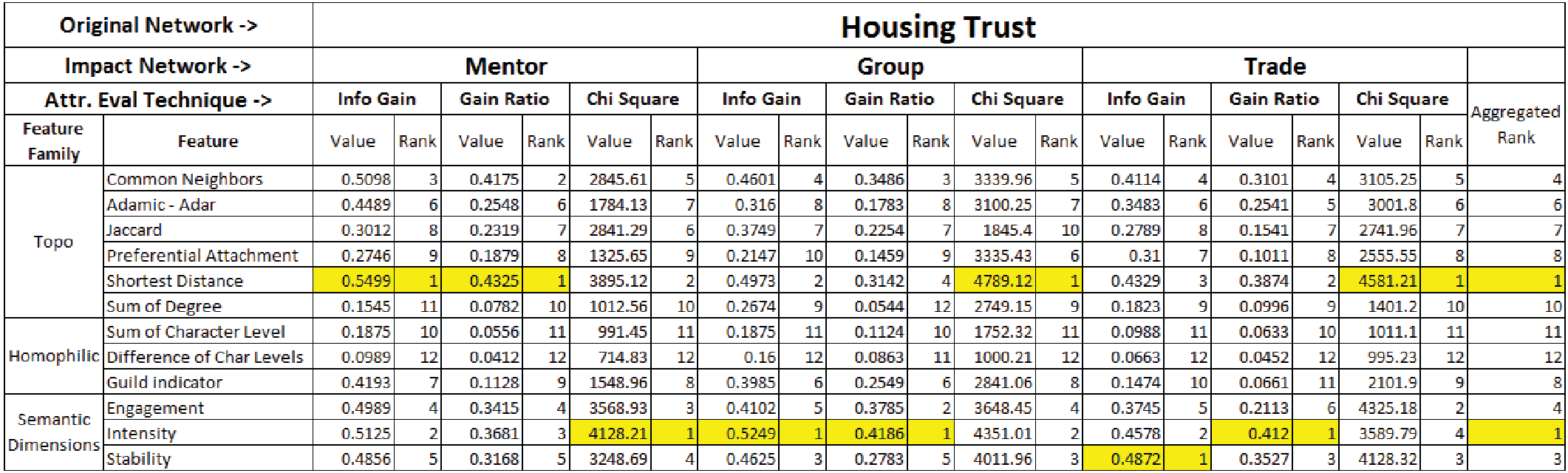
These features were fed into various classifiers (J48, JRip, BayesNet) to solve two link prediction problems:
- Can we predict future socialization using trust? (Answer: No, the impact was negligible).
- Can we predict trust using socialization? (Answer: Yes, accuracy jumped by 4-9%).
Critical Findings: The Social Bandwidth Limit
The most profound insight from this study is the refutation of the "Mutual Reinforcement" theory. Instead of a circular loop, the researchers observed a peak-and-decline pattern.
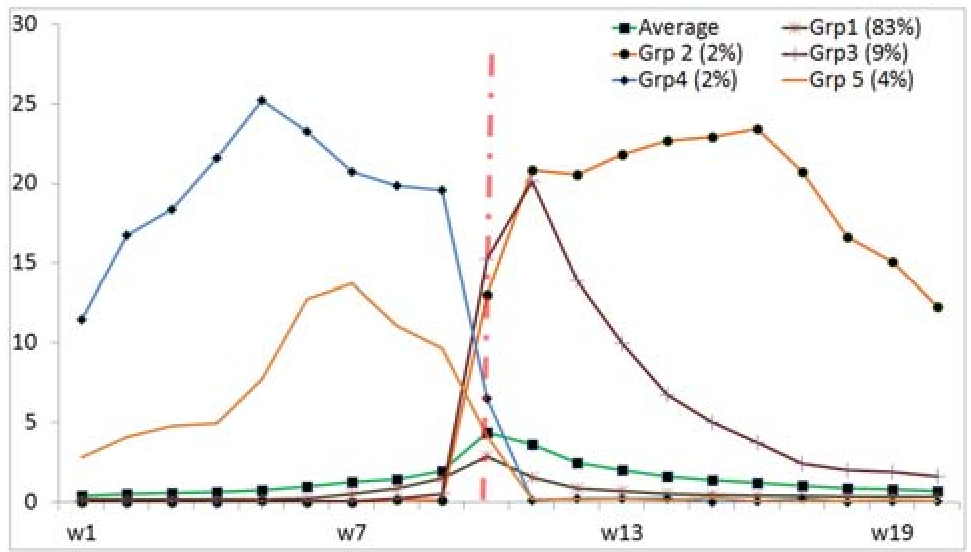
As seen in the charts for Grouping (a), Mentoring (b), and Trading (c), the peak occurs almost exactly at the point of trust formation. The authors attribute this to Social Bandwidth (referencing Robin Dunbar). Humans have limited cognitive resources for socialization. We invest heavily in a "trust-test" phase; once the bond is confirmed, we "save" that bandwidth and move on to developing other relationships.
Conclusion and Takeaways
- Trust is a Result, Not a Catalyst: In online settings, trust is the "finish line" for intense social vetting.
- Predictive Power: Semantic features like Intensity are far more powerful indicators of relationship shifts than static topographical features like Common Neighbors.
- Design Implication: For platform designers, fostering trust requires creating high-intensity interaction "rituals" that allow users to hit that socialization threshold efficiently.
While the study is limited to a single gaming environment, it provides a rare, high-stakes look at the mechanics of human connection in the digital age.